CppCon 2017: Chandler Carruth “Going Nowhere Faster”
CppCon2 HN recommenders · recommended in 3 months, 2017–2026
talk · advanced · evergreen · 2017–2026 on HN
Chandler Carruth shows how to squeeze more performance out of already-optimized C++ code, covering how the CPU executes it. The talk goes into pipelining, branch prediction and speculative execution using benchmarks.
Recommended as the best presentation on how modern CPUs run code, and why speculative execution matters for performance.
Up next
 3 mo on HN
Inside Africa's Food Forest Mega-Project
Andrew Millison
3 HN recommender · 2025–2026
 4 mo on HN
De-fragmenting C++: Making Exceptions and RTTI More Affordable and Usable - Herb Sutter CppCon 2019
CppCon
3 HN recommender · 2020–2025
 3 mo on HN
CppCon 2017: Fedor Pikus “C++ atomics, from basic to advanced. What do they really do?”
CppCon
3 HN recommender · 2017–2025
 2 mo on HN
Amazon Sells Fake Electrical Fuses
Louis Rossmann
2 HN recommender · 2024–2026
 3 mo on HN
Jared Mauch - Getting Fiber To My Town (NLNOG Live! September 2020)
NLNOG
3 HN recommender · 2020–2025
 9 mo on HN
The essence of calculus
3Blue1Brown
10 HN recommender · 2017–2025
 10 mo on HN
CppCon 2016: Jason Turner “Rich Code for Tiny Computers: A Simple Commodore 64 Game in C++17”
CppCon
13 HN recommender · 2016–2024
 4 mo on HN
C++ Exceptions for Smaller Firmware - Khalil Estell - CppCon 2024
CppCon
5 HN recommender · 2025–2026
 16 mo on HN
How Python was Shaped by leaky Internals, Armin Ronacher, Flask framework
Видео с мероприятий {speach!
15 HN recommender · 2017–2025
 11 mo on HN
CppCon 2015: Andrei Alexandrescu “std::allocator...”
CppCon
7 HN recommender · 2017–2025
 12 mo on HN
Preventing the Collapse of Civilization / Jonathan Blow (Thekla, Inc)
DevGAMM
14 HN recommender · 2020–2025
 10 mo on HN
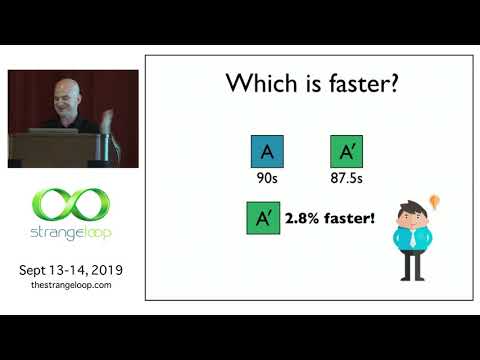
"Performance Matters" by Emery Berger
Strange Loop Conference
12 HN recommender · 2019–2025
5 comments from Hacker News
The best presentation I've seen about CPU performance related to pipelining, branch prediction, and speculative execution was Chandler Carruth's "Going Nowhere Faster" presentation at CppCon 2017 [0]. I do recommend watching the whole presentation, but if you watch nothing else then just watch the 5 minutes or so from the linked timestamp. [0]: ▶ this video
Chandler Carruth has a good talk with an example of why speculative execution is critical for performance. ▶ this video It starts around 36m13s time frame.
Disclaimer: I am not an expert and have not measured. This is armchair theory. But, I would argue two things. First, the former appears to have at least one unaligned arithmetic: > 400538: mov 0x200b01(%rip),%rdx # 601040 <counter> ...while the latter's equivalent instruction is 4-byte aligned: > 40057d: mov 0x200abc(%rip),%rdx # 601040 <counter> So, I would argue that's the biggest source of _speedup_ in the second case. However, I'm really interested in whether that's true since I don't see a memory fence; so the memory should be in L0 cache for both cases; I have trouble believing that an unaligned access can be so much slower with the data in cache. As for the `callq` to `repz retq`, I would venture a guess that the CPU's able to identify that there are no data dependencies there and the data's never even stored; I'd argue that it probably never even gets executed because the instruction should fit in instruction cache and branch prediction cache and all. Arguably. Like I said, I'm not an expert. I'd say run it through Intel's code analyzer tool. link Tangential video worth watching: ▶ this video Edit: actually, thinking about it, it's not unaligned access , it's unaligned math . I don't think that should affect performance at all? Fun.
Sure, but wouldn’t it make sense to extend the instruction set to allow the compiler to use these registers instead of reserving them for speculative / out-of-order execution? It was just a thought i had after watching a talk by a compiler guy: ▶ this video
>The YouTube inteface says "auto-generated" Ok, I never noticed that. I just read the captions and assumed obvious misspellings were auto-generated. For example in this video[1], the caption text is "L1D cache misses" but he's actually saying "L1-dcache misses" . (The Linux terminal screen he's showing does display "L1-dcache" .) Even though that video is not labeled as "auto-generated", I assumed it was because of the bad caption. Based on your info, I guess CppCon uses humans like Mechanical Turk or other non-domain typists to manually add the captions. [1] ▶ this video