Let's #TalkConcurrency Panel Discussion with Sir Tony Hoare, Joe Armstrong, and Carl Hewitt
Erlang Solutions3 HN recommenders · recommended in 3 months, 2019–2026
talk · intermediate · evergreen · 2019–2026 on HN
A panel with Tony Hoare, Joe Armstrong and Carl Hewitt, hosted by Francesco Cesarini, on the history and future of concurrency. The three creators of CSP, Erlang and the actor model discuss their differing approaches.
HN recommends it for getting the inventors of major concurrency models together, disagreements included.
Up next
 14 mo on HN
The Soul of Erlang and Elixir • Sasa Juric • GOTO 2019
GOTO Conferences
16 HN recommender · 2019–2024
 11 mo on HN
"Testing Distributed Systems w/ Deterministic Simulation" by Will Wilson
Strange Loop Conference
12 HN recommender · 2014–2024
 10 mo on HN
Erlang Factory 2014 - That's 'Billion' with a 'B': Scaling to the Next Level at WhatsApp
Erlang Solutions
6 HN recommender · 2014–2022
 9 mo on HN
"Turning the database inside out with Apache Samza" by Martin Kleppmann
Strange Loop Conference
9 HN recommender · 2015–2025
 9 mo on HN
The Language of the System - Rich Hickey
ClojureTV
10 HN recommender · 2013–2025
 9 mo on HN
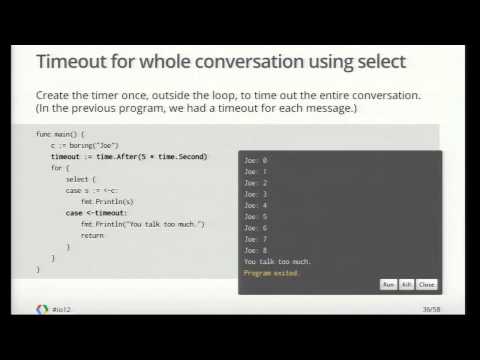
Google I/O 2012 - Go Concurrency Patterns
Google for Developers
9 HN recommender · 2012–2025
 7 mo on HN
Conflict Resolution for Eventual Consistency • Martin Kleppmann • GOTO 2016
GOTO Conferences
3 HN recommender · 2017–2020
 7 mo on HN
"Unison: a new distributed programming language" by Paul Chiusano
Strange Loop Conference
7 HN recommender · 2020–2023
 6 mo on HN
Paxos lecture (Raft user study)
Diego Ongaro
6 HN recommender · 2013–2024
 5 mo on HN
Hewitt, Meijer and Szyperski: The Actor Model (everything you wanted to know...)
jasonofthel33t
5 HN recommender · 2015–2025
 5 mo on HN
Advanced Topics in Programming Languages: A Lock-Free Hash Table
GoogleTalksArchive
4 HN recommender · 2013–2024
 5 mo on HN
"I See What You Mean" by Peter Alvaro
Strange Loop Conference
6 HN recommender · 2016–2019
5 comments from Hacker News
Watch the guy who came up with Erlang, the Actor model and CSP discuss it: ▶ this video One of my favorite videos on youtube.
I was introduced to him pretty late in the game, in this interview where he and Joe Armstrong and Carl Hewitt talked concurrency! It was interesting hearing them discuss their different thoughts and approaches ▶ this video
▶ this video This recent panel (Armstrong, Hewitt and Hoare) discussion on concurrency was the first time I got to know about him and it gave me a lot of food for thought.
Not quite. Erlang uses the Actor model which delivers messages asynchronously to named processes. In Go, messages are passed between goroutines via channels, which provide a synchronization mechanism (when un-buffered). The ability to synchronize allow one to setup a "rhythm" to computation that the Actor model is explicitly not designed to do. Also, note that a process must know its consumer in the Actor model, but goroutines do not need to know their consumer in the CSP model. Channels can even be passed around to other goroutines! Each have their own pros and cons. You can see some of the legends who invented different methods of concurrency here: ▶ this video There's also a nice talk Rob Pike gave that illustrated some very useful concurrency patterns that can be built using the CSP model: link
Threads + some kind of channel (a la Erlang processes or Go's goroutines) are pretty much direct programmatic representations of CSP. sorry if i misinterpreted, but i dont think that is correct that erlang processes exemplify channels/csp afaiu erlang is based on non-sequencial processes more like the actor model, there is no "communicating sequencial" process at the base of it (though you can implement csp in actor languages) afaik here you can see joe armstrong and carl hewitt fundamentally disagree with sir tony haore (csp) and sequential channels as a fundamental construct [1] ▶ this video again, apologies if im arguing something that wasnt implied, it was just something i noticed ^^