Grasshopper 744m Test | Single Camera (Hexacopter)
SpaceXRecommended by 1 HN commenter across 1 month, 2014–2021
demo · general · evergreen · 2014–2021 on HN
SpaceX footage of the Grasshopper vehicle's 744 m test hop, filmed from a hexacopter that gets closer than earlier flights. Grasshopper was a vertical takeoff and landing rig built to test returning rockets to the pad.
Used as the go-to clip showing SpaceX's reusable-rocket landing tests, often in comparisons with other vertical landing programs.
Up next
 11 mo on HN
Light Years Ahead | The 1969 Apollo Guidance Computer
TNMoC
Recommended 11× on HN · 2021–2026
 9 mo on HN
The Solar Gravitational Lens will Map Exoplanets. Seriously.
Launch Pad Astronomy
Recommended 10× on HN · 2020–2025
 7 mo on HN
34C3 - The Ultimate Apollo Guidance Computer Talk
media.ccc.de
Recommended 9× on HN · 2018–2025
 6 mo on HN
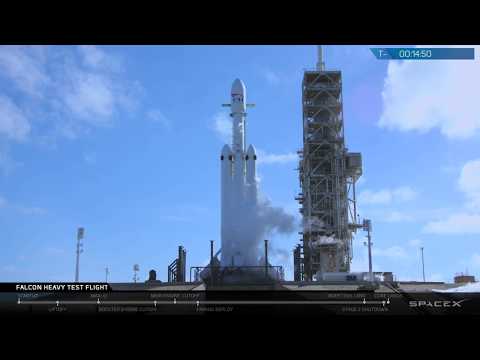
Falcon Heavy Test Flight
SpaceX
Recommended 4× on HN · 2018–2026
 7 mo on HN
I Was SCARED To Say This To NASA... (But I said it anyway) - Smarter Every Day 293
SmarterEveryDay
Recommended 9× on HN · 2023–2025
 8 mo on HN
Starbase Tour with Elon Musk [PART 1 // Summer 2021]
Everyday Astronaut
Recommended 11× on HN · 2021–2024
 5 mo on HN
Carl Sagan - Pale Blue Dot
carlsagandotcom
Recommended 5× on HN · 2011–2026
 6 mo on HN
Apollo Guidance Computer Part 1: Restoring the computer that put man on the Moon
CuriousMarc
Recommended 8× on HN · 2019–2024
 5 mo on HN
Dr. Robert Zubrin with a brilliant answer to "Why Should We Go To Mars?"
Jamin Gray
Recommended 3× on HN · 2016–2021
 6 mo on HN
The REAL Possibility of Mapping Alien Planets!
PBS Space Time
Recommended 4× on HN · 2023–2024
 6 mo on HN
How Much Do Rockets Pollute? Are They Bad For Our Air?
Everyday Astronaut
Recommended 6× on HN · 2020–2023
 6 mo on HN
Orbital Rings
Isaac Arthur
Recommended 4× on HN · 2017–2025
8 comments from Hacker News
That would be awesome. I was astounded the first time I saw one of their McGregor, Texas rocket tests from the point-of-view of a hexacopter flying near the rocket's flightpath. ▶ this video In this video, the copter is actually HOVERING ABOVE the rocket as the rocket descends back down to the launchpad. The only time I've ever seen something like that before was Hollywood (Apollo 13, and then when the footage was re-used in Austin Powers 2).
The DC-X was a tiny compared to Starship. Starship uses revolutionary new Full-Flow Staged Combustion engines that have never flown. Starship is testing a never used before method of reentry and guidence. Starship is testing a never used before method of landing. Starship is testing never used before method of heat shielding tiles and how to attach them. Starship is not just testing the ship itself, but also the mass manufacturing line for Starship. Its not a test mule, its a mass production pipeline that is being designed at the same time as the product it produces. Will likely be the first Orbital rocket to use Methlox fuel. The DC-X was a fundamental dead-end, many of its engineers went to BlueOrigin and worked on New Shepard, a sub-orbital only hopper. SpaceX Grasshopper is more comparable to the DC-X then the DC-X to Starship. ▶ this video That program likely cost less then $60 million.
Not only this, but the spacex grasshopper test was the first that I saw that had the rocket do a vertical takeoff, and then land. ▶ this video
Elon's Grasshopper from 2 years ago: ▶ this video The New Shepard went much higher though (100.5km vs 744m).
SpaceX has been launching and landing non-orbit rockets for a long time: ▶ this video There's nothing magical about 100 km that makes Blue Origin's rocket more useful. 100 km is just a round number. It's not useful until it's literally 100 times more powerful so it can get to orbit. Implying that Blue Origin's achievement is comparable to what SpaceX is attempting is disingenuous. But, predictably, that's exactly what the news media is doing.
Grasshopper was "just" a test vehicle, it never went to space. Here's a video of what they were doing with it: ▶ this video
SpaceX, Hawthorne, CA - link (US citizen/PR only) You've probably heard of SpaceX -- we build and fly rockets! Check out link and ▶ this video . What you might not know is that we need software engineers. Some of the positions we are looking to fill currently are: Lead front-end software engineer - link Software engineer for Borg, our flight data logging and analysis system - link Simulations software engineer, writing the software used to fool the flight software into thinking it's in space - link
1. How fast can a satellite travel up the tether? Let's say 50km/h, and it's going to an altitude of 35,000km. That's a month just in travel time. Using the tether for that period of time would be extremely costly. Currently, around 125 satellites launch a year, so they would need to be going up the tether at 500km/h, one after the other, day and night. And if we need to wait for a platform to descend, they need to be moving at 1,000km/h. Otherwise, we need multiple space elevators, or multiple shipments climbing at once and passing one another to meet current demand. 2. What's the cost of building and maintaining a space elevator? 3. What's the cost of having a satellite climb the tether to an altitude of 35,000km? That's a lot of energy. Taking this into consideration, is it tantalizingly cheap compared to strapping on a rocket? SpaceX has run tests with a reusable Falcon 9 rocket. Cost of fuel for a launch is $200,000. I'm skeptical the space elevator would be much cheaper. The magic of SpaceX... ▶ this video Downside of a rocket, it's heavy, and most of the energy is wasted lifting the rocket, and not the payload. Advantage, you don't have to pay to maintain cables that are long enough to wrap around the entire Earth.