Om Next - David Nolen
ClojureTV3 HN recommenders · recommended in 3 months, 2015–2015
talk · advanced · 2015–2015 on HN
David Nolen presents Om Next, the redesign of the ClojureScript Om library, drawing on Relay, Netflix's JSONGraph and Datomic. He covers the tradeoffs in handling the client-server boundary over immutable data.
HN commenters recommend it as the lead ClojureScript developer's own account of Om's evolution, one-way data flow and single-state design.
Up next
 7 mo on HN
Hey Underscore, You're Doing It Wrong!
InfoQ
9 HN recommender · 2014–2022
 8 mo on HN
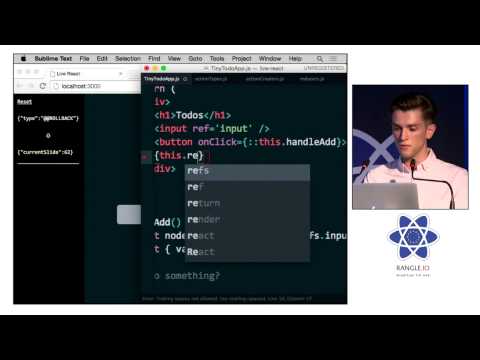
Dan Abramov - Live React: Hot Reloading with Time Travel at react-europe 2015
ReactEurope
12 HN recommender · 2015–2022
 18 mo on HN
Ruby Conf 12 - Y Not- Adventures in Functional Programming by Jim Weirich
Confreaks
17 HN recommender · 2013–2026
 14 mo on HN
The Soul of Erlang and Elixir • Sasa Juric • GOTO 2019
GOTO Conferences
16 HN recommender · 2019–2024
 14 mo on HN
"Simple Made Easy" - Rich Hickey (2011)
Strange Loop Conference
14 HN recommender · 2022–2026
 13 mo on HN
"Making Impossible States Impossible" by Richard Feldman
elm-conf
9 HN recommender · 2017–2026
 12 mo on HN
William Byrd on "The Most Beautiful Program Ever Written" [PWL NYC]
PapersWeLove
11 HN recommender · 2017–2026
 11 mo on HN
The Value of Values with Rich Hickey
InfoQ
10 HN recommender · 2014–2023
 12 mo on HN
Why Isn't Functional Programming the Norm? – Richard Feldman
Metosin
12 HN recommender · 2019–2025
 11 mo on HN
Maybe Not - Rich Hickey
ClojureTV
14 HN recommender · 2018–2025
 11 mo on HN
Solving Problems the Clojure Way - Rafal Dittwald
Clojure/north
10 HN recommender · 2019–2025
 10 mo on HN
Lecture 1A: Overview and Introduction to Lisp
MIT OpenCourseWare
10 HN recommender · 2019–2026
4 comments from Hacker News
I have nothing to say on Lein vs Boot, but I'm a long-term emacers with > 10 years and I can't endorse Cursive strongly enough. I've got easily at least 1k hours in my .emacs.d. Suffice it to say, it takes a lot to take away from Emacs/SLIME. Never bought into the Textmate hype during the Ruby days, or the SublimeText hype subsequently because Emacs already had all that functionality if not out of the box, there certainly was someone with an .el I could borrow. It takes a lot for me to leave Emacs, especially for a LISP. Here's my 2 cents - Cursive is worth it . (Hey Ideogram folks, if you want an endorsement, feel free to use that paragraph in exchange for a lifetime license ;)). For one-off-scripts, for back-end solutions, and what tipped me over the edge, it's CLJS script integration goes beyond acceptable -- it's actually fun to work in-- Cursive is my go-to. Om and Figwheel (optionally with Prismatic Schema if you like type guarantees) makes web development's feedback loop a lot tighter. Rich Hickey assembled a team of just insanely talented and charismatic(1) developers who not only are a) remarkably intelligent but b) know when to steal ideas and integrate them [none of that too-proud-NIH-syndrome there], and c) know how to interact in a way to that is community-feedback-positive(2) so people contribute. Watch this talk by David Nolen ▶ this video (CLJS lead). [Sidebar - He even mentions how that whole immutable, one way data flow, datomic-ish single state idea existed in o
Sorry if it wasn't apparent but I agree / advocate strongly for what you mention, and we use that model at my company. If you look at how Om evolved though, it started out with that simple model of passing the state object down to child components. Then cursors were implemented to make it easier to pass around parts of your global state without having components needing to know everything. GraphQL doesn't mean moving to stateful components, it's just a nicer way to have a singleton data store because instead of chunking and passing a map around, components can declare which data they need. In that system components are still read only, and dispatch to external pure functions. David Nolen does a great job talking about the trade offs and the evolution of everything in this talk ▶ this video I highly recommend it!
> ...but right now we're focusing on building stuff instead of playing with languages Which is exactly what's so compelling with regard to ClojureScript and say Om or any one of the React wrappers out there: you guys already use Clojure and ClojureScript and its libraries are incredibly pragmatic and designed for "real work". CoffeeScript would seem more like language play than ClojureScript, but of course I'm speaking as an outsider. :) Also if you haven't already, take a look at David Nolen's recent talk on Om Next[1]. Personally if I were using Clojure on the backend, I'd be pushing hard for it on the frontend too. [1] ▶ this video
Any idea why they decided to use string-based queries for GraphQL? I feel something that can be composed programmatically without having to deal with string concatenation like Falcor's queries or the Datomic Pull syntax proposed in Om Next [1] could be more flexible and robust. I may be missing something. [1] ▶ this video