30 Essential Ideas you should know about ADHD, 1A Intro, Chronic Developmental Disability
Adhd Videos9 HN recommenders · recommended in 8 months, 2017–2024
lecture · intro · evergreen · 2017–2024 on HN
The first clip from Russell Barkley's 30 Essential Ideas about ADHD series, introducing ADHD as a chronic developmental disability. It is part of a lecture series on the disorder by a leading ADHD researcher.
HN commenters repeatedly recommend Barkley's lectures as the best introduction to understanding ADHD.
Up next
 1 mo on HN
TV journalist documents wild ride inside Waymo self-driving car in San Francisco
ABC7 News Bay Area
1 HN recommend · 2023–2024
 3 mo on HN
Dr Russell Barkley on ADHD Meds and how they all work differently from each other
Adhd Videos
3 HN recommender · 2018–2024
 2 mo on HN
Nick Bostrom - The Simulation Argument (Full)
Science, Technology & the Future
2 HN recommender · 2016–2019
 2 mo on HN
HandmadeCon 2015 - Pat Wyatt
Molly Rocket
2 HN recommender · 2016–2023
 9 mo on HN
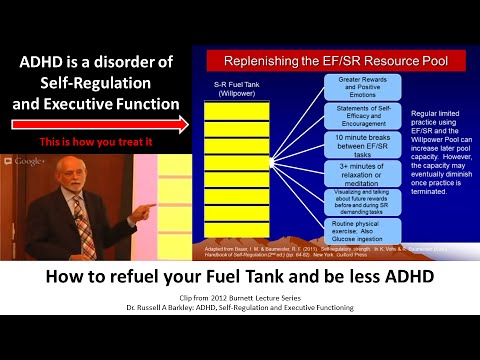
This is how you treat ADHD based off science, Dr Russell Barkley part of 2012 Burnett Lecture
Adhd Videos
10 HN recommender · 2015–2025
 10 mo on HN
MarI/O - Machine Learning for Video Games
SethBling
10 HN recommender · 2015–2026
 6 mo on HN
Mock Interview with Shawn McGrath
Molly Rocket
6 HN recommender · 2017–2023
 3 mo on HN
DEF CON 22 - Adrian Crenshaw- Dropping Docs on Darknets: How People Got Caught
DEFCONConference
3 HN recommender · 2015–2024
 13 mo on HN
Essential Ideas for Parents
Jason Salotti
9 HN recommender · 2015–2025
 12 mo on HN
Stanford's Sapolsky On Depression in U.S. (Full Lecture)
Stanford
14 HN recommender · 2009–2026
 11 mo on HN
The great porn experiment | Gary Wilson | TEDxGlasgow
TEDx Talks
10 HN recommender · 2012–2023
 11 mo on HN
ADHD: Essential Ideas for Parents - Dr. Russell Barkely
ADHDtips
11 HN recommender · 2018–2025
11 comments from Hacker News
▶ this video I highly recommend the first 4 parts of this playlist (at least) and other videos and writings by Dr Barkley.
I got diagnosed with ADHD 3 months ago after discovering a) my daughter had it and b) that it's highly hereditary. Probably the best introduction to ADHD is a 1.5 lecture by Dr. Russell Barkley, a top researcher in this area. It's technical, empowering and fun: ▶ this video Looking back in my life, I've built sophisticated TODO list and second brain systems to help me manage. Now it's obvious that it's because my working memory is poor because of my neurodivergency. Omnifocus (for GTD) and Obsidian (to be an extension of my brain) are my goto for leveraging my ADHD superpower. If you're looking for a community to learn more for yourself or for someone else: reddit.com/r/adhd is a great place to start.
Yeah, I think there's a large subset of people with ADHD who have some kind of alternate circadian rhythm. Mine seems to be 36 hours; for almost 35 years my peak working hours have been 4pm to 5am, with the ability to hyperfocus until I collapsed if I'm really into what I'm doing. Not for lack of trying to have a "normal" schedule...oh god I try really hard multiple times a year. It's just not natural. You should know that stimulants are only one type of approach for treating ADHD. Your best resource, you may have discovered, is Russell Barkley; I cannot recommend him enough. Also check out the YouTube channel How to ADHD. Some relevant Barkley videos: link ▶ this video Fair warning: You may discover some of the things you've done for your whole life without second guessing are actually typical ADHD symptoms. And if you're like me, this might thoroughly shake your snowglobe.
I too highly recommend Russel Barkley's videos about ADHD. They taught me so much. The most striking thing was learning how it's a primarily emotional disorder, and how this has harmed my relationships. Here's a fantastic lecture (split into ~5 minute segments -- this guy gets it :) by Dr. Barkley: ADHD - The 30 Essential Ideas Everyone Needs to Know ▶ this video
> these videos are dumb, doesn't everyone do those things? Have any person go through the adult/inattentive-type ADHD symptoms [1]. Everyone will see themselves nodding. It's difficult for people to understand the difference if they are not affected. There's a difference between common headaches and migraine, or between bad mood and depression. It's about the intensity and the frequency (broadly speaking). This doesn't mean that everyone who procrastinates has ADHD. It's really hard to explain the state of complete mental unability to perform a task that I don't like to do vs. "being lazy". When I first described my symptoms to my wife, she was also like "everyone has those symptoms from time to time". Only after reading a chapter from a book about adult ADHD she understood the difference. Unfortunately, the book is in German. What I can recommend is Dr Russel's ADHD presentation [2] and Roman Kogan's ADHD Wiki [3]. > What intervention(s) have you found the most helpful? Well before learning about ADHD, I have developed many coping mechanisms. The use of todo lists, calendars and alarm clocks has probably made the biggest difference. As you have mentioned the "chase for novelty", I can only imagine how big your bookmark list has become. I've coped with this one by having a single "inbox" bookmark folder and clearing it frequently. Anything I want to keep for a longer time ends up in one of my tools (Static Marks [4] - a tool I've made for long-term bookmarks, OneNote for note
>long term effects of putting people on a close chemical cousin of methamphetamine indefinitely What is your basis for this "concern"? Sure it sounds bad, but there are plenty of chemical compounds with "off by one" differences that have completely different effects.... that's just... chemistry. Just so you know, (depending on who you read) those with untreated ADHD may live, on average, 10 fewer years than the rest of the population. So if I had to chose between your concerns and 10 better quality years, I know what I'm picking. > Medical professionals are just speculating at this point when they say it's some kind of neurological disorder rather than just part of the range of physiologically normal brain function. Where are you getting this from? Any papers? If this is the consensus then I really must not have been paying attention (pun intended) You seem to have a lot of "observational" experience in a specific setting, but little more knowledge or understanding than the tip of the iceberg "top-5 symptoms". ADHD is an incredibly complex developmental issue. Look at the issues with ADHD and gauging signals from the body, how those affect eating. Look at various issues with sensitivities sensory stimulation. Issues with inhibition and how they permeate behaviours. Reducing ADHD to "focus" is like reducing baseball to throwing a ball around. Maybe look into some of Dr Russel Barkley's lectures. Some of them are a little dated but mostly accurate. ▶ this video
This is an invaluable resource, but is available directly on YouTube at ▶ this video (Playlist breaks it up into stomachable chunks.)
As someone who has recently started figuring out this whole ADHD thing, definitely seek out help for it. There are a ton of really powerful tools and support systems that make a tremendous difference. Especially organizational systems designed for people with executive function deficits (whether that's ADHD or not, doesn't really matter!) Caddra has an interesting chart here for suggestions: link I also like Russell Barkley's lectures and books: ▶ this video and link (especially Taking Charge of Adult ADHD) And additionally, if you find that these things speak to you, medication makes a tremendous difference. I really can't overstate the degree to which it can change your life.
There is absolutely no benefit to having a LD. Seriously, there is NONE - people with LDs who attain success do so in spite of their LD, not because of it. This notion that LDs make you more "creative" or whatever is backed by absolutely no research and is mostly a bunch of feel-good nonsense. A great reference for this is Dr. Russell Barkley: link His Youtube videos/lectures are extremely insightful as well: ▶ this video
ADHD is a quantitative disorder that touches a spectrum of symptoms. Yours might be heavier in some aspects and lighter in others. It's also often tied to other psychological issues. Not everything works the same for everyone. For "vanilla ADHD" the most impairing factors will often be: - Executive function. This can be organisation, getting started or keeping up with dopamine depleting tasks (chores, bills, etc.) and keeping track of time during tasks - Emotional regulation. This can be emotional reactivity (often called RSD online), or other all sorts of difficulties dealing with emotions in a productive way. This one is often left out in discussions but the most harmful for life outcomes (especially frustration/anger based dysregulations) - Short term memory issues. Part of executive function but should be noted specifically. The first thing to note is natural external dopamine will help. This is getting proper sleep, nutrition and exercise. Exercise, especially intense activities like HIIT will help regulate dopamine naturally. For executive function, the best is to have a system. There are plenty out there (bullet journals, productivity apps, etc.) Find one that you actually use without forcing yourself to. Can be a TODO list in google keep/apple notes, or a Bullet Journal or something like TikTik For short term memory issues, write everything down. This often plays into the system above. For emotional regulation, DBT is the best place to start. The DBT workbook can be f
> Just so you know, (depending on who you read) those with untreated ADHD may live, on average, 10 fewer years than the rest of the population. So if I had to chose between your concerns and 10 better quality years, I know what I'm picking. I don't have a problem with that. > Where are you getting this from? Any papers? If this is the consensus then I really must not have been paying attention (pun intended) The burden of proof is on them to show that they are not speculating. Some kind of repeatable physiological test would do nicely. > You seem to have a lot of "observational" experience in a specific setting, but little more knowledge or understanding than the tip of the iceberg "top-5 symptoms". ADHD is an incredibly complex developmental issue. Look at the issues with ADHD and gauging signals from the body, how those affect eating. Look at various issues with sensitivities sensory stimulation. Issues with inhibition and how they permeate behaviours. Reducing ADHD to "focus" is like reducing baseball to throwing a ball around. I may have confused you by mistakenly saying the brain is "complicated" when I should have said "complex." What I meant was mind-bogglingly unimaginably confusingly tricky and hard to understand. Also, I don't recall reducing ADHD to "focus," where did I do that? I'm quite curious, what are the top-6-through-10 symptoms that I should be made aware of so I can better understand? > Maybe look into some of Dr Russel Barkley's lectures. Some of them are