C++ and Beyond 2012: Herb Sutter - atomic Weapons 2 of 2
alexsmail2 HN recommenders · recommended in 2 months, 2019–2024
talk · advanced · evergreen · 2019–2024 on HN
Part two of Herb Sutter's C++ and Beyond 2012 session on atomic weapons, a deep dive into the C++ memory model, atomics, memory ordering, and hardware behavior. It ends with the modern meaning of volatile.
HN recommends it as an in-depth, practical introduction to atomics and weak versus strong memory ordering, relevant to ARM and Rust as well as C++.
Up next
 5 mo on HN
C++ and Beyond 2012: Herb Sutter - atomic Weapons 1 of 2
alexsmail
4 HN recommender · 2020–2024
 11 mo on HN
CppCon 2015: Andrei Alexandrescu “std::allocator...”
CppCon
7 HN recommender · 2017–2025
 12 mo on HN
Lexical Scanning in Go - Rob Pike
GoogleFOSSSydney
13 HN recommender · 2012–2025
 10 mo on HN
CppCon 2017: Matt Kulukundis “Designing a Fast, Efficient, Cache-friendly Hash Table, Step by Step”
CppCon
9 HN recommender · 2018–2026
 9 mo on HN
RustConf 2018 - Closing Keynote - Using Rust For Game Development by Catherine West
Rust Programming Language
9 HN recommender · 2018–2023
 10 mo on HN
CppCon 2016: Jason Turner “Rich Code for Tiny Computers: A Simple Commodore 64 Game in C++17”
CppCon
13 HN recommender · 2016–2024
 9 mo on HN
Ideas about a new programming language for games.
Jonathan Blow
7 HN recommender · 2014–2025
 9 mo on HN
CppCon 2014: Mike Acton "Data-Oriented Design and C++"
CppCon
9 HN recommender · 2015–2026
 9 mo on HN
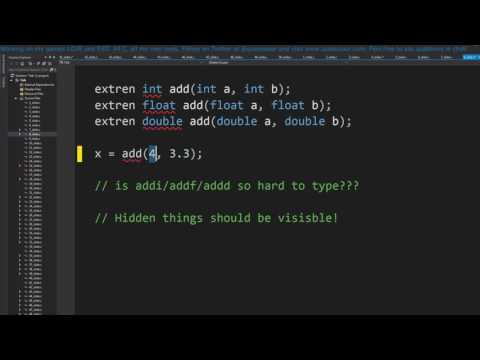
How I program C
Eskil Steenberg
8 HN recommender · 2017–2025
 9 mo on HN
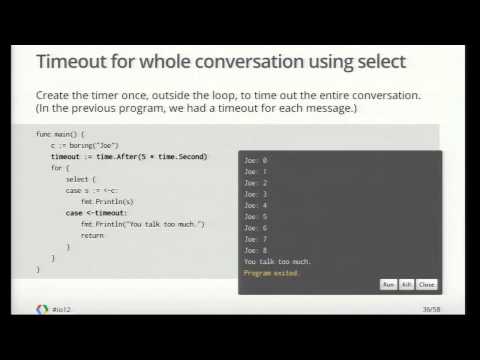
Google I/O 2012 - Go Concurrency Patterns
Google for Developers
9 HN recommender · 2012–2025
 7 mo on HN
CppCon 2015: Kate Gregory “Stop Teaching C"
CppCon
7 HN recommender · 2016–2025
 7 mo on HN
Zig: A programming language designed for robustness, optimality, and clarity – Andrew Kelley
Recurse Center
6 HN recommender · 2018–2024
6 comments from Hacker News
"Is Parallel Programming Hard, And, If So, What Can You Do About It?" is one of the best books about atomics and concurrency, and my #2 recommendation. link My #1 actually isn't a book at all, but the two "atomic Weapons" talks by Herb Sutter, which are extremely good. link ▶ this video
For a more in depth introduction to the topic with a lot of practical code examples, I highly recommend Herb Sutter’s excellent talk: Part 1 link Part 2 ▶ this video
The book, especially chapter 7 seems to say several things completely opposite to what Herb Sutter did in his famous talk a number of years ago. In the book: > This means that on ARM64, sequentially consistent operations are exactly as cheap as acquire and release operations. Or, rather, that ARM64 Acquire, Release, and AcqRel operations are as expensive as SeqCst. Unlike x86-64, however, Relaxed operations are relatively cheap, as they don’t result in stronger ordering guarantees than necessary. However in Herb Sutter's talk (specifically the second half here: ▶ this video ) he says that ARMv8 Acquire/Release/AcqRel operations are cheaper than SeqCst. This book seems to claim that x64 is somehow superior to ARMv8, which from my understanding is completely wrong.
I would imagine that any implementation of x86 would have to bear the weight of reverse-compatibility. With reverse comparability, the bad design decisions just compound, for example complicated stuff like memory synchronization ▶ this video
It’s true that ARM alone isn’t the reason for the M1’s performance, but it’s definitely a significant factor. x86 is old — modern x86 chips are still backwards-compatible with the original 8086 from 1978 — and it’s stuck with plenty of design decisions that might have been the correct choice sometime within the past 45 years but no longer today. Whereas the M1 only implements AArch64, a complete redesign of the ARM architecture from 2012, so it doesn’t have to deal with legacy architectural baggage. (We’ve known x86 was the wrong design since the 80’s — hence why there’s no Intel chips in smartphones — but it hasn’t been realistic for anybody except Apple to spend 10 years and billions of dollars to make a high-performance non-x86 chip.) Some examples: - x86 guarantees strong memory ordering on multi-processor systems, which adds completely unnecessary overhead to every memory access. arm64 uses a weak memory model instead, providing atomic instructions with relaxed or acquire/release semantics (see ▶ this video for a more detailed discussion). This significantly improves performance all around the board, but especially with reference counting operations (which are extremely common and often a bottleneck in code written in ObjC/Swift): link > fun fact: retaining and releasing an NSObject takes ~30 nanoseconds on current gen Intel, and ~6.5 nanoseconds on an M1 - x86 instruction decode is pretty awful, a significant bottleneck, and not parallelizable due to the haphazardly-design
Herb Sutter's (three hour long!) Atomic Weapons talk goes over the modern meaning of volatile towards the end: ▶ this video