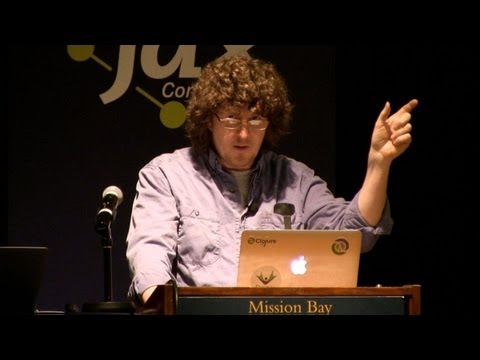
"The Economics of Programming Languages" by Evan Czaplicki (Strange Loop 2023)
Strange Loop Conference10 HN recommenders · recommended in 8 months, 2023–2026
talk · general · evergreen · 2023–2026 on HN
Evan Czaplicki, creator of Elm, examines how programming languages are funded. He looks at where compiler engineers' salaries come from, why Go has about 5 engineers while Dart has about 30, and how this limits language design.
Recommended repeatedly as a funny, informative talk on the economics behind programming languages and open source.
Up next
 5 mo on HN
Jordan Peterson debate on the gender pay gap, campus protests and postmodernism
Channel 4 News
5 HN recommender · 2018–2023
 2 mo on HN
Hjernevask - Brainwashing (Eng Sub) Part 1 - The Gender Equality Paradox
The Bookman
3 HN recommender · 2015–2018
 5 mo on HN
How one tweet can ruin your life | Jon Ronson
TED
5 HN recommender · 2018–2025
 5 mo on HN
Scale By The Bay 2018: Bryan Cantrill, Rust and Other Interesting Things
FunctionalTV
5 HN recommender · 2021–2024
 9 mo on HN
Harder Drive: Hard drives we didn't want or need
suckerpinch
12 HN recommender · 2022–2025
 3 mo on HN
Old Geeks Yell At Cloud (with Andrew Clay Shafer & Bryan Cantrill)
Arrested DevOps
3 HN recommender · 2017–2023
 11 mo on HN
The Value of Values with Rich Hickey
InfoQ
10 HN recommender · 2014–2023
 3 mo on HN
Badness 0 (Apostrophe‛s version)
suckerpinch
4 HN recommender · 2024–2026
 16 mo on HN
How Python was Shaped by leaky Internals, Armin Ronacher, Flask framework
Видео с мероприятий {speach!
15 HN recommender · 2017–2025
 12 mo on HN
Why Isn't Functional Programming the Norm? – Richard Feldman
Metosin
12 HN recommender · 2019–2025
 11 mo on HN
Maybe Not - Rich Hickey
ClojureTV
14 HN recommender · 2018–2025
 10 mo on HN
Conway's Game Of Life in APL
Dyalog
11 HN recommender · 2010–2024
12 comments from Hacker News
> This talk explain why, it's not technical: ▶ this video Really good talk, I remember watching it when it came out. Elm is what got me looking into FP several years ago, a nice language it was.
For me, my favorites were: 0. "Computational Physics, Beyond the Glass" by Sam Ritchie (Strange Loop 2023) - link - This guy created an interactive Lisp-based Physics visualizer and got started on it by reading Structure and Interpretation of Classical Mechanics . He now has a full-fledged project, and touches upon many ideas for educating people through innovative means. Really loved this video. Connected the ideas of Logo programming environment and something like a LISP-Physics visualizer. 1. "The Economics of Programming Languages" by Evan Czaplicki (Strange Loop 2023) - ▶ this video - How does creating a new programming language work really? Who are the players, and what goes behind? Very highly recommend this funny, informative talk to understand aspects of creating a programming language other than the theoretical ones. 2. Function Composition in Programming Languages - Conor Hoekstra - CppNorth 2023 - link - This is actually about array languages and Haskell and not C++. Encountered "tacit" programming for the first time, and it opened a slightly new way of thinking for me. And others that I liked were: 0. Ruby on Rails: The Documentary - link - Not a Rubbyist, but still liked this documentary. 1. "Software & The Game of Go" by David Nolen (Strange Loop 2023) - link 2. "Making Hard Things Easy" by Julia Evans (Strange Loop 2023) - link - I always liked Evans' written content and zines, as they were fun to read and helped people. It was nice to see how she operate
> Are there technical reasons that Rust took off and D didn't? This talk explain why, it's not technical: ▶ this video > What are some advantages of D over Rust (and vice versa)? Advantages for D: Build faster, in typical programs you would need about 20 packages not 100, COM objects, easy meta-programming, 3 compilers. GC, way better at scripting. Advantages for Rust: borrow-checker is better. rustup.
Oh boy, I always had this knack for seeing/testing multiple langauges and when I had first discovered nim, I used to watch some nim youtube related content and I remember someone in nim community pointed out about this same video from the creator of elm that you also mention. So, I think that I had watched the video and honestly, I will watch it now once again since I don't remember it clearly but If I remember, I really liked it. A quick search points me to the video, though I am not sure ▶ this video
I am not an OSS contributor, so I have no personal experience whatsoever in this context. But I saw this talk by Evan Czaplicki (author of Elm) a while ago.[1] The talk is primarily about the economics of open-source programming languages, but I think that a lot of the issues discussed overlap with other areas of OSS. From the description of the youtube video: > In the mythology of open source, programming languages are created by people who seemingly have no direct economic function. They are just really good at compilers (somehow) and have a house to live in (somehow) and have a lifetime to devote to creating a useful programming language (somehow!) > We will examine specific organizations that create programming languages. Where do the salaries for compiler engineers come from? How does Go end up with 5 engineers and Dart end up with 30? Who signs off on these expenses and why? Does this put any boundaries on language design or development practices? And how do the economics work for people outside of the major tech corporations? > My goal is to give the talk I needed to hear 10 years ago when I was just starting on Elm. By clearly delineating the many variations of corporate funding and independent funding, I hope users will come away with a better foundation for evaluating and comparing programming languages. [1] ▶ this video
This reminds me of Evan Czaplicki's great talk where he basically traces the funding of most modern programming languages to search engine revenues :-) ▶ this video
There's a great talk by Evan Czaplicki [0] that outlines the financial significance of browsers. It helps make sense of why Microsoft (and Apple) act(s) in this way. [0]: ▶ this video
And for those who are interested, Evan (creator of Elm) gave a great Strange Loop '23 talk that hints at where he imagines things going, if he could figure out how to get the economics to work. ▶ this video
A bunch of great talks at Strange Loop this year! Two off the top of my head: • "An approach to computing and sustainability inspired from permaculture" by Devine Lu Linvega: link • "The Economics of Programming Languages" by Evan Czaplicki (Strange Loop 2023): ▶ this video I've also been loving TodePond's cellular automata videos. Their SPLASH talk was mind-blowing, but it doesn't look like it's out yet. • TodePond playlist: link
> if you don't care about the feature ... all you're left with is a broken window. Maybe. Or maybe I'm left with a building that works fine for me. It might be lacking some features that some people want, but maybe thats ok. > Maybe the onboarding is the real issue. ... the maintainers are too busy to do that themselves most of the time. Yeah; I saw a great talk from Strange Loop the other day by the developer of Elm on the economics of opensource software[1]. He pointed out that a "good" opensource project really wants good dev work, a maintained issue tracker, infrastructure (CICD, etc), a good website, documentation, blog posts, onboarding of devs, community stuff, conference talks, trademarks, a roadmap, and so on. But it takes more than one person to do all of that. It takes a whole team. And we're spoiled by opensource projects like React or Rust which are sponsored by companies with money. My little opensource projects just have me, in my hobbyist time. And I'm not very good at all the non-programming things. And I'd much rather be programming than doing all of that other stuff. I think a lot of projects really want fulltime maintainers. But instead they just have the unpaid, overworked authors doing what we can. Of course users want better. But, well, thats how it is at the moment. Honestly, its surprising that everything works as well as it does. [1] ▶ this video
I think Evan's pointing at something, and everyone's looking at the finger. I don't think this is really about Elm at all, but the preparation for Arcadia. In his talk, Economics of Programming Languages ▶ this video , he does reveal a peek at what he's been working on for the past seven years: a query language with functional ideas applied to them. He points at the boundaries in web apps that typically destroys type information: - language <-> storage - storage <-> wire What if we could preserve the type information across these boundaries? What would that buy us? One answer he had was easier migrations. They'd just be a type diff, rather than hand-written SQL. So I think the right question is, can we infer what Arcadia is going to be like given the changes he's shipping with Elm? What does incremental compilation give query languages?
> They could also have funded developing a free, open source toolchain. If the actual purpose of the Ada mandate was cartel-making for companies selling Ada products, that would have been counter-productive to their goals. Not that compiler vendors making money is a bad thing, compiler development needs to be funded somehow. Funding for language development is also a topic. There was a presentation by the maker of Elm about how programming language development is funded [0]. [0]: ▶ this video