2009 Chevy Malibu vs 1959 Bel Air Crash Test | Consumer Reports
Consumer Reports1 HN recommender · recommended in 1 month, 2014–2023
demo · general · evergreen · 2014–2023 on HN
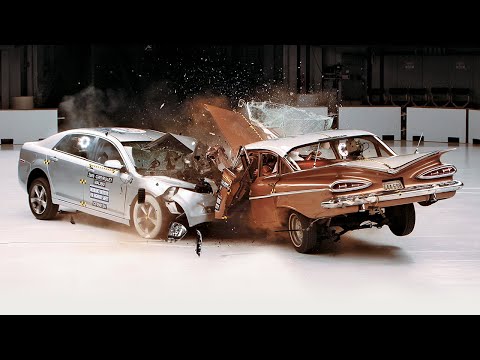
A Consumer Reports and IIHS crash test pitting a 2009 Chevy Malibu against a 1959 Bel Air. It shows how much better modern cars protect occupants.
HN uses it as shorthand for how compounding engineering improvements, crumple zones especially, made things safer, applied to analogies well beyond cars.
Up next
 15 mo on HN
Around The Corner - How Differential Steering Works (1937)
US Auto Industry
17 HN recommender · 2013–2024
 9 mo on HN
Cities Aren't Loud: Cars Are Loud
Not Just Bikes
10 HN recommender · 2021–2025
 5 mo on HN
How Differential Gear works (BEST Tutorial)
ConceptVBS
5 HN recommender · 2013–2020
 6 mo on HN
A New Car UI: How touch screen controls in cars should work
Matthaeus Krenn
4 HN recommender · 2017–2023
 5 mo on HN
These Stupid Trucks are Literally Killing Us
Not Just Bikes
11 HN recommender · 2023–2026
 5 mo on HN
The 919 Tribute Tour: On-board record lap, Nordschleife.
Porsche
3 HN recommender · 2018–2026
 6 mo on HN
Why Electric Bikes are More Dangerous than Motorcycles
FortNine
5 HN recommender · 2021–2025
 5 mo on HN
Spinning Levers - How A Transmission Works (1936)
US Auto Industry
5 HN recommender · 2018–2026
 5 mo on HN
Are Electric Cars Worse For The Environment? Myth Busted
Engineering Explained
5 HN recommender · 2018–2023
 5 mo on HN
1959 Chevrolet Bel Air vs. 2009 Chevrolet Malibu IIHS crash test
IIHS
5 HN recommender · 2014–2026
 5 mo on HN
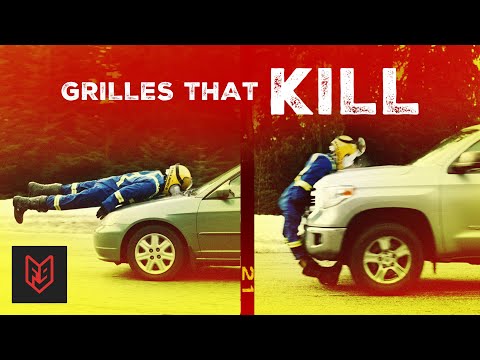
The Grille Trend that Kills 509 People per Year
FortNine
5 HN recommender · 2024–2026
 4 mo on HN
Riding through Iran on a small motorcycle as British person.
c90adventures
4 HN recommender · 2016–2021
11 comments from Hacker News
Modern car design saves lives. Cars in the 1950's had stiff, thick plates and it didn't do them much good. Have a look at the excellent 2009 vs 1959 car crash test video: ▶ this video
Most modern passenger car passenger cells don't need roll cages because their passenger safety cells are properly engineered, and because crash safety is much more comprehensive, with wheels and suspension components designed to intentionally fail and crumple in a crash so they aren't pushed into the passenger cell. A ton of cars pass Euro-NCAP and IIHS crash and rollover tests with flying colors. Roll cages were a Thing because, well, this: ▶ this video Obviously not every car is up to snuff, especially at the bottom end of the market. You couldn't pay me to drive a current production GM, Ford, Suzuki, Mitsubishi, etc compact sedan. 5-point harnesses aren't really that necessary at 0-60mph speeds in a vehicle with modern airbags; the fifth strap is mostly for anti-submarining but a number of manufacturers have produced seats that are anti-submarining and anti-submarining dashboard design (both material and shape) is a thing as well. All of it's possible, it's just a lot of car companies are cheap and consumers don't really shop based on stuff like "is there an anti-submarining design to the dash."
Not just modified vehicles or hummers, but a road filled with SUVs, minivans, delivery trucks, crossovers. Even a "standard" Ford F150 is goliath, and an indestructable frame won't save you. To the contrary, a super-rigid frame translates into occupant injury. Crumple zones, energy absorbing materials, deformation of structures = survivability. A 20 mph head-on collision in a 1950s auto with a full frame design is often far more serious than a 40 mph collision in a modern auto. Head-to-head comparison: ▶ this video (likely death vs possible foot injury) Now contemplate a 6' long vehicle with 1' or less of "crumple zone".
You being seriously injured or dying in an offset ~30mph collision, versus getting out of the car dazed and confused is the difference. And yes, passenger safety didn't change much for American cars between the 50's and early 80's. ▶ this video You causing more pollution (particulate, NOx, etc) than a hundred luxury SUVs or more, is the difference. Driving down the highway at 75mph able to hear the back seat passenger whisper versus having to talk loudly so the person in the front seat next to you can understand you. A climate control system that keeps the car comfortable whether it is -20 degrees or 100 degrees. Handling, brakes, and acceleration that is astronomically better than whatever your Chevette has. There's no such thing as a "200mpg engine" - most modern car engines are very efficient, with the Prius's Atkinson cycle engine being the most efficient among worldwide-available, mass-production, affordable cars. It's a function of aerodynamics, parasitic electrical and mechanical losses, and weight. > It's not all one thing or the other, and it never should be, but we've been milking the old internal combustion cash cow for so long we've virtually guaranteed her death, even though evolution of the internal combustion engine would be a net benefit. Making an engine that would last 750,000 miles is certainly possible - just look at engines in big rigs - but people don't care about that in a personal vehicle, and the capex and opex for such an engine is incredible compared to
This video of a crash test between a 2009 Chevy Malibu and 1959 Bel Air is a good illustration of the improvements that have been made in car safety ▶ this video
I think it easy to lose sight of the big picture. Things are constantly improving, even if the road is winding. People just forget some of the horrors of the past. We used to have VB/VBA, now we have Javascript. We used to have Ada, now we have Rust. C++ has evolved. Even C has evolved, in a kind of meta way: C itself hasn't evolved much, but the ecosystem around it has evolved a lot. How common was something like Valgrind back in 1990? Whenever you forget how much we've moved forward, despite occasional setbacks, look at this: ▶ this video :-)
And that's actually rational behavior. It's also a very simple and very materialistic explanation of why humankind evolves, bit by bit. It works the same way even for discovering new medicine or any kind of technology. The new thing must be at least a bit better than the old thing. Over time those improvements compound and you end up with this: ▶ this video
Somebody should show Uncle Bob this: ▶ this video My point being: yes, if we'd be perfect drivers at all times and in all weather conditions there would be no more accidents. Luckily for us auto designers haven't adopted this perspective :)
Estimates of excess deaths due to nuclear, counting chernobyl , are the lowest of any energy technology. This isn't even counting the part where no new nuclear reactor could possibly be as unsafe as Chernobyl or Fukushima in the same way that no modern car could be as unsafe as as a car from the 1960s: ▶ this video
A 1957 Ford pickup is going to be an absolute deathtrap in an accident. I'm not sure that's a great example. Not quite that exact combo, but you get the idea: ▶ this video
The death rate per miles driven in the United States has fallen dramatically in my lifetime, and I can remember when the annual number of deaths was much higher.[1] That said, the article makes a very interesting claim about attitudes that we should all follow to the end of the article for further discussion here: "There’s an open secret in America: If you want to kill someone, do it with a car. As long as you’re sober, chances are you’ll never be charged with any crime, much less manslaughter." My wife bike-commutes year-round (yes, even in Minnesota), and as I mention this among Facebook friends, other friends who are also bike commuters point out that car drivers can basically kill bicyclists in the United States with no legal penalty at all. That's not a good social environment for getting more people out for exercise and energy conservation by substituting bicycling for driving cars. The history reported in this article is very interesting. There are a lot of contemporary photographs of changing American cities. The quotations from experts provide perspective on the visuals: "'If a kid is hit in a street in 2014, I think our first reaction would be to ask, "What parent is so neglectful that they let their child play in the street?,"' says Norton. "'In 1914, it was pretty much the opposite. It was more like, "What evil bastard would drive their speeding car where a kid might be playing?" That tells us how much our outlook on the public street has changed." Indeed. Are we