Design Microservice Architectures the Right Way
InfoQ2 HN recommenders · recommended in 2 months, 2019–2021
talk · intermediate · evergreen · 2019–2021 on HN
Michael Bryzek of Flow gives a QCon London 2018 talk on key decisions for building maintainable microservices. It covers infrastructure, continuous deployment, communication, event streaming and language choice.
HN commenters recommend it for showing the tooling possible when schemas and APIs are treated as code.
Up next
 3 mo on HN
CSS Grid Changes EVERYTHING - Amazing Presentation
Coding Tech
4 HN recommender · 2018–2019
 1 mo on HN
Locksmith ripoffs: Hidden camera investigation (Marketplace)
CBC News
1 HN recommend · 2021–2024
 3 mo on HN
How to Speed up a Python Program 114,000 times.
InfoQ
3 HN recommender · 2015–2022
 5 mo on HN
"Games as a service" is fraud.
Accursed Farms
5 HN recommender · 2019–2024
 3 mo on HN
Rant: Entity systems and the Rust borrow checker ... or something.
Jonathan Blow
3 HN recommender · 2018–2025
 9 mo on HN
Mike Monteiro: F*ck You, Pay Me
CreativeMornings HQ
12 HN recommender · 2015–2026
 10 mo on HN
Crockford on JavaScript - Volume 1: The Early Years
YUI Library
10 HN recommender · 2013–2022
 2 mo on HN
Homemade Transistor Demonstration
Jeri Ellsworth
2 HN recommender · 2013–2021
 15 mo on HN
RailsConf 2014 - All the Little Things by Sandi Metz
Confreaks
15 HN recommender · 2015–2025
 14 mo on HN
"Simple Made Easy" - Rich Hickey (2011)
Strange Loop Conference
14 HN recommender · 2022–2026
 13 mo on HN
"Making Impossible States Impossible" by Richard Feldman
elm-conf
9 HN recommender · 2017–2026
 12 mo on HN
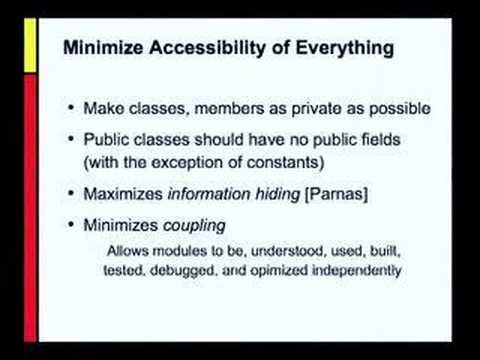
How To Design A Good API and Why it Matters
Google TechTalks
12 HN recommender · 2011–2025
3 comments from Hacker News
My main reasons: 1. It's standardized all the implementation for each language is roughly similar and has the same feature sets (middlewares, stubs, retry, hedging, timeouts, deadlines, etc). 2. High performance framework/webserver in "every" language. No more "should I use flask or the built in http server or gunicorn or waitress or..." 3. Tooling can be built around schemas as code. There's a great talk that I highly recommend about some of the magic you can do [0]. 4. Protos are great for serialization and not just over a network! Need to store configs or data in a range of formats (json, prototxt, binary, yaml)? 5. Streaming. It's truely amazing and can dramatically reduce latency if you need to do a lot of collection-of-things or as-soon-as-x processing. 6. Lower resource usage. Encoding/decoding protos is faster then encoding and decoding json. At high throughput that begins to matter. 7. Linting & standards can be defined and enforced programatically [1] 8. Pressures people to document things. You comment your .c or .java code, why not comment your .proto? [0] - ▶ this video [1] - link
Reminds me a lot of this talk: ▶ this video I think it's a really powerful paradigm. I think an org adopting such patterns widespread leads to some really rad capabilities. GDPR compliance, for example, is really tough in SOA architectures in companies without a ton of engineering capacity, but this sort of data/api introspection could do a lot to change that. Any plans to open source projection for languages other than Java? edit: I see that typescript and rust are available on github as well
Flow.io (Flow Commerce) | Hoboken, New Jersey | Dublin, Ireland - link Flow is a next generation solution for cross-border commerce. Backed by Bain Capital Ventures, Flow has built an API-first, turn-key solution that has been transforming how brands localize their site and sell cross-border. Flow integrates into existing e-commerce platforms and provides brands with a high degree of flexibility over all aspects of the customer experience (local currency pricing, duty & tax calculation, local merchandising), local checkout (local payment methods, local language) and cheap/fast international shipping options resulting in steep growth in international sales. Our dream is to remove borders from global commerce. We are building a point-to-point global eCommerce platform that enables brands to expand internationally. We help brands with everything from catalog management, pricing, currency risk, payment processing, to logistics. The business was founded by Mike Bryzek (co-founder/CTO of e-commerce giant, Gilt Groupe) and Rob (founder/CEO of leader in customer experience, Fizzback). Our approach to software is pretty unique and offers great opportunities to learn. We are a microservices architecture (Scala backends, ReactJS frontends), practice API-first software development, and run continuous delivery (merging a PR deploys the change). You can find more on our approach to software delivery here ( link ) and on YouTube ( ▶ this video ) (100k+ views and counting!) Current open roles