Using ground relays with Starlink
Mark Handley5 HN recommenders · recommended in 2 months, 2020–2020
explainer · intermediate · 2020–2020 on HN
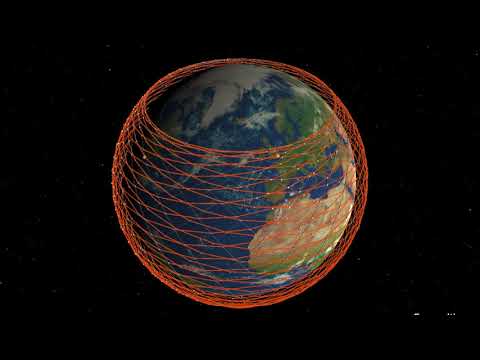
Mark Handley of UCL explains, with simulation visualizations, how early Starlink satellites without inter-satellite links could still give low-latency wide-area communication by hopping via ground relays. He shows it can beat fibre on many long paths.
Cited in Starlink latency debates as a clear visual analysis showing sub-100ms latency is plausible even without inter-satellite links.
Up next
 4 mo on HN
Turning Photons Into Food
Apogee Instruments Inc.
3 HN recommender · 2020–2021
 2 mo on HN
Making Sense of VRChat, the "Metaverse" People Actually Like
People Make Games
2 HN recommender · 2022–2025
 3 mo on HN
Starlink revisions, Nov 2018
Mark Handley
4 HN recommender · 2018–2023
 1 mo on HN
Electroflight | Fully Charged
Everything Electric CARS
1 HN recommend · 2016–2018
 3 mo on HN
Violence | Slavoj Žižek | Talks at Google
Talks at Google
4 HN recommender · 2010–2022
 5 mo on HN
Gimbal UFO - A New Analysis
Mick West
8 HN recommender · 2022–2025
 9 mo on HN
Harder Drive: Hard drives we didn't want or need
suckerpinch
12 HN recommender · 2022–2025
 9 mo on HN
This Video Is Sponsored By ███ VPN
Tom Scott
9 HN recommender · 2019–2026
 6 mo on HN
A New Way to look at Networking
Google
6 HN recommender · 2011–2018
 6 mo on HN
Net Neutrality: Last Week Tonight with John Oliver (HBO)
LastWeekTonight
7 HN recommender · 2014–2017
 4 mo on HN
Characters, Symbols and the Unicode Miracle - Computerphile
Computerphile
4 HN recommender · 2014–2025
 5 mo on HN
8 Frames in 16ms: Rollback Networking in Mortal Kombat and Injustice 2
GDC Festival of Gaming
4 HN recommender · 2020–2025
12 comments from Hacker News
I would highly recommend the video linked from this article: ▶ this video It's a simulation of the various ways in which the Starlink network could be arranged to route between satellites and ground stations; very detailed and super interesting.
You don't need inter-satellite links for low latency, as Mark Handley has elegantly pointed out in his incredible video. I don't think internet access will amount to even 50% of the revenue of Starlink. ▶ this video
This [1] is a good youtube explanation of how a hybrid between Starlink and ground stations could still improve connectivity: [1] ▶ this video
If you want a really great visualization and latency estimates for starlink check out the models and videos this guy came up with: link ▶ this video The comment from the FCC about it not accounting for "processing [&] routing" is kindof nonsense on its face, those are not novel problems they're already done by ever other router and switch, including several other satellite networks.
The orbital planes top parts are all up there at high latitudes. The circle you are seeing is actually made up of several different orbital planes that swoop down toward/past the equator and then up/down to 60 degrees N/S. Seeing them move will make it clearer. Here’s an awesome visual explanation with a ton of other cool info: ▶ this video
A ground station doesn't have to actually be on the ground. They could park a boat in the ocean between London and NYC with equipment to act as a repeater. This YouTube video (along with others on this channel) does a good job of explaining how this could work. [ ▶ this video ]
The research community really should do a better job of engaging with the wider world, irrespective of whether it increases citations. For example, I had this paper in Hotnets 2019, and about 80 people saw my presentation. But I also spent some time, turned it into a little video and put it on YouTube. 360,000 people have seen it there. Now the subtleties were probably lost on many of those people, but if only a few of those people got something out of it, then it will likely have had more impact than the original paper. ▶ this video
There's no doubt that this sort of technology can in principle deliver sub-100ms latencies. Take a look at my analysis here with inter-satellite links: link And here without ISLs: ▶ this video Now, these videos assume no queuing delay. It's really hard to guarantee low queuing delay in a traditional IP network, but there's been a lot of research over the years, and we have a range of ideas that can be used to deliver minimal queuing with reasonable utilization. In fact doing this for Starlink is something I'm actively researching at the moment. I'm convinced it can be done, but it won't look like a conventional IP network internally. I don't know what SpaceX will actually do, so if the FCC has doubts, this is perhaps where they are concerned. Other delays might be in the ground segment, but that's more or less the same for SpaceX's terestrial competitors, and the FCC seems to think they can do it.
Computationally, it's difficult, but I don't think it's intractable. Bear in mind this this is not an animation, but a real-time simulation: ▶ this video I'm running Dijkstra across this mesh at 30fps in real-time on my laptop while also doing the 3d animation. My laptop fan does spin a bit, but it's not crazily optimized code, and for the video I was also recording to H.264 simultaneously. Doing routing for all customers simultaneously is certainly feasible if their groundstations do the computation, based on routing state supplied in real-time by the constellation. Other solutions are probably possible too, but this seems simplest to me, and scales linearly with customers.
I didn't downvote you, but the size of the beam is heavily dictated by the elevation they're willing to work with, and the wider the elevation, the more expensive the antenna. So give that they need to decrease the size of the beam to keep antenna cost down, it's highly likely that the beam size is much, much smaller than what you cited there. Just take a look to see how many handoffs there are over CONUS alone: ▶ this video
Elon Musk has stated that until they have inter-satellite laser links deployed, they can get wide area low latency communications by relaying via ground stations at a high slant angle. I built a simulator and ran an analysis of this, and actually it works pretty well. My video analysing all this is here: ▶ this video
These first satellites don't have the free-space lasers I modelled in that paper, but my simulations show they can still beat fibre on many paths without inter-satellite links, by relaying via groundstations: ▶ this video Later satellites will have inter-satellite links, but probably not till near the end of this year, and most of the first phase will already be deployed by then.