4 Chords | Music Videos | The Axis Of Awesome
The Axis of Awesome3 HN recommenders · recommended in 3 months, 2012–2025
comedy · general · evergreen · 2012–2025 on HN
A comedy-music medley from the Australian band The Axis of Awesome showing that dozens of famous pop songs use the same four-chord progression. The performers cycle through a long list of hits over the same chords.
HN commenters use it as the canonical demonstration that popular songs reuse one chord progression, especially in threads on music analysis and AI-generated music.
Up next
 6 mo on HN
Civil War General-Purpose Computing | Cory Doctorow | Talks at Google
Talks at Google
4 HN recommender · 2012–2026
 7 mo on HN
QuakeCon 2012 - John Carmack Keynote
QuakeCon Official
6 HN recommender · 2012–2018
 4 mo on HN
"CHASING ICE" captures largest glacier calving ever filmed - OFFICIAL VIDEO
Exposure Labs
4 HN recommender · 2013–2017
 12 mo on HN
Mechanical Computer (All Parts) - Basic Mechanisms In Fire Control Computers
Excelsior10000
13 HN recommender · 2014–2025
 5 mo on HN
C++ and Beyond 2012: Herb Sutter - atomic Weapons 1 of 2
alexsmail
4 HN recommender · 2020–2024
 11 mo on HN
What Happened to Horses Is Happening to Us
CGP Grey
11 HN recommender · 2014–2026
 11 mo on HN
Music Theory and White Supremacy
Adam Neely
11 HN recommender · 2020–2024
 8 mo on HN
Music Software & Bad Interface Design: Avid’s Sibelius
Tantacrul
8 HN recommender · 2019–2026
 8 mo on HN
Trackers: The Sound of 16-Bit
Ahoy
7 HN recommender · 2021–2026
 6 mo on HN
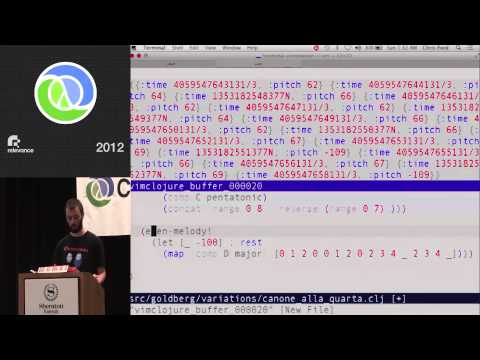
Functional Composition - Chris Ford
ClojureTV
6 HN recommender · 2013–2023
 6 mo on HN
Intro to Synthesis Part 1 - The Building Blocks of Sound & Synthesis
matrixsynth
3 HN recommender · 2018–2022
 6 mo on HN
The Marvel Symphonic Universe
Every Frame a Painting
6 HN recommender · 2017–2026
12 comments from Hacker News
Heh, I just this afternoon listened to a radio show about the famously popular vi-IV-I-V/I-V-vi-IV chord progression [1]. If you haven't heard it before, the "4 Chords" medley by Axis of Awesome is a great demonstration of its ubiquity [2]. [1] link [2] ▶ this video
Though a bit more on the "actual implementation" side of things, there's an Australian group called "Axis Of Awesome" who did an interesting song called "Four Chords". It shows the use of a set of four common chords in a lot of different songs. ▶ this video
On a related note (corniest pun of the day), the Australian musical comedy act Axis of Awesome made a song called Four Chords Song , which is basically a 47-song medley all using the same chord progression. link They've said that the chords are used by some of the most well known songs in the world, and their performance demonstrates this nicely, as in this clip: ▶ this video The above link is the official video; but they explain their reasoning better in this live performance: link
By convention in music, we use Roman numerals to signify what chord we should play relative to the root (key). "I" refers to the root/tonic/key and we count up from there. [1] So, for example, a common three chord progression in a major scale would be I – IV – V. If we take the key of C, those would be C, F, G, as F and G are the fourth and fifth chords respectively. In the key of G, it'd be G, C and D. In that key, a good example song is "Sweet Home Alabama", where almost the entire song is just V - IV - I over and over again. One of the most popular chord progressions, used in an astounding number of pop songs is known as the "Four Chord Trick", I – V – VI – IV, famously demonstrated by the Aussie comedy band Axis of Awesome[2] I think I'd agree with the person you're replying to, both in that the original source is flawed due to not including the "dupes", despite them being important, and also because key is largely irrelevant, chord progression is much more important. [1] link [2] ▶ this video .
I think there's a lot of different reasons all simultaneously going on. Most human musicians have very little power; that's been going away for a long time, even since "canned music" "robots" pushed live bands out of cinemas a century ago: link Most popular music already feels, and to an extent is, fake. Not only because mere recording allows repeated takes until it's inhumanly "perfect". When I played an MP3 of Britney Spears to my mum around the turn of the century, she thought it was a robot singing because of the autotune. The Monkees was famously an attempt at a manufactured band whose members just happened to not feel like playing that game and did it for real, Gorillaz is even more obviously manufactured. Parasocial relationships are inherently different from "real" relationships, but the performers have to pretend that it's personal when they address a crowd or a camera. Axis of Awesome demonstrated the similarity of most modern hits with their "4 Chords": ▶ this video Those with the power were, possibly still are, the record labels; but if the AI are trained on the works of small musicians that can't afford the copyright cases or the political influence, but also whose works are not under the umbrella of the labels who do have those resources but not the right or short term motivation to intercede on their behalf, the big labels themselves may lose the consumer market to free AI output, while professionals will dismiss both the AI output and the label's output as "just
I challenge you to listen to 4 chords of awesome and tell me again about how every song is completely original. How does eragon exist when it's definitely ripped parts from star wars, etc...ai usually doesn't spit out a full plagiarism, but a loosely inspired work which is what most media we consume is. Edit: 4 chords of awesome link is ▶ this video
How much is really being said by the highest dollar-valued modern music? ▶ this video and link come to mind for different reasons.
iirc those are the same "4 chords" used by the Axis of Awesome [1]. Certainly sounded like that to my ear from memory, but don't really have enough music notation/theory knowledge to know for certain and I may have been mis-remembering. [1] ▶ this video
> Most popular songs are composed by using mostly the same repeating chord patterns ▶ this video Way too many to list.
Primarily, it's about payoff / benefit. Imagine you're 40 years old and you've never played an instrument. You have limited ambition - you want to have fun and play a little bit around campfire. How do you start, let's say on a guitar: 1. I show you G, C, D chords and print out a simple, easily understandable chart you can take home. You now can play hundreds of songs after 30 min lesson and a few mins of practice. You can spend time playing around and slowly learning rhythm, strumming techniques and patterns, while singing to your songs and getting a feel for your instrument. A week or three later I show you E-minor and now you can play virtually every pop song made in last 20 years. [1] If you get excited and interested, we throw in Aminor, and eventually F Major and now you know power chords and you're the master of it all. You're having fun, you're playing, you're improving, and you're having FUN. You can focus on good techniques and sounding good. When and if you want more, we can learn basic music theory and pentatonic patterns, and then one day if you're serious and ready for some pain, you can learn some staff notation. Or! 2. I give you some books and tell you to learn notes. You download an app or six to enable you to mindlessly practices notes every day. You spend months studying by rote and can maybe play Twinkle Twinkle Little star, poorly. But it's academic because you gave up a long time before you got there as there was no FUN to be had and you have children a
This is a solid answer, but I'd also add - there are very few general music buffs. Maybe I'd count, with years in pro music performance, degree in Jazz and a lifetime of listing to and performing an insanely wide variety of genres... but not a buff for all styles. Computer systems are actually not a bad analogy. How many people do you know that have an in-depth knowledge of Assembly in different systems (including the oldest ones), GPUs, ML, Python, JS, Haskell, C++, Rust, ALGOL, Compilers, Hardware development, etc. Then add into the mix having an in-depth knowledge of the creators of those things, what else they did, failures, influences, their mentors. You always have the choice of breadth versus depth, within your time constraints. I think learning about a single artist or band, looking up the producer, label, members and following up on all those leads to see what else they have done - and see if you like it is a great beginning. Some genres like jazz might seem difficult to get into, and that's fine. No need to delve in until you find a hook that peaks your interest. And then when you find out about a genre (and jazz is an excellent example) - you'll find sub-genres you like, and don't and maybe you are interested in the evolution - like many people love bebop, but don't listen to "dixieland jazz" or big band swing, or modern fusion. You will never hear all the music. But depth (in my opinion) breads a lot more passion than breadth just for the sake of it. So rather tha
Great work, Jake Albaugh. Needs one critical revision, though: I, V, VI, IV in major MUST NOT be allowed! ▶ this video