Procedural Programming: It Never Went Away — Kevlin Henney | Build Stuff
Build Stuff - #1 Software Dev Conf2 HN recommenders · recommended in 3 months, 2018–2021
talk · intermediate · evergreen · 2018–2021 on HN
Kevlin Henney argues that procedural programming never went away despite later paradigms such as OO and functional. He traces the history of structured programming and shows where procedural thinking still lives in modern code and why it matters for readabili…
HN people recommend it as a fascinating history lesson showing that the field keeps rediscovering ideas from the 1960s.
Up next
 2 mo on HN
The Brexit effect: how leaving the EU hit the UK | FT Film
Financial Times
3 HN recommender · 2022–2024
 6 mo on HN
The Marvel Symphonic Universe
Every Frame a Painting
6 HN recommender · 2017–2026
 2 mo on HN
Babel Fish - The Oddest Thing In The Universe - The Hitchhiker's Guide To The Galaxy - BBC
BBC Studios
1 HN recommend · 2020–2025
 2 mo on HN
Salad Mug - DYNAMO DREAM, Ep1
IanHubert
3 HN recommender · 2021–2023
 16 mo on HN
How to Speak
MIT OpenCourseWare
17 HN recommender · 2020–2025
 2 mo on HN
The real reason Boeing's new plane crashed twice
Vox
2 HN recommender · 2019–2019
 3 mo on HN
that dark matter video aged like milk
Angela Collier
3 HN recommender · 2024–2024
 11 mo on HN
🚀 TDD, Where Did It All Go Wrong (Ian Cooper)
DevTernity Conference
11 HN recommender · 2018–2024
 15 mo on HN
RailsConf 2014 - All the Little Things by Sandi Metz
Confreaks
15 HN recommender · 2015–2025
 14 mo on HN
"Simple Made Easy" - Rich Hickey (2011)
Strange Loop Conference
14 HN recommender · 2022–2026
 13 mo on HN
"Making Impossible States Impossible" by Richard Feldman
elm-conf
9 HN recommender · 2017–2026
 12 mo on HN
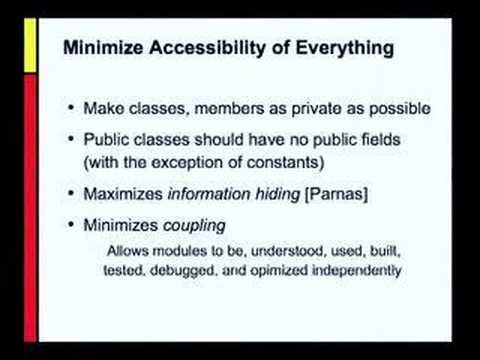
How To Design A Good API and Why it Matters
Google TechTalks
12 HN recommender · 2011–2025
7 comments from Hacker News
I strongly recommend this talk by software consultant and author Kevlin Henney called Procedural Programming: It's Back? It Never Went Away He talks a bit out Algol 68 and how influential it was on programming language design. Many language keywords we're familiar with today originated in the 50 year old language specification for Algol 68: int, bool, skip, void, struct. Here's the snippet from the talk about Algol 68 - it's brilliant: ▶ this video
I really liked this talk about the history of programming and how so many ideas we consider recent or modern are in fact much older than many of us realise. Watching this talk merely amplifies the feeling that the programming profession is in a perpetual loop - discarding or forgetting ideas or concepts, then re-discovering them anew. What's also striking is how rich and varied were the programming ideas that emerged from the 60s and 70s. Kevlin Henney - Procedural Programming: It's Back? It Never Went Away ▶ this video
If you have an interest in the history of programming methodologies, this talk is fascinating: Procedural programming: it's back? It never went away ▶ this video
You may appreciate Kevlin Henney's talk, "Procedural Programming - It's back? It never went away."[1] It's a tour of how all the best discoveries of the past decade or two really date back to the 1960s. [1] ▶ this video ▶ this video
▶ this video Sequence, selection, iteration (or recursion if available). Note that the child overlooked the assumption that it's sequential.
I will start with a couple clarifications, in good faith. I will admit that I have made lazy errors in this discussion. Specifically in regard to terminology. Afaik, there is no term for "temporally unsynchronized" other than parallelism or concurrency, and I have misused the term concurrency at times. I have also used the term transition to mean "asynchronous state transition". This may clarify my past statements, but I will attempt to do better, going forward. So I'll visit on the material you are most familiar with so that my comments might have the most specific impact or irrelevance. For your verification, I read your paper here: link To begin, I agree on the concept. If "constraining architecture" means any separation of concerns or interface. To demonstrate that I did read through the code snippets you provided and completely irrelevant to the points being discussed, I believe there was an error in the code you posted in Listing 8@p.136 - - k: degreesK { self basicC :( degreesF - 273.15. \*wat?\* ivar : ui / celsiusTextField / intValue := self c . ivar : ui / fahrenheitTextField / intValue := self f. } I also thought the implementation was a little muddled and would implement a solution similar to this^. Object subclass: #Temperatures { var c. -changedC : sender { self c: sender intValue. self updateValues: { #val : c, #type: 'Celcius' }. } -changedF : sender { self f: sender intValue. self updateValues: { #val : f, #type: 'Farenheit' }. } -changedK : sender { self k
> If "constraining architecture" means any separation of concerns or interface. It doesn't. It means you work with constraints, for example dataflow constraints. For example: link > I also thought the implementation was a little muddled Yes! That was the point of that section of the paper, that doing the straightforward thing leads to a muddle: "At this point, it becomes clear that our original strategy of updating the UI from the individual setter methods is probably not tenable in the long run." A little later: "As we have seen, even a conceptually very simple application such as a temperature converter quickly attracts significant complexity with non-obvious trade-offs once the requirements of an interactive version of that application are taken into account." The fact that you need to create these centralised updater methods is non-obvious, and leads to a bunch of related non-local changes. Also a muddle. "This complexity is not the result of a complicated domain model, but rather of the architectural embellishments required to move data from location to location in order to keep the different parts of the application (model, user interface, persistence) synchronized. In the next section, we will look at a mechanism for simplifying this kind of overhead." > ReactJS (uses HOM like Objective-Smalltalk) ReactJS uses Higher Order Messaging? Where? > Chatty: "We highlight a strong coupling between languages and architecture,..." Which was my point, yes, thank you! We are lim