Charger prototype finding its way to Model S
TeslaCited 11× on HN, 2015–2026
demo · general · 2015–2026 on HN
A one-minute Tesla clip showing a prototype robotic snake charger that finds a Model S's charge port and plugs itself in.
Brought up whenever robotic or automatic EV charging comes up, as the memorable 2015 demo that never became a product.
Up next
 15 mo on HN
Around The Corner - How Differential Steering Works (1937)
US Auto Industry
17 HN recommender · 2013–2024
 9 mo on HN
Cities Aren't Loud: Cars Are Loud
Not Just Bikes
10 HN recommender · 2021–2025
 5 mo on HN
How Differential Gear works (BEST Tutorial)
ConceptVBS
5 HN recommender · 2013–2020
 6 mo on HN
A New Car UI: How touch screen controls in cars should work
Matthaeus Krenn
4 HN recommender · 2017–2023
 5 mo on HN
These Stupid Trucks are Literally Killing Us
Not Just Bikes
11 HN recommender · 2023–2026
 5 mo on HN
The 919 Tribute Tour: On-board record lap, Nordschleife.
Porsche
3 HN recommender · 2018–2026
 6 mo on HN
Why Electric Bikes are More Dangerous than Motorcycles
FortNine
5 HN recommender · 2021–2025
 5 mo on HN
Spinning Levers - How A Transmission Works (1936)
US Auto Industry
5 HN recommender · 2018–2026
 5 mo on HN
Are Electric Cars Worse For The Environment? Myth Busted
Engineering Explained
5 HN recommender · 2018–2023
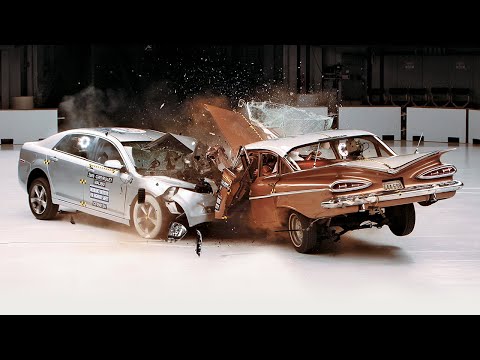 5 mo on HN
1959 Chevrolet Bel Air vs. 2009 Chevrolet Malibu IIHS crash test
IIHS
5 HN recommender · 2014–2026
 5 mo on HN
The Grille Trend that Kills 509 People per Year
FortNine
5 HN recommender · 2024–2026
 4 mo on HN
Riding through Iran on a small motorcycle as British person.
c90adventures
4 HN recommender · 2016–2021
11 comments from Hacker News
This is what a pancake motor looks like.[1] Thin and flat. Wrong form factor for fitting into a wrist. Strings ("tendons") have their own problems. Wear at bearing points, mostly. You need an opposed pair, too. So there's a motor, a winding drums, and something like a spring to maintain tension. Or two motors and two winding drums, which gives better control. That's why snake robots have never caught on. They're good painting robots, because they can get into tight spots. But repetitive cycling wears the tendons at the same place on each cycle. There was a good application - Tesla's snake charging robot.[2] All the complicated stuff is in the pedestal, and you can surround that with concrete to prevent damage if it's hit by a car. The snake part has no motors, just discs and strings, plus the connector and probably a cell phone camera at the end. It can be made easily replaceable, like a gas station hose. But some people thought it was too creepy. [1] link [2] ▶ this video
I liked the Tesla snake robot for charging.[1] But it upset many people. It looks complicated but is a rather simple mechanical design. There are several motors in the base pulling on cables. The arm itself is just segments, disks, and cables. So all the complexity is in the base, and you can surround that with a metal or concrete box to prevent damage. Arm replacement wouldn't be too expensive. Tesla is now touting wireless car charging, but that's a lot of power to transmit through air. [1] ▶ this video
The robotic arm that connects your Tesla to the charger Tesla demoed that in 2015, but didn't make it into a product.[1] Apparently too many people thought it was "creepy". (That's a good way to do the job. Snake arm robots are quite simple. The tube just contains some pull cables running through disks with holes.[2] All the motors are in the base. So you can build one of these with a protected base and an easily replaced arm tube. The usual problem with snake robots is that the cables wear out. But that's in painting applications, where they're in constant motion all day. A charging robot moves, slowly, for maybe one minute per hour. They're not very repeatable, which is fine in this application. The car won't be in the same place every time anyway. There's a TV camera in the end to find the socket. It's too bad that didn't ship as a product.) [1] ▶ this video [2] link
That's very good. Note lack of "we built an agricultural fruit-picking arm that can survive five years of picking". Remember Tesla's robotic charging arm? [1] That was a good idea. If Tesla ever gets unsupervised autonomous driving to work reliably in parking lots, that will be useful. Then cars can self-charge. (The snake arm seems complicated, but it's not. The arm is just segments, cables, and discs. The motors are all in the base. So this can be built in a way such that damaged arm replacement is about as hard as gas pump hose replacement. Snake arm robots are not used much because they have a wear problem where the cables go through the discs. But that's for painting robots, which move constantly. A charging robot makes maybe ten moves a day.) [1] ▶ this video
> "You will have some sort of docking station in your garage and when you park short-term the car flips the batteries for you with a loaded one" Are you serious? Tesla did this and presented a tech demo in 2013: link > "auto-plug itself and charges overnight. No cables, no mess." Another Tesla tech demo: ▶ this video Also, what do you mean "superchargers disappearing?". It seems that Tesla is way a head on a lot of things and it will take quite an effort/investment for the incumbents to catch up. Though in reality, wide EV adoption is a WIN for everybody and is actually the core mission of Tesla, which is to "Accelerate Sustainable Transport"
It seems like Tesla is at least hinting to aim for a system where you can basically send your car out to charge and have it back when you need it. Combining auto pilot with this prototype, it is at least feasible that it could work ▶ this video Edit: Also this discussion: link
Can we please standardize charging stations to not require a person to manually establish a connection? It seems that it would pose such an awkward and unnecessary hurdle. Especially in the coming age of self driving cars. Every time you arrive or leave you have to remember to (dis-)connect the charger. Why not just have some kind of inductive energy transfer or I dunno... something. Edit1: Heh, this could work I guess: ▶ this video - seems it could be too expensive for mass-usage though. Edit2: This is more what I had in mind: link
You need a Tesla robotic charger snake: ▶ this video :) (it's only a prototype for now). But no, it's not a huge issue. New cars seem to come with apps nowadays, so as you said your car can just send you a notification to your phone if you haven't plugged it in five minutes after arriving back home. And maybe another one if it's still not plugged in before you go to bed. Unavailability of charging (see sibling comment) is a bigger issue that won't be as easy to tackle. But reminding users to charge their car isn't what's hindering EV adoption. You can be late if you forget to fill up your petrol car, too. That can easily take ten minutes if there's a bit of a queue.
By this logic should we have autonomous refueling already? It's been done a few times.[1][2] The systems are rather slow and clunky, but work. Dealing with all the variation between cars runs up the cost. Tesla has a charging robot.[3] This is much easier, since Tesla controls both sides of the interface. The car actively cooperates, opening the charging port door. Tesla also interlocks the car so that you can't drive away while plugged in. I'm surprised that Tesla hasn't deployed those robot chargers yet. [1] link [2] link [3] ▶ this video
Yeah I understand what you mean and I think you're right. 1000 charge points is unacceptable but do we really need that? Given the current generation Tesla can already self navigate pretty well what's stopping the cars navigate the car park in your absence and charge themselves at a few central charge points. ▶ this video
The gif is sped up. This vid is actual speed ▶ this video I think it's awesome. But, it obvious that the current implementation will inspire the creeps in lots of people. Sci-fi horror has put an unfortunate bad rap on robotic tentacles and chromed vertebrae.