Null References: The Billion Dollar Mistake - Tony Hoare
JoseCanCited 4× on HN, 2020–2025
talk · intermediate · evergreen · 2020–2025 on HN
Tony Hoare's InfoQ talk in which he describes introducing null references in ALGOL W in 1965 and calls it his billion-dollar mistake. He discusses language designer responsibility and run-time checks.
The standard citation whenever null safety and language design come up.
Up next
 16 mo on HN
How Python was Shaped by leaky Internals, Armin Ronacher, Flask framework
Видео с мероприятий {speach!
15 HN recommender · 2017–2025
 12 mo on HN
Why Isn't Functional Programming the Norm? – Richard Feldman
Metosin
12 HN recommender · 2019–2025
 11 mo on HN
Maybe Not - Rich Hickey
ClojureTV
14 HN recommender · 2018–2025
 10 mo on HN
Conway's Game Of Life in APL
Dyalog
11 HN recommender · 2010–2024
 9 mo on HN
Lecture 1A | MIT 6.001 Structure and Interpretation, 1986
MIT OpenCourseWare
11 HN recommender · 2012–2024
 10 mo on HN
Crockford on JavaScript - Volume 1: The Early Years
YUI Library
10 HN recommender · 2013–2022
 10 mo on HN
Growing a Language, by Guy Steele
Bill Pugh
11 HN recommender · 2014–2026
 10 mo on HN
Effective Programs - 10 Years of Clojure - Rich Hickey
ClojureTV
10 HN recommender · 2017–2026
 9 mo on HN
Brian Goetz - Stewardship: the Sobering Parts
ClojureTV
10 HN recommender · 2014–2025
 10 mo on HN
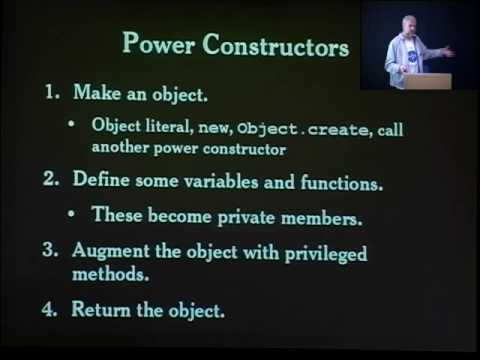
JavaScript: The Good Parts
Google TechTalks
11 HN recommender · 2009–2020
 9 mo on HN
Ideas about a new programming language for games.
Jonathan Blow
7 HN recommender · 2014–2025
 8 mo on HN
"Propositions as Types" by Philip Wadler
Strange Loop Conference
9 HN recommender · 2015–2026
4 comments from Hacker News
> Sure. With infinite energy, anything’s possible - we can prevent all bugs. The problem is, we don’t have infinite energy. You don't need infinite energy but it is a significant undertaking. The UB seem to obey a power law in regards to their lifetime i.e. every X years number of UB caused problems halves. > I can only recall one serious concurrency bug I’ve ever had (a data race) which took some debugging time to track down, but it wasn’t in Go. YMMV. That's what is nasty about UB in data races. It's not trivial to find and it's a pain in the neck to reproduce. So even taking you at your word, you not having issues with data races isn't the same as "I wrote code free of data races". > As for the “billion dollar mistake”, I understand the argument in the context of C or C++, but not in the context of Go. Even without a chance of UB. You're adding an implicit `Type | null` to every piece that uses nullable code without handling the null case. Each time you forget to do it, you cause either an UB or a null pointer error. And the place it manifests is different from where it's generated. Furthermore, listening to Tony Hoare's talk ( ▶ this video ), he mentions that trying to avoid the null, in the context of a language like Java or C#, that permits them is also causing people to waste time working around them. > The middle network layer will report the error to the user, I fix it, and move on, a $0 mistake. Sure, but that's not a $0 mistake. It's {time to fix * hourly rate}. Even if
> Even without a chance of UB. You're adding an implicit `Type | null` to every piece that uses nullable code without handling the null case. Each time you forget to do it, you cause either an UB or a null pointer error. And the place it manifests is different from where it's generated. > Furthermore, listening to Tony Hoare's talk ( ▶ this video ), he mentions that trying to avoid the null, in the context of a language like Java or C#, that permits them is also causing people to waste time working around them. It's an insignificant amount of time in my experience, which makes this irrelevant in practice. I’ve never had to "work around them", this is either a theoretical argument or just sloppy programming. > Sure, but that's not a $0 mistake. It's {time to fix * hourly rate}. Even if you're doing for OSS, you could have been spending that time doing something else. Oh, come on, you’re smart enough to understand that a few minutes every few months may not be exactly $0, but it’s such an insignificant value that it can be treated as $0. > Sure. But trading "ease of use" for "preventing errors" is not something I want in any language I use. Well, you can choose your trade offs, and you can let others choose theirs. So I guess you use Ada for everything? or maybe you use Coq to prove everything? Of course you don’t, you’re also making trade offs, just different ones. > Null/nil are about as good concepts today as silently skipping errors. You exaggerate again. I do not agree with tha
There's a constant tension between bit-packing and rich semantics older than me! As you likely know C.A.R. Hoare calls `null` his "billion-dollar mistake": ▶ this video . I linked the Cliff Click talk because it's the best example that I know about of someone using some semi-formal rigor around valid states and the transitions between them in the context of raw atomic operations to get a quite clearly correct result with a legitimate performance imperative: he had a machine with 768 cores, customers who bought that machine to have 768 threads jump on a hash table all at once and wanted ~~700x more throughput having paid for the machine. But even Cliff Click made sure that both his conceptual states and their physical representations were going A -> B -> C w.r.t. a given conceptual "register". I'm not trying to knock the serious concurrency pros who need atomic and/or relaxed operations in some super hot path: there are unambiguous use cases for this stuff. I've legitimately needed these things once or twice myself. Lock-free is a bad default. Even the elite concurrency pros work very hard to get something that's both robust and still a win after the constant factors. I'm saying "proceed with high caution, and on the basis of measurement", not "never ever do this".
I believe that's a reference to Tony Hoare's famous talk about the invention of null references which he calls his billion dollar mistake ▶ this video