Samplerates: The Higher the Better, Right?
FabFilter1 HN recommender · recommended in 1 month, 2021–2023
tutorial · intermediate · evergreen · 2021–2023 on HN
Dan Worrall explains when higher sample rates help in recording and mixing, and when they do not. He goes into oversampling versus higher sample rates, and aliasing in distortion plugins.
Recommended as a clear explainer on Nyquist, aliasing and sample rate conversion artifacts.
Up next
 15 mo on HN
But what is the Fourier Transform? A visual introduction.
3Blue1Brown
16 HN recommender · 2018–2025
 13 mo on HN
D/A and A/D | Digital Show and Tell (Monty Montgomery @ xiph.org)
FL Studio
15 HN recommender · 2017–2026
 8 mo on HN
The Fast Fourier Transform (FFT): Most Ingenious Algorithm Ever?
Reducible
7 HN recommender · 2021–2026
 6 mo on HN
(1/4) Intro/History: Introducing a 100-year-old mechanical computer
engineerguy
6 HN recommender · 2015–2023
 5 mo on HN
David Kriesel: Traue keinem Scan, den du nicht selbst gefälscht hast
media.ccc.de
4 HN recommender · 2019–2025
 6 mo on HN
The more general uncertainty principle, regarding Fourier transforms
3Blue1Brown
7 HN recommender · 2019–2025
 6 mo on HN
JPEG DCT, Discrete Cosine Transform (JPEG Pt2)- Computerphile
Computerphile
6 HN recommender · 2015–2026
 5 mo on HN
Fourier Optics used for Optical Pattern Recognition
Huygens Optics
5 HN recommender · 2021–2025
 4 mo on HN
Characters, Symbols and the Unicode Miracle - Computerphile
Computerphile
4 HN recommender · 2014–2025
 4 mo on HN
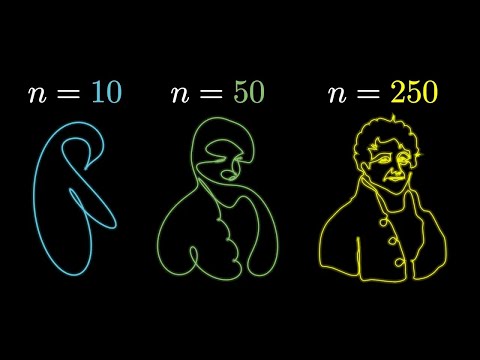
But what is a Fourier series? From heat flow to drawing with circles | DE4
3Blue1Brown
4 HN recommender · 2020–2025
 4 mo on HN
Dasher: information-efficient text entry
Google TechTalks
2 HN recommender · 2016–2025
 4 mo on HN
But what are Hamming codes? The origin of error correction
3Blue1Brown
4 HN recommender · 2020–2023
3 comments from Hacker News
Dan Worrall made a fantastic video which touches on Nyquist. His youtube channel is a tremendous resource: ▶ this video
There is a bit more to that when we get to having to modify or convert audio formats, without "right" algorithms it might introduce some artifacts via aliasing ▶ this video
This is largely because MP3 is a crappy, old format. Try high-bitrate Opus on most samples and you're a lot less likely to get above-chance results on an ABX test, pretty much ever, at high bitrates. Ultimately though, lossy compression is always program-dependent ("program" here means the song, not the app). The encoders use psychoacoustic algorithms, and there is no way to prove they will perform well on all samples. So you will always be able to find corner cases where an encoder or format does worse and results in more audible artifacts; some of these might be encoder bugs, some might not. Therefore, it is fair to say that you might not want to rely on lossy compression for archival. But it is perfectly reasonable to use it to put music on devices to actually listen to. You say good mastering makes it easier to notice encoding artifacts, but actually, bad mastering can do that too. Over-compressed stuff (in dynamic range) with inter-sample peaks above 0dB can clip and distort after getting run through a lossy codec. As for lossless formats, though, anything above 48kHz 16 bits is complete nonsense for final delivery to consumers. All the "high resolution" stuff with higher sample rates and bit depths is just marketing bullshit, and this has been repeatedly demonstrated in trials (the well-designed ones anyway; there are plenty of terrible ones - no, comparing the 96kHz download to the 48kHz download of a song is not how you test this properly). Bit depths above 16 are use