Munk Debate on Artificial Intelligence | Bengio & Tegmark vs. Mitchell & LeCun
Policy-Relevant Science & Technology2 HN recommenders · recommended in 2 months, 2023–2023
talk · general · 2023–2023 on HN
A Munk Debate on the proposition that AI research and development poses an existential threat. Yoshua Bengio and Max Tegmark argue for it, and Melanie Mitchell and Yann LeCun argue against.
HN commenters recommend it as a good debate with leading figures on both sides of the AI existential risk question.
Up next
 3 mo on HN
The Power of Big Data and Psychographics | 2016 Concordia Annual Summit
Concordia
4 HN recommender · 2017–2026
 3 mo on HN
Myopia: A Modern Yet Reversible Disease — Todd Becker, M.S. (AHS14)
AncestryFoundation
2 HN recommender · 2021–2025
 3 mo on HN
Why Japan Arrests Foreigners
Paolo fromTOKYO
3 HN recommender · 2020–2026
 3 mo on HN
"Agile Methods The Good, the Hype and the Ugly," Bertrand Meyer
Association for Computing Machinery (ACM)
2 HN recommender · 2018–2024
 3 mo on HN
Moral behavior in animals | Frans de Waal
TED
3 HN recommender · 2019–2024
 5 mo on HN
GigCityElixir23 - Bryan Hunter
Groxio
4 HN recommender · 2023–2025
 4 mo on HN
FULL INTERVIEW with Yuri Bezmenov: The Four Stages of Ideological Subversion (1984)
Nicholas Marshall
4 HN recommender · 2020–2026
 7 mo on HN
Dr Shashi Tharoor MP - Britain Does Owe Reparations
OxfordUnion
8 HN recommender · 2017–2023
 11 mo on HN
What Happened to Horses Is Happening to Us
CGP Grey
11 HN recommender · 2014–2026
 6 mo on HN
Why Would AI Want to do Bad Things? Instrumental Convergence
Robert Miles AI Safety
6 HN recommender · 2019–2023
 6 mo on HN
Veritasium: What Everyone Gets Wrong About AI and Learning – Derek Muller Explains
Perimeter Institute for Theoretical Physics
6 HN recommender · 2025–2026
 6 mo on HN
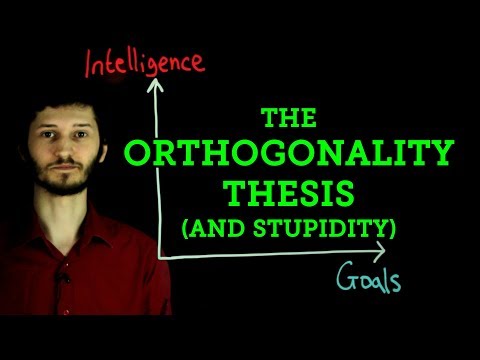
Intelligence and Stupidity: The Orthogonality Thesis
Robert Miles AI Safety
6 HN recommender · 2022–2026
4 comments from Hacker News
All of the talk about "AI Safety" and "Effective Altruism" cannot be dismissed as BS. As technology has become more and more integrated into the very fabric of society, some dangers are very real unless we explicitly use Human standards of Morals/Ethics to regulate them. Of course this should be no excuse to go off into la-la land. From link Scholars discuss current risks from critical systems failures, bias, and AI enabled surveillance; emerging risks from technological unemployment, digital manipulation, and weaponization; and speculative risks from losing control of future artificial general intelligence (AGI) agents. Also watch Munk debate: AI research and development poses an existential threat featuring Yoshua Bengio, Max Tegmark, Melanie Mitchell and Yann LeCun - ▶ this video
Do you seriously think that the people that brought you pfas + other plethora of toxins and their subsequent effects across many systems really care about the dangers of AI? Please, enjoy it while it lasts. What they really need is big fat alien dick to come dick slap them across the face and bring them back to reality. Because of course there will be negative "known unknown" consequences and "unknown unknown" consequences just like there have been consequences with the rest of the so called "goodwill" advancements. It's suicidal to think otherwise. Pretending there wont be is just their historically proven strategy to play down your fears. It's just part of the run of the mill PR management tactic. Nothing new to see here. Tis a good one: ▶ this video
Very well said! The big problem is going to be some "not so intelligent" Human making decisions based on AI/ML output without verification or even worse having AI itself make the decision. Here is a Munk debate "AI research and development poses an existential threat" - Yoshua Bengio & Max Tegmark vs. Melanie Mitchell & Yann Lecun - ▶ this video
I just opened it up and found a fun bit during Melanie Mitchell's opener: ▶ this video Paraphrasing: > Yoshua Bengio has written about a scenario where an AI is asked to solve climate change, and it designs a virus that decimates humans. Presto. No more humans, no more climate change. > This is an example of the fallacy of dumb superintelligence. It's a fallacy to think that a machine could be smarter than humans in all respects and still lack all common-sense understanding of humans, such as understanding why we made the request and that we prefer not to be wiped out... We would never give unchecked autonomy and resources to an AI that lacked these basic aspects of intelligence - it just does not make sense.