Why It's Impossible to Tune a Piano
minutephysics2 HN recommenders · recommended in 3 months, 2015–2026
explainer · general · evergreen · 2015–2026 on HN
A minutephysics video explaining why a piano cannot be perfectly tuned, comparing equal temperament with just intonation and the math of harmonics.
Commenters link it as a quick, clear explanation of why twelve notes only approximate simple ratios.
Up next
 2 mo on HN
How Do Bikes Stay Up?
minutephysics
2 HN recommender · 2016–2024
 11 mo on HN
Music Theory and White Supremacy
Adam Neely
11 HN recommender · 2020–2024
 8 mo on HN
Music Software & Bad Interface Design: Avid’s Sibelius
Tantacrul
8 HN recommender · 2019–2026
 8 mo on HN
Trackers: The Sound of 16-Bit
Ahoy
7 HN recommender · 2021–2026
 6 mo on HN
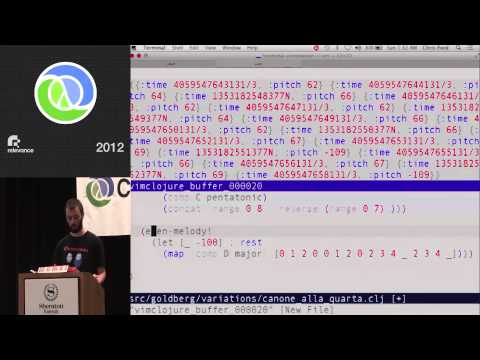
Functional Composition - Chris Ford
ClojureTV
6 HN recommender · 2013–2023
 6 mo on HN
Intro to Synthesis Part 1 - The Building Blocks of Sound & Synthesis
matrixsynth
3 HN recommender · 2018–2022
 6 mo on HN
The Marvel Symphonic Universe
Every Frame a Painting
6 HN recommender · 2017–2026
 6 mo on HN
Notation Must Die: The Battle For How We Read Music
Tantacrul
6 HN recommender · 2023–2026
 5 mo on HN
DOOM: Behind the Music
GDC Festival of Gaming
4 HN recommender · 2017–2023
 5 mo on HN
ORCA Sequencer Intro (Experimental Livecoding!)
Allieway Audio
4 HN recommender · 2019–2025
 5 mo on HN
How I Designed a Free Music Font for 5 Million Musicians (MuseScore 3.6)
Tantacrul
5 HN recommender · 2021–2024
 4 mo on HN
K Lars Lohn - Keynote - PyCon 2016
PyCon 2016
4 HN recommender · 2016–2021
4 comments from Hacker News
I can help with a couple of these. 12 notes is a kludge, because powers of 2^(1/12) well approximate simple ratios. These simple ratios (such as 3:2) sound good. I like this video for explanation: ▶ this video Also, the reason that the letters are in the wrong order is that we're playing the wrong scale. The monks who invented the scale usually sang in A-minor (so we use the first letter for that scale). Nowadays, we use the major scale, which has the same spacing between notes, but in a different order. It just so happens that C-major has the same notes as A-minor, so that's why we count from C. A great channel for this is Michael New, he explains everything very clearly: link Music, much like language, has a lot of technical debt.
minutephysics had a nice video about the mathematics that go behind piano tuning too. "Why It's Impossible to Tune a Piano" ▶ this video
A related video on the numbers behind piano music, on why it is mathematically impossible to perfectly tune a piano : ▶ this video
To +1 the "no objective foundation": browse music theory research a bit! There's a ton of caveats and poor-sounding fits and whatnot for literally every approach, and there's endless discussion of it. E.g. have a MinutePhysics take on how the common 12 note western scale falls apart: ▶ this video And that's before even getting into completely alternate approaches, or how strongly harmonics affect perception: link or link (maybe to clarify: there are objective aspects , in that sound is measurable. but there is nothing like a "grand unified theory" that covers all music, nor are roughly any of the popular ones internally consistent - it's far, far too varied for that, and physics often doesn't allow the desired consistency, causing more variety)