Sand Flea Jumping Robot
Boston Dynamics2 HN recommenders · recommended in 2 months, 2013–2024
demo · general · evergreen · 2013–2024 on HN
A short Boston Dynamics clip of the Sand Flea, an 11-pound RC-car-style robot that can jump about 30 feet into the air. An onboard stabilization system keeps it oriented in flight and for landings.
Brought up as a favorite and as an inspiration for small, cheap jumping robots for obstacle crossing and planetary exploration.
Up next
 11 mo on HN
What Happened to Horses Is Happening to Us
CGP Grey
11 HN recommender · 2014–2026
 6 mo on HN
Zipline - How Rwanda Built A Drone Delivery Service
Real Engineering
9 HN recommender · 2019–2023
 5 mo on HN
Amazing Invention- This Drone Will Change Everything
Mark Rober
5 HN recommender · 2023–2024
 4 mo on HN
7 Minutes of Terror: The Challenges of Getting to Mars
NASA Jet Propulsion Laboratory
5 HN recommender · 2016–2021
 4 mo on HN
Slaughterbots
Stop Autonomous Weapons
4 HN recommender · 2018–2026
 4 mo on HN
Drone Delivery Was Supposed to be the Future. What Went Wrong?
Wendover Productions
4 HN recommender · 2022–2023
 3 mo on HN
Giant Robot Project, Part 1
Jaimie Stuff
3 HN recommender · 2011–2020
 4 mo on HN
Sci-Fi Short Film “Slaughterbots” | DUST
DUST
5 HN recommender · 2021–2026
 4 mo on HN
The Fastest Maze-Solving Competition On Earth
Veritasium
5 HN recommender · 2023–2024
 3 mo on HN
7 Minutes of Terror: Curiosity Rover's Risky Mars Landing | Video
VideoFromSpace
3 HN recommender · 2017–2021
 4 mo on HN
Festo - SmartBird
Festo
4 HN recommender · 2011–2021
 3 mo on HN
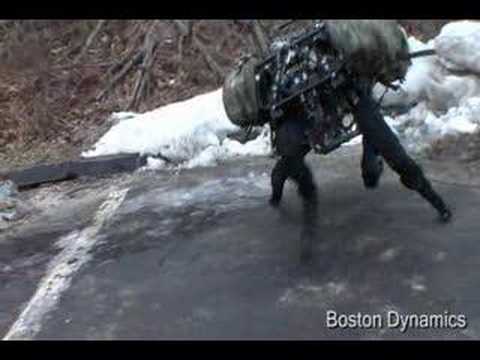
Boston Dynamics Big Dog (new video March 2008)
olinerd
3 HN recommender · 2008–2019
10 comments from Hacker News
Have you seen the robots they developed? Reducing it to "moving from point A to B" is misleading, in my opinion, even if technically true. They essentially developed machines that could move in difficult terrains, often where humans themselves couldn't. My favorite is the Sand Flea, a small car which can jump 9 meters (30-feet) into the air: ▶ this video
Aha, Boston Dynamics has such wild repertoire of robots. Well done. Forget Big Dog, I like this robot a lot: ▶ this video Maps, Self-Driving car, robots and a high quality analytics team. On top of that, robotic team comprises of various reputed groups with talented well regarded individuals. I look forward to the future. Also, how much disparity will arise in quality of living between North America and various Asian countries, or even Europe.
I'm not sure about that specifically, I've only taken an intro to orbital mechanics class so esoteric orbital maneuvers are a bit beyond me but I understand that in some cases it is possible. I would imagine that one technique that we have yet to try is putting fuel depots in long distance places to facilitate the execution of these manuevers. With that said what I had in mind when I wrote my comment wasn't using one rocket to launch a 100 probes to different solar bodies but instead to launch 100 probes to a single body in one go. I envision a time where we'll deploy massive constellations of remote sensing satellites, like mini-star link constellations for each solar body be it a moon or planet so that we can get real-time data across the whole body instead of having to stitch together pieces of data from one probe. Like Starlink these constellations will be able to relay data between the nodes should they lose line of sight with Earth and will be able to relay data to other constellations orbiting other nearby solar bodies to get the data to Earth if the whole constellation is blocked.[0] I could see a near future where we start sending these Starlink like communications/remote sensing craft at the same time we send craft designed to pepper the surface of a body with multiple rovers and stationary probes to survey the surface of planets and again relay the data they collect between themselves and the constellations above. It would be cool to see terrestrial bodies explored
I had similar thoughts when I saw the flea robot from Boston Dynamics.[0] Imagine exploring mars with a combination of a dozen or so flea type robots that have solar panels on them and a robot arm for sample retrieval that can fold up into the body. They can trundle around the surface taking video and picking up samples as desired and then return to the stationary lander that they came from when needed. The stationary lander can have all of the sample analysis machinery, seismograph, weather station, as well as a high bandwidth uplink to satellites in orbit / Earth. Keep landing more and more of these within the the same area so that the fleas can travel between the stationary landers as they travel further and further, heck you can even form a mesh network between all of the machines on the ground, and offload a lot of heavy computational processing to the stationary landers that could be powered by an RTG. You can risk individual fleas doing dangerous things that you otherwise wouldn't want to risk one large all in one lander on, as losing a flea only degrades a small fraction of your research and if fleas get stuck somewhere another flea can attempt to rescue it. You could even have the fleas return home to overwinter if they're not designed to withstand the winter. There's so much versatility that you gain in a model like this with small disposable rover robots paired with massive stationary landers. [0] ▶ this video
Here's a Boston Dynamics one that is less than a foot long, 11 pounds, and can jump 30 feet (easily from ground to roof of one story building) ▶ this video
Boston Dynamics tackled this problem with the SandFlea robot ca. 2010, albeit in a single axis while exploiting the intermediate axis theorem. You can see it in action @ 0:17 in their sole released video[1], where the robot snaps flat during the ascent phase. This was done primarily to increase the likelihood that the vehicle would land on all four wheels, in order to maximize energy dissipation by the wheels on landing and thus minimize shock seen by the body. As a secondary benefit, footage from the onboard camera stood a chance to be usable during a hop, instead of being a blurry mess. Lots of great details in their patent filing for the robot[2]. Source: I helped design this robot [1]: ▶ this video [2]: link
So if it falls on its side, something that has a probably a 50% chance of happening, can it get back up? I always thought that for exploring another planet, you shouldn't really use something with wheels or wings. Something different like small "jumping robots" would make a lot more sense in a place where you have literally the ability to do 0-hardware maintenance. Instead of a single expensive flying robot, why not send a fleet of these little small jumping-robots instead, to more quickly and cheaply explore the area: ▶ this video
A slightly larger version of Sand Flea seems like a better fit. Disposable, can be deployed relatively cheaply in large quantities, with good camo nearly invisible on the ground, can scale obstacles by jumping. Could be made to carry a fragmentation payload and/or spy gear. ▶ this video
Yes, a robot that can jump on top of a building in 1 jump sounds more useful to me, something like this one: ▶ this video .
How is it practical? It's a beautiful design, but far simpler designs can run circles around it in every scenario I can imagine. A small version might make for a fun desk toy. When I think practical, I think Boston Dynamics. link ▶ this video