Quantum Computing for Computer Scientists
Microsoft Research12 HN recommenders · recommended in 13 months, 2018–2025
talk · intro · evergreen · 2018–2025 on HN
An 88-minute Microsoft Research talk that explains how quantum computers beat classical ones using basic linear algebra, qubits, superposition and gates. It works through the Deutsch oracle problem and ends with entanglement, teleportation and a live demo.
It is HN's most frequently recommended starting point for quantum computing because it avoids pop-science hand-waving and needs only basic linear algebra.
Up next
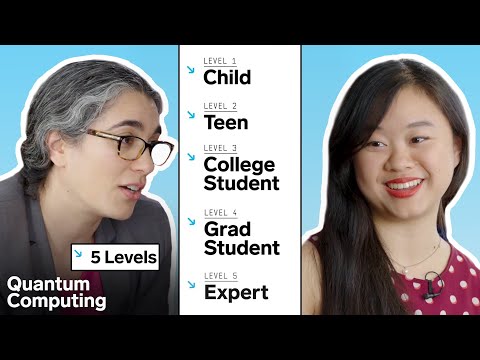 2 mo on HN
Quantum Computing Expert Explains One Concept in 5 Levels of Difficulty | WIRED
WIRED
2 HN recommender · 2019–2021
 6 mo on HN
Paxos lecture (Raft user study)
Diego Ongaro
6 HN recommender · 2013–2024
 3 mo on HN
Slavoj Žižek on "They Live" (The Pervert's Guide to Ideology)
Christian G
3 HN recommender · 2020–2026
 4 mo on HN
The Mathematics of Quantum Computers | Infinite Series
PBS Infinite Series
4 HN recommender · 2017–2023
 2 mo on HN
Solaris | SCIENCE FICTION | FULL MOVIE | directed by Tarkovsky
Mosfilm
2 HN recommender · 2022–2025
 3 mo on HN
Do Events Inside Black Holes Happen?
PBS Space Time
5 HN recommender · 2016–2021
 3 mo on HN
Why guitarists USED TO play more in tune! (Microtonal Frets)
Brandon Acker
3 HN recommender · 2022–2026
 3 mo on HN
35C3 - The year in post-quantum crypto
media.ccc.de
3 HN recommender · 2019–2019
 3 mo on HN
How Quantum Computers Break Encryption | Shor's Algorithm Explained
minutephysics
3 HN recommender · 2019–2023
 3 mo on HN
Hacking at Quantum Speed with Shor's Algorithm | Infinite Series
PBS Infinite Series
3 HN recommender · 2018–2019
 2 mo on HN
Quantum Expert Insight: Peter Shor
Qiskit
2 HN recommender · 2021–2024
 2 mo on HN
Lisp at the Frontier of Computation, by Robert Smith at Rigetti Computing
Arthur Gleckler
3 HN recommender · 2017–2019
12 comments from Hacker News
▶ this video This video is the simplest explanation that I have found for Quantum Computing which doesn't do the whole pop-sciency "is both zero and one at the same time" nonsense.
The Quantum Computing for Computer Scientists video by Microsoft Research ( ▶ this video ) really hammered it home for me. It goes slowly and the presenter, in his own words "shuts up and does the math".
This talk [1] helped me at the start. The only prerequisite is knowing basic linear algebra. Now, if you're interested in how quantum computers operate, well good luck. That's a whole other beast. [1] ▶ this video
Start here: ▶ this video You don't need to know quantum theory necessarily, but you will need to know some maths. Specifically linear algebra. There are a few youtube courses on linear algebra For a casual set of video: - link For a more formal approach: - link And the corresponding open courseware - link Linear algebra done right comes highly recommended - link
MSR has a very clear and accessible tutorial on quantum computing for anyone interested in getting up to speed with the fundamentals: ▶ this video .
> what is programming a quantum computer like? You compose a series of gates that manipulate the state qbits to perform calculation. My understanding is that these gates can be abstracted in a somewhat familiar programming language environment. I've got a very rudimentary understanding, my crude summary would be: it's basically applied linear algebra, leveraging the properties of superposition to perform some types of computations more efficiently. Namely, reducing some search spaces to sqrt n. This video is a good hands on intro: ▶ this video
The shortest possible answer is that qubit states are modeled as two-dimensional vectors on the complex unit sphere. We arbitrarily designate two orthonormal vectors on this sphere as corresponding to classical states 0 and 1. If the qubit vector isn't in the 0 or 1 state, it's in some linear combination of them. This is called superposition. Since most people don't know what linear combination means, superposition is explained as "sort of both at the same time". Upon measurement the qubits are collapsed to 0 or 1 with some probability proportional to how close they are to the 0 and 1 states. The precise probabilities are given by something called the Born rule. I gave a longer talk aimed at computer scientists if you're interested beyond this explanation: ▶ this video
The videos by Microsoft Research[1] and PBS[2] are perhaps the most accessible and yet accurate explanations of quantum computing I have found so far. [1] ▶ this video [2] link
For those who are interested, this lecture was sent to me as an overview of quantum computation for people like me: people who know how to code and know some basic linear algebra. It goes deeper than the pop-sci articles about "doing all combinations at once" but remains accessible and by the end you understand entanglement and can read some Q# code. ▶ this video
I think this talk is an excellent 'foot in the door' intro. Should provide a solid foundation, and plenty of insider jargon to follow up on! ▶ this video
There is absolutely no way to understand quantum mechanics without learning the math. All metaphors are faulty and will lead you to incorrect conclusions. Fortunately the advent of quantum computing has made the math quite easy - it's just linear algebra of the type one would pick up within the first week of an undergraduate course. I made a video aimed at computer scientists which you might find useful: ▶ this video
Here is a long-ish video that explains quantum computers without using pop-science hand-wavy terminology ▶ this video