Hacking at Quantum Speed with Shor's Algorithm | Infinite Series
PBS Infinite Series3 HN recommenders · recommended in 3 months, 2018–2019
explainer · intermediate · evergreen · 2018–2019 on HN
PBS Infinite Series explains how Shor's algorithm lets a quantum computer break RSA encryption, building on earlier episodes about cryptography and the math of quantum computers. It works through the idea step by step.
HN recommends it as a clear, worked explanation of Shor's algorithm for building intuition.
Up next
 4 mo on HN
The Mathematics of Quantum Computers | Infinite Series
PBS Infinite Series
4 HN recommender · 2017–2023
 4 mo on HN
But what are Hamming codes? The origin of error correction
3Blue1Brown
4 HN recommender · 2020–2023
 1 mo on HN
Keynote by John Carmack at Oculus Connect 2014
kungfl
1 HN recommend · 2014–2016
 3 mo on HN
Susan Crawford on Captive Audience: The Telecom Industry & Monopoly Power in the New Gilded Age
Berkman Klein Center for Internet & Society
3 HN recommender · 2013–2014
 3 mo on HN
The effects of DBS on the motor symptoms of Parkinson's Disease
Andrew Johnson
5 HN recommender · 2013–2016
 3 mo on HN
Pranks Destroy Scam Callers- GlitterBomb Payback
Mark Rober
3 HN recommender · 2022–2024
 3 mo on HN
Tesla Autonomy Day
Tesla
3 HN recommender · 2019–2024
 11 mo on HN
Bret Victor - Inventing on Principle
Rui Oliveira
12 HN recommender · 2013–2025
 13 mo on HN
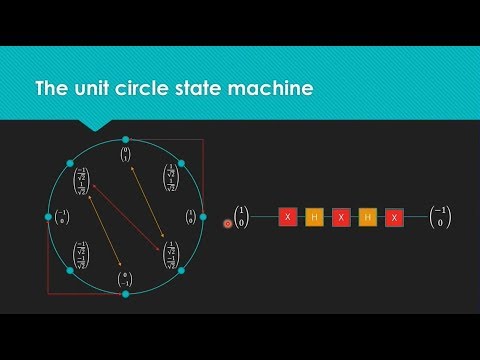
Quantum Computing for Computer Scientists
Microsoft Research
12 HN recommender · 2018–2025
 3 mo on HN
35C3 - The year in post-quantum crypto
media.ccc.de
3 HN recommender · 2019–2019
 3 mo on HN
How Quantum Computers Break Encryption | Shor's Algorithm Explained
minutephysics
3 HN recommender · 2019–2023
 2 mo on HN
Quantum Expert Insight: Peter Shor
Qiskit
2 HN recommender · 2021–2024
4 comments from Hacker News
I'd recommend Charles Petzold's Code: link Which does a great job building up computing from bits all the way to a adders, CPUs, and assembly language (with the historical background around it too). I think the easiest way to get an idea for Quantum Computing and what the difference is comes from watching a specific example, I thought this example of Shor's algorithm was pretty good: ▶ this video
It's not that they can execute a computation faster in the traditional sense. It is that you can exploit the quantum behaviour in some types of computation (e.g. factoring primes) to make the answer more probable, and thus more likely to be "observed", when you read the state of the quantum computer and thus make it easy to locate the correct answer compared to traditional algorithms. PBS Infinite Series has several videos on quantum computing and Shor's algorithm: 1. link "The Mathematics of Quantum Computers" 2. link "How to Break Cryptography" 3. ▶ this video "Hacking at Quantum Speed with Shor's Algorthm"
You should check out these videos, one of them might give you an understanding! - link | Quantum Computers Explained - link | The Mathematics of Quantum Computers - ▶ this video | Hacking at Quantum Speed with Shor's Algorithm - link | A series by the author of the standard textbook These are videos I particularly like!
A note for the savvy: A quantum computer is not a magic bit-string that mysteriously flips to the correct answer. A n-qubit quantum computer is not like 2^n phantom computers running at the same time in some quantum superposition phantom-zone. That's the popular misconception, but it's effectively ignorant techno-woo. Here's what really happens. If you have a string of n-qubits, when you measure them, they might end up randomly in of of the 2^n possible configurations. However, if you apply some operations to your string of n-qubits using quantum gates, you can usefully bias their wave equations, such that the probabilities of certain configurations are much more likely to appear. (You can't have too many of these operations, however, as that runs the risk of decoherence .) Hopefully, you can do this in such a way, that the biased configurations are the answer to a problem you want to solve. So then, if you have a quantum computer in such a setup, you can run it a bunch of times, and if everything goes well after enough iterations, you will be able to notice a bias towards certain configurations of the string of bits. If you can do this often enough to get statistical significance, then you can be pretty confident you've found your answers. link ▶ this video EDIT: I rather like Issac Arthur, but unfortunately, his Quantum Computing episode is an example of exactly this kind of popular misconception. I've called him out on it in comments. link EDIT: I can't find my comment anym