Mountain West Ruby 2012 Capability vs. Suitability by Gary Bernhardt
Confreaks2 HN recommenders · recommended in 2 months, 2015–2023
talk · intermediate · evergreen · 2015–2023 on HN
Gary Bernhardt argues that software history moves in reactions to earlier tools, and that new tools are not simply better in every way. He distinguishes capability (what a tool allows) from suitability (what it fits), and warns against repeating past mistaken…
HN commenters reuse the capability-versus-suitability framing to discuss languages, restriction versus freedom, and tool design.
Up next
 18 mo on HN
Ruby Conf 12 - Y Not- Adventures in Functional Programming by Jim Weirich
Confreaks
17 HN recommender · 2013–2026
 6 mo on HN
Monktoberfest 2016: Bryan Cantrill - Oral Tradition in Software Engineering
RedMonk Tech Events
6 HN recommender · 2016–2026
 15 mo on HN
RailsConf 2014 - All the Little Things by Sandi Metz
Confreaks
15 HN recommender · 2015–2025
 14 mo on HN
"Simple Made Easy" - Rich Hickey (2011)
Strange Loop Conference
14 HN recommender · 2022–2026
 13 mo on HN
"Making Impossible States Impossible" by Richard Feldman
elm-conf
9 HN recommender · 2017–2026
 12 mo on HN
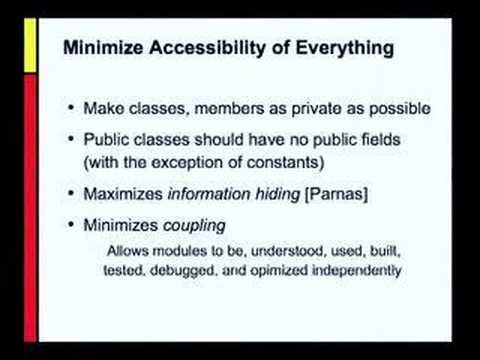
How To Design A Good API and Why it Matters
Google TechTalks
12 HN recommender · 2011–2025
 11 mo on HN
The Value of Values with Rich Hickey
InfoQ
10 HN recommender · 2014–2023
 10 mo on HN
Overwatch Gameplay Architecture and Netcode
GDC Festival of Gaming
16 HN recommender · 2019–2025
 11 mo on HN
Solving Problems the Clojure Way - Rafal Dittwald
Clojure/north
10 HN recommender · 2019–2025
 10 mo on HN
Lecture 1A: Overview and Introduction to Lisp
MIT OpenCourseWare
10 HN recommender · 2019–2026
 11 mo on HN
Alan Kay - Normal Considered Harmful
powerfuloutlet
10 HN recommender · 2012–2026
 10 mo on HN
A Philosophy of Software Design | John Ousterhout | Talks at Google
Talks at Google
11 HN recommender · 2018–2026
4 comments from Hacker News
There was this talk ("Capability vs Sustainability") from 2012: ▶ this video Very nearly exactly what you're describing; not sure if it's the same thing you were thinking of, or just part of a similar thought-wave at the time.
See also the Gary Bernhardt talk, Capability vs. Suitability: ▶ this video Some technologies are radical new developments designed to give people some new capability they never had before. Other technologies are refinements of some previous capability technology, restricting the capabilities but more suitable for some particular problem-space or setting. It's not necessarily "nobody has big ideas anymore", it's just a natural cycle. On the other hand, if you want a less-charitable view, consider this: programming in the 1980s was dominated by ideas from C, a language developed in the 1970s. Programming in the 1990s brought the influence of Smalltalk, a language developed in the 1970s. The 2000s saw the introduction of functional programming ideas from Lisp, a language developed in the 1970s. These days, the hot new programming language features are being taken from Standard ML, a language developed in the 1970s. Someday the 1970s will be mined out, and then we can start coming up with new ideas again.
This really comes back to the Capability vs. Suitability model that Gary Bernhardt has spoken about: ▶ this video IRC is capable. It is a box of nuts and bolts that lets us communicate and build awesome bots and so on. Bloating the protocol gives us suitability: features that are robust and can federate.
Using Elm, even a little bit, has given me a perspective on what a different language can do in the browser. If you subscribe to Gary Benhardt’s Capability/Suitability theory of programming history [1], JavaScript is the highly capable technology that can be used for any sort of architecture you can imagine, and Elm is a turn towards suitability that says, “some of those architectures are unsound or have a very low floor for quality.” You might want to abstract over DOM APIs for different reasons, but at their semantic core they are fine. [1] ▶ this video