How not to be ignorant about the world | Hans and Ola Rosling
TEDRecommended by 5 HN commenters across 6 months, 2015–2023
talk · general · evergreen · 2015–2023 on HN
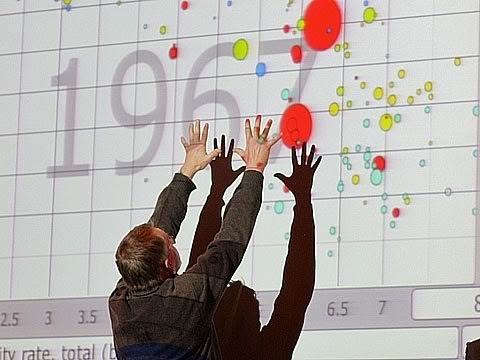
Hans Rosling and his son Ola run an audience quiz with global population, health and income data to show how wrong most people are about the world. Ola then gives four ways to get less ignorant.
Recommended as evidence that the world is improving despite negative news, and for how people misjudge global trends.
Up next
 4 mo on HN
The Zipf Mystery
Vsauce
Recommended 4× on HN · 2018–2024
 2 mo on HN
China's Bicycle sharing WENT INSANE!
serpentza
Recommended 2× on HN · 2017–2018
 2 mo on HN
Testing if 60 minutes of silence drives you crazy
Veritasium
Recommended 2× on HN · 2014–2019
 1 mo on HN
Master Hands - Chevrolet Manufacturing (1936)
US Auto Industry
Recommended 1× on HN · 2015–2019
 14 mo on HN
A Better Default Colormap for Matplotlib | SciPy 2015 | Nathaniel Smith and Stéfan van der Walt
Enthought
Recommended 15× on HN · 2015–2026
 12 mo on HN
Hans Rosling's 200 Countries, 200 Years, 4 Minutes - The Joy of Stats - BBC
BBC
Recommended 10× on HN · 2010–2023
 11 mo on HN
DON'T PANIC — Hans Rosling showing the facts about population
Gapminder Foundation
Recommended 8× on HN · 2017–2021
 8 mo on HN
Wealth Inequality in America
politizane
Recommended 8× on HN · 2013–2025
 7 mo on HN
Animations of unseeable biology | Drew Berry | TED
TED
Recommended 7× on HN · 2017–2025
 7 mo on HN
Immigration, World Poverty and Gumballs
NumbersUSA
Recommended 7× on HN · 2013–2024
 5 mo on HN
The best stats you've ever seen | Hans Rosling
TED
Recommended 5× on HN · 2013–2026
 5 mo on HN
4 2 1 Christopher Domas The future of RE Dynamic Binary Visualization
Adrian Crenshaw
Recommended 7× on HN · 2013–2026
8 comments from Hacker News
I'm not sure if capitalism deserves the credit or not, but you are completely correct when you say that life is much, much better now than it was even in the recent past. To those who doubt this: Please watch Hans Rosling's talk first, which I will link below. I promise it is not a waste of your time. ▶ this video
Not the person you were responding to, but I learned it from this TED talk: ▶ this video (Not joking in the least. It's a very good presentation. Title is: How not to be ignorant about the world | Hans and Ola Rosling)
You really should watch this Hans Rosling's TED talk: ▶ this video It's not misleading. Malnutrition is going down, lack of education is going down, lack of access to healthcare is going down. The more you read the Guardian, the more you have misconceptions about how bad the world is developing.
Can you provide some sources? Last time I looked into statistics on these topics I found the opposite to be true. The brothers Rosling have a nice talk about how all the big stats are improving globally (gender equality, education, health, extreme poverty, life expectation) ▶ this video
Hans Rosling had a talk about this topic[1] 6 years ago, albeit less about "mean" and more about how "bad" the world was, and more importantly, how bad people thought the world was compared to how it actually is. Not too surprisingly, even media and journalists scored worse than random guessing. So it's hard to point fingers to the viewer getting wrong impression of the world when the information senders themselves can't measure it (or send it) correctly [1] ▶ this video
The "How not to be ignorant about the world" ( ▶ this video ) TED talk by Hans (Rest In Peace) and Ola Rosling covers this topic well. Objectively the world is improving for humanity, however in the West and in "developed" nations it's harder to feel like things are going well.
The core message I found from this article was that, to be a valuable participant on the discussion of improvement in society, when it comes to industry, is: based on Chesterton's Fence principle, we need to inform ourselves of the good industrialization have brought us (and accept it), and from there acknowledge their short-comings/side effects so that an proposed solution does not undermine the good that was added by it. This includes pointing out where industrialization is not doing much good (such as fashion and its CO2 emission as someone pointed out) Isn't being pedantic about each bullet point (that obviously can't go in to fine detail because of short summary) kind of ignoring the overall point? Is the core argument such an emotion inducing controversial point that justify almost straw-man-like criticism? edit: I now understand that it seems to be a bit of a politically heated topic. For me, a non-american, I saw similarity in "Industrial Literacy" and what Hans Rosling[1] told us a couple of years ago: "Hey, it is not as bad as you think" [1] ▶ this video
While the parent comment is getting downvotes, probably due to the somewhat accusatory form, the facts behind it are universally true: our civilization is improving. If you took several metrics and weighted them by people's concern, you would see a positive trend [1]. Any "good news" is a statement of the fact, and should be a duh moment to everybody. Granted, we need the "bad news" too, as certain things still need fixing. However living with a negative impression of the world is living in denial. [1] ▶ this video