NeXT vs Sun
hoffman606133 HN recommenders · recommended in 3 months, 2015–2026
demo · intermediate · 2015–2026 on HN
A 1991 NeXT promotional video that stages a head-to-head programming contest between a NeXT computer and a Sun workstation. It shows NeXT's interface builder and object-oriented tooling producing an application far faster than traditional UNIX development.
HN uses it as the canonical example of rapid application development and object-oriented tooling productivity, though many note it is biased marketing.
Up next
 14 mo on HN
Micro Men - 720p (2009)
gimpymoo
15 HN recommender · 2015–2026
 3 mo on HN
Self and Self: Whys and Wherefores
Stanford
3 HN recommender · 2010–2025
 15 mo on HN
RailsConf 2014 - All the Little Things by Sandi Metz
Confreaks
15 HN recommender · 2015–2025
 14 mo on HN
"Simple Made Easy" - Rich Hickey (2011)
Strange Loop Conference
14 HN recommender · 2022–2026
 13 mo on HN
"Making Impossible States Impossible" by Richard Feldman
elm-conf
9 HN recommender · 2017–2026
 12 mo on HN
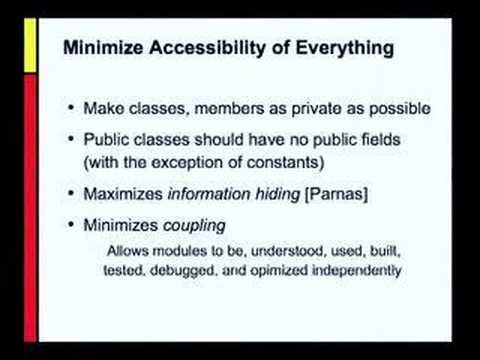
How To Design A Good API and Why it Matters
Google TechTalks
12 HN recommender · 2011–2025
 11 mo on HN
The Value of Values with Rich Hickey
InfoQ
10 HN recommender · 2014–2023
 10 mo on HN
Overwatch Gameplay Architecture and Netcode
GDC Festival of Gaming
16 HN recommender · 2019–2025
 11 mo on HN
Solving Problems the Clojure Way - Rafal Dittwald
Clojure/north
10 HN recommender · 2019–2025
 10 mo on HN
Lecture 1A: Overview and Introduction to Lisp
MIT OpenCourseWare
10 HN recommender · 2019–2026
 11 mo on HN
Alan Kay - Normal Considered Harmful
powerfuloutlet
10 HN recommender · 2012–2026
 10 mo on HN
A Philosophy of Software Design | John Ousterhout | Talks at Google
Talks at Google
11 HN recommender · 2018–2026
12 comments from Hacker News
So very much this. I think programming languages are also long overdue for some controlled trials. They can't be blinded: any experimental subject bright enough to learn to program is probably going to know what language they are programming in. But trials comparing the effectiveness of different languages. How long they take to attain a specified level of proficiency, how long to learn enough to produce working code, and importantly, readability: for instance, how long it takes to find intentionally-planted bugs in existing, unfamiliar code. NeXT did this, way back in the 1980s, and Sun lost badly: ▶ this video There is a writeup of some of it here: link But speaking as a non-video-liker, this 17min one is worth it.
There's a fun bit of marketing [0] NeXT did when AppKit was the new thing, comparing building a reasonably non-trivial application with it to a Sun workstation using C. Obviously biased, but still an interesting look into the development environment that among other things brought us the Web and DOOM. 0. ▶ this video
Started programming in 1982. Object oriented programming was a huge advance - especially in developer productivity. A side effect was the dramatic improvement in developer tools: gui builders, IDEs, etc all improved dramatically. Probably the watershed moment for OO was this NeXT video that showed the difference: ▶ this video
Many of those features were already available in MS-DOS and Windows 3.x IDEs from Borland for Turbo Pascal and C++. Which is why when I got into UNIX development felt like going into the stone age of development tools, thankfully XEmacs was already there. Which by the way, it was born for Energize C++, in 1993! link Also here is what NeXTSTEP development environment looked like, used for Quake tooling development, in a 1991 marketing video. ▶ this video Which is why, I usually assert I cannot understand the nostalgia of CLI and TUI, being there at the time, and not being able to use some of these systems, due to the amount of money they required.
I don't know how realistic is this video but it was interesting ▶ this video A sun vs next rapid development challenge.
Besides the sibling comment, that was kind of Smalltalk like, in the sense how code navigation and code editing was implemented. You can also get a glimpse of it on the famous NeXT vs Sun commercial. ▶ this video
We should have developer benchmarks for programming languages such as "time to first successful compile", "time to first running copy", "time to find the root cause of a certain bug". Similar to that Sun vs NeXT competition back in the day: ▶ this video Maybe platforms like Leetcode and HackerRank can publish such statistics. I'd find such benchmarks way more interesting than comparisons of milliseconds for solutions to some arbitrary algorithms that we'll never use in real life. I'm not saying they aren't useful, but they aren't interesting.
Still, the Web might have never existed without Objective-C, which is moreso my point. From [0]: > A second phase would almost certainly involve some programming in order to set up a real system at CERN on many machines. An important part of this, discussed below, is the integration of a hypertext system with existing data, so as to provide a universal system, and to achieve critical usefulness at an early stage. > (... and yes, this would provide an excellent project with which to try our new object oriented programming techniques!) TBL March 1989, May 1990 Objective-C had a wonderfully pragmatic approach to OOP, though it remained tied to the systems it was on because of the standard object libraries that enabled it. NeXT promotional materials really liked to showcase its suitedness to rapid application development, whether Jobs himself doing so [1] or in a staged competition with Sun [2] [0] link [1] link [2] ▶ this video
Just like the Web supports responsive design and not everyone actually uses it. For Motif I am aware of the one provided with Motif++, now gone from the Web, and the one provided by ICS ( link ). I guess Solaris might have lacked one indeed, given NeXT's commercial. ▶ this video Sun was never good at desktop software anyway, killed NeWS, Swing while powerful requires graphics programming knowledge to make cool UIs and then there was F3 (JavaFX 1.0), and the Java Desktop Framework Integration project went nowhere.
What mattered on A/UX for application developers on Apple platforms was the System APIs layer ported to run on top of X Windows integration. Likewise, anyone doing NeXT development was focused on Objective-C frameworks all the way down to driver kit. As Application developer on a NeXT, the tune was all about WebObjects, Renderman, EOF. Applications like Lotus Improv, Wingz, and those being put out by Omni Group were the meat of the kind of applications that people considered to use NeXTSTEP, not BSD command line utilities. Pretty much patent on commercials like NeXT vs Sun. ▶ this video Or Steve Jobs opinion on UNIX users, link and later when back at Apple link AIX is definitly UNIX, because it isnt' like A/UX, NeXTSTEP, OS X or iOS, where the UNIX layer is there more to bring stuff into the platform, while the main developer stack is something else.
It is a bit hard to explain in an HN comment something that requires live experience, You can start by having a look at, link "Eric Bier Demonstrates Cedar" link "Alto System Project: Dan Ingalls demonstrates Smalltalk" link "SYMBOLICS CONCORDIA ONLINE DOCUMENTATION HYPER TEXT MARKUP 1985" link You can see how NeXT builds on many of these concepts on the famous "NeXT vs Sun" marketing piece, ▶ this video Sun also had some ideas along these lines with NeWS, "NeWS: A Networked and Extensible Window System," link Naturally OS/2, BeOS, Windows, macOS, iOS, and even Android share some of the ideas. Now, before I proceed note that actually modern Linux distributions have all the tooling to make these concepts happen, but it fails short to have everyone agree on a proper stack. So basically, the main idea is to have a proper full stack in place for developing a Workstation computer as one single experience, from bottom all the way to the top. On Xerox's case, they used bytecode with in-CPU execution via programmable microcode loaded on boot, and later on just a thin native glue on top of host OS. The environments had frameworks / modules for the whole OS stack, supported distributed computing, embedded of data structures across applications (OLE can trace its roots back to these ideas), REPLs that not only could interact with the whole OS (commands, modules, running applications), it was also possible to break into the debugger, change the code and redo the failed instructions.
By writing system level macOS software , although I think you mean old style POSIX UNIX stuff. Here is a thing, already with NeXTSTEP, UNIX support wasn't never something worthwhile looking for, NeXTSTEP was used for its Objective-C tooling and frameworks, like Renderman and Improv. The UNIX stuff was just a solution for having a quick ramp up for their OS development, and just like Microsoft with Windows 3.1 NT, to have a tick in the box when selling to the government, Their famous commercial against Sun, hardly touches on UNIX like development. ▶ this video You aren't going to see a CLI on that NeXTSTEP screen. Just like the SDK is all about Objective-C related stuff, even the device drivers were written in Objective-C. link The only fouls here are those that keep giving their money to corporations instead of supporting Linux OEMs, as Microsoft cleverly discovered. In fact, had either A/UX not been discontinued or Microsoft seriously supported their POSIX personality, Linux would never taken off, as the same crowd would be happily using these systems.