Rails Conf 2013 The Magic Tricks of Testing by Sandi Metz
Confreaks5 HN recommenders · recommended in 5 months, 2013–2019
talk · intermediate · evergreen · 2013–2019 on HN
Sandi Metz's RailsConf 2013 talk offers practical guidelines for deciding what to test and how, so tests stay cheap and stable. She argues for testing the public interface rather than implementation and using mocks appropriately.
HN recommends it as an incredible talk whose testing principles apply beyond Ruby.
Up next
 11 mo on HN
"Testing Distributed Systems w/ Deterministic Simulation" by Will Wilson
Strange Loop Conference
12 HN recommender · 2014–2024
 4 mo on HN
How To Make Infrared Cooling Paint (Electricity Free Air Conditioning)
NightHawkInLight
4 HN recommender · 2022–2025
 10 mo on HN
A Tour of the Acme Editor
Russ Cox
11 HN recommender · 2012–2026
 12 mo on HN
8-bit computer update
Ben Eater
14 HN recommender · 2017–2023
 15 mo on HN
RailsConf 2014 - All the Little Things by Sandi Metz
Confreaks
15 HN recommender · 2015–2025
 11 mo on HN
🚀 TDD, Where Did It All Go Wrong (Ian Cooper)
DevTernity Conference
11 HN recommender · 2018–2024
 11 mo on HN
Bret Victor - Inventing on Principle
Rui Oliveira
12 HN recommender · 2013–2025
 11 mo on HN
Solving Problems the Clojure Way - Rafal Dittwald
Clojure/north
10 HN recommender · 2019–2025
 11 mo on HN
Debugging Under Fire: Keep your Head when Systems have Lost their Mind • Bryan Cantrill • GOTO 2017
GOTO Conferences
8 HN recommender · 2018–2025
 10 mo on HN
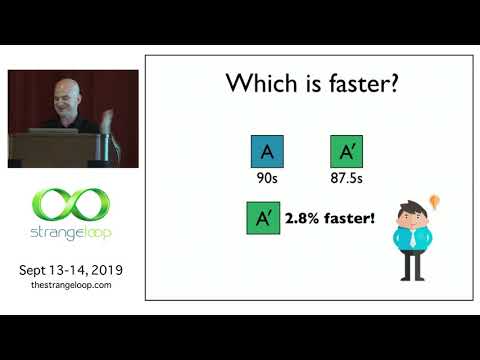
"Performance Matters" by Emery Berger
Strange Loop Conference
12 HN recommender · 2019–2025
 8 mo on HN
Tech Talk: Linus Torvalds on git
Google
9 HN recommender · 2007–2023
 9 mo on HN
"How NOT to Measure Latency" by Gil Tene
Strange Loop Conference
9 HN recommender · 2015–2026
5 comments from Hacker News
What I wish people had told me about testing: * You write tests in accordance with a pattern: 1. Arrange 2. Act 3. Assert 4. Annihilate If you annihilate your test data with configuration options, and you abstract your "arranging" into factories and custom methods, then every test you write should be exactly three lines. When I learned this it gave me a consistent mental framework to think about how to write good tests. * Test the interface not the implementation: This was an eye opening realization about what to test. If you haven't seen it yet, watch Sandi Metz' incredible RailsConf talk - ▶ this video - it's so good * Stubs: Stubs are exactly like the viruses' that we learned about in biology class. You load them up with a value then they literally latch onto a method and inject that value into it. When you're just starting out with testing, effective use of stubs can get you really far, and only when you start hitting the limits of practicality is when you need to think about bringing in something more complicated. * Testing isn't easy per se, but it is definitely enjoyable if you focus on making it that way * Cucumber is pretty stupid, don't waste your time with it
Not always before, but always eventually and usually once I’m done with “exploration”. Testing done right should be a time saver in the long run! I think many people are turned off by testing and especially unit testing because it ends up being difficult and maintenance is more of a pain than it’s worth. There are many good strategies to make it easier that in my experience have yet to be well adopted: ▶ this video link
There are some really fantastic testing resources in the Ruby community. The talk that most influenced my approach to building unit tests (even though I write Go these days) was one of Jim Weirich’s: link I’ve found that his zero-knowledge approach gives me a suite of tests that have high signal when they fail. Sandi Metz has also spoken extensively on testing, and I particularly like her advice on using mocks in tests appropriately. This talk of hers on the subject comes to mind: ▶ this video
I spend about 30% of my time on a new feature writing tests. BTW that is in RoR which the primary language I code in. I would recommend watching this video by Sandi Matz on testing: ▶ this video . I have used this methodology a lot to determine what I should test.
Shout out for Sandi Metz book POODR, and her Railsconf talk The Magic Tricks of Testing, if you're a rubyist (though the principles hold true for non-ruby OO programmers too). ▶ this video