Functional architecture - The pits of success - Mark Seemann
NDC Conferences5 HN recommenders · recommended in 6 months, 2018–2025
talk · intermediate · evergreen · 2018–2025 on HN
Mark Seemann argues that functional programming naturally yields many of the best practices object-oriented developers learn painfully. He shows how functional architecture leads to a pit of success, with a pure core and impure shell.
Recommended as a practical demonstration of how functional thinking improves design without going off the deep end.
Up next
 2 mo on HN
Why Can't AI Make Its Own Discoveries? — With Yann LeCun
Alex Kantrowitz
2 HN recommender · 2025–2026
 15 mo on HN
RailsConf 2014 - All the Little Things by Sandi Metz
Confreaks
15 HN recommender · 2015–2025
 14 mo on HN
"Simple Made Easy" - Rich Hickey (2011)
Strange Loop Conference
14 HN recommender · 2022–2026
 13 mo on HN
"Making Impossible States Impossible" by Richard Feldman
elm-conf
9 HN recommender · 2017–2026
 12 mo on HN
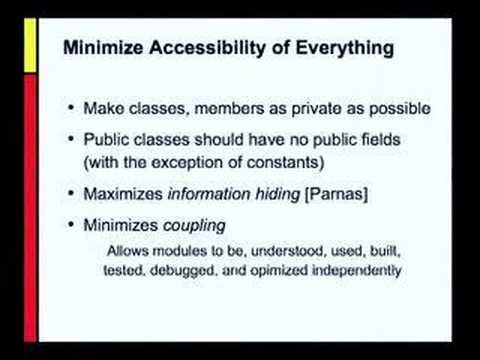
How To Design A Good API and Why it Matters
Google TechTalks
12 HN recommender · 2011–2025
 11 mo on HN
The Value of Values with Rich Hickey
InfoQ
10 HN recommender · 2014–2023
 10 mo on HN
Overwatch Gameplay Architecture and Netcode
GDC Festival of Gaming
16 HN recommender · 2019–2025
 11 mo on HN
Solving Problems the Clojure Way - Rafal Dittwald
Clojure/north
10 HN recommender · 2019–2025
 10 mo on HN
Lecture 1A: Overview and Introduction to Lisp
MIT OpenCourseWare
10 HN recommender · 2019–2026
 11 mo on HN
Alan Kay - Normal Considered Harmful
powerfuloutlet
10 HN recommender · 2012–2026
 10 mo on HN
A Philosophy of Software Design | John Ousterhout | Talks at Google
Talks at Google
11 HN recommender · 2018–2026
 10 mo on HN
"Uncle" Bob Martin - "The Future of Programming"
Paul Stringer's Mobile Tech
10 HN recommender · 2016–2022
10 comments from Hacker News
His videos about functional programming are amazing (Mark Seemann). "Pit of success" is one of the best. ▶ this video
I spend a lot of time thinking about these sorts of topics (actually, I just taught a 4 hour session yesterday that used most of the terms in this article), working with newer, less experienced developers, and trying to figure how to distill the essence of "architecture" down to something simple that everyone can start with. This is what I’ve started telling people: Use mostly functions, try to make most of them pure. I think that can get people (even new devs) 80% of the benefits (testability, composability, loose coupling, and the ability to reason about code) of more complicated, prescriptive architectures (Hexagonal, Onion, Ports & Adapters, Clean, etc) with a minimal amount of ramp up. Of course, this isn't the solution to every problem (it obviously depends on the domain you are working in, for me its webDev and backends), but I think maybe its a good way for people to start. Edit: Here is a great talk demonstrating that by following a simple functional approach, your code can naturally fall into a “pit of success”: ▶ this video
"pit of success" from the previous comment might refer to this video, which is long but good especially to adjust to a different mindset ▶ this video
Mark Seemann has a good talk on this called the "functional pits of success" -> ▶ this video Of all the languages I've used nothing is quite as fun as refactoring an F# app down to nothing. Expressive power is king in F# with the whole .NET ecosystem behind it.
> So while FP is just another tool, it's also a framework for thinking that helps people make better choices I’ve been getting more into functional programming this past year (via Clojure, though my day-job is mostly JavaScript/TypeScript) and this is the big takeaway for me. Type theory and monads may have their place, but thinking about separating logic from side-effects is, I think, the most valuable aspect of functional programming. That is a thought process that you can apply in pretty much any language that will give you the biggest bang for your buck. Edit: Here’s some great examples of the benefits of functional thinking without going off the deep end. 1. Boundaries by Gary Bernhardt - link 2. Pits of Success by Mark Seemann - ▶ this video 3. Grokking Simplicity by Eric Normand - link
The goal is that everything in the core is pure data types and functions. Now, depending on your problem domain, your core can be small or huge compared to the shell. Your question was all about IO/effects. They are impure and belong to the shell. If what you work on does mostly IO then you will have a lot of impure code lying around by definition. Still, the idea is that you should keep the amount of time spent in impure land minimal, ie. drop into pure structures/computation as soon as possible during program execution and only dip out of on occasions when you have to do IO. Here is a good talk about these ideas: ▶ this video
5yrs ago I was roughly the same, depends how much you commit up front. I had minimal FP experience, so I bought "Domain Modeling Made Functional" [1] by Scott Wlaschin and used it for side projects / class libs first. Took about 6 months to experience the full mental shift. Even if you eventually decide you can't commit a team to F#, it's highly worth it because doing at least one app in F# will vastly improve your C# and how you structure applications. [2] I personally just got addicted to the expressive power, it's hard to replicate with any other ecosystem given the full power of .NET under the hood. Giraffe is also a great place to start if you know ASP.NET Core. [3] [1] link [2] ▶ this video [3] link
Yeah, me too. They published quite a lot of papers using it [0]. The datalog integration is pretty nice too, haven't gotten to learning Prolog yet, but seeing how concise a sudoku solver can be implemented in it was an experience. (edit) you can import Java, Kotlin and Scala in it too, those are automatically Impure. Would enable purely functional architecture [1] and falling into the "Pit of success" [2]. [0] link [1] link [2] ▶ this video
good default behavior and how it nudges programmers to favor predictable and composable solutions Agree. Mark Seeman calls these the "Functional pits of success" ▶ this video I think the toughest thing about F# is that it doesn't offer as many Google-able easy solutions, so I'm stuck using it for utility and client libs at work. Trying to get a whole team onboard is a non-starter. It takes a good 6-12 months to adjust the mindset and most people are just looking to come into work, find their tough questions on StackOverflow and head out for the day.
> I don’t have that talent, focus and skill. Same. I'm perfectly happy to fall into the pit of success[1]. 1. ▶ this video