Servo Architecture: Safety and Performance
linux conf au 2017 - Hobart, Australia3 HN recommenders · recommended in 3 months, 2017–2017
talk · intermediate · 2017–2017 on HN
Jack Moffitt presents the architecture of Servo, Mozilla's experimental browser engine written in Rust, focusing on parallelism across cores, GPUs and SIMD and the safety properties gained from Rust.
HN recommends it as an exciting look at how a browser can be rebuilt for performance and safety, including the WebRender ideas that fed into Firefox Quantum.
Up next
 3 mo on HN
Where Do Trees Get Their Mass?
Veritasium
3 HN recommender · 2015–2021
 3 mo on HN
How to Speed up a Python Program 114,000 times.
InfoQ
3 HN recommender · 2015–2022
 3 mo on HN
Email Hates the Living
m
3 HN recommender · 2015–2022
 1 mo on HN
Fastest browser engine by far at 500 FPS! Servo Webrender - CSS on the GPU part 1: Rust
𝓖𝓷𝓸𝓶𝓮💫𝓢𝓪𝓷𝓮
1 HN recommend · 2017–2017
 11 mo on HN
CppCon 2015: Andrei Alexandrescu “std::allocator...”
CppCon
7 HN recommender · 2017–2025
 12 mo on HN
Lexical Scanning in Go - Rob Pike
GoogleFOSSSydney
13 HN recommender · 2012–2025
 10 mo on HN
CppCon 2017: Matt Kulukundis “Designing a Fast, Efficient, Cache-friendly Hash Table, Step by Step”
CppCon
9 HN recommender · 2018–2026
 9 mo on HN
RustConf 2018 - Closing Keynote - Using Rust For Game Development by Catherine West
Rust Programming Language
9 HN recommender · 2018–2023
 10 mo on HN
CppCon 2016: Jason Turner “Rich Code for Tiny Computers: A Simple Commodore 64 Game in C++17”
CppCon
13 HN recommender · 2016–2024
 9 mo on HN
Ideas about a new programming language for games.
Jonathan Blow
7 HN recommender · 2014–2025
 9 mo on HN
CppCon 2014: Mike Acton "Data-Oriented Design and C++"
CppCon
9 HN recommender · 2015–2026
 9 mo on HN
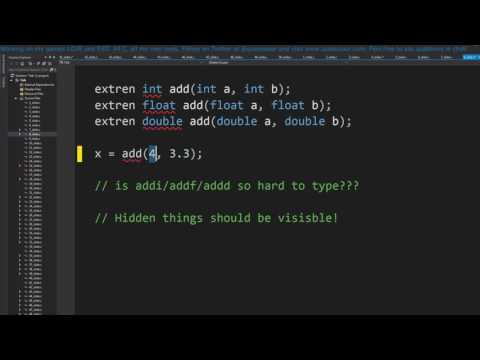
How I program C
Eskil Steenberg
8 HN recommender · 2017–2025
3 comments from Hacker News
There seem to be a lot of people that are saying "oh, without XUL based extensions, Firefox is just a (worse) Chrome clone, so I might as well just use Chrome." I think what they might be missing is that Mozilla's conclusion is a lot like the people seem to be thinking here -- even though Chrome doesn't have the fancy extensions that are possible in Firefox, many many more people are using Chrome than Firefox, because they see it as a better Firefox. Clearly, that has something to do with either security or performance, where Firefox has a perceived lag. Mozilla is actively working to improve performance, and you may not want to switch to Chrome after all, because Chrome may instead be the poor man's Firefox (I personally think this is already the case, simply because with my 679 open tabs, Chrome would simply kill itself [44 loaded]). This video is one of the most exciting I have seen with regards to web browser performance, and it's Mozilla: ▶ this video More info on what this means for Firefox: link TL;DR: What if even with the missing XUL extensions, you wouldn't want to switch to Chrome, because Firefox was just plain faster?
This is a great explanation. I also recommend Metajack's talk on WebRender in Servo: ▶ this video Also go read everything else Lin Clark has done. They're pretty great.
If you have the time there is a nice talk about WebRender: link Here is another great talk: ▶ this video At ~25:30 he'll also talk a bit about Quantum. In a nutshell WebRender is used to send a web page to the GPU which will paint all divs, borders, shadows, images etc. Currently WebRender is the only component I'm aware of that is inside Firefox Nightly. It's still behind a config though.