Super Mario World Ending Theme sight-read by Tom Brier
Keeper1st2 HN recommenders · recommended in 2 months, 2017–2025
music · general · evergreen · 2017–2025 on HN
Pianist Tom Brier sight-reads a piano arrangement of the Super Mario World ending theme, working from a first-draft score by Keeper1st. He takes some liberties with the score as he plays.
HN commenters recommend it as a showcase of remarkable sight-reading and a favorite when sight-reading or notation comes up.
Up next
 2 mo on HN
Illustrating Crafting Interpreters
Bob Nystrom
2 HN recommender · 2020–2024
 6 mo on HN
Containers From Scratch • Liz Rice • GOTO 2018
GOTO Conferences
6 HN recommender · 2018–2025
 1 mo on HN
Resident Evil Village PC DRM: Cracked Code Really Does Run Better - Confirmed
Digital Foundry
1 HN recommend · 2021–2024
 11 mo on HN
Video explains the world's most important 6-sec drum loop
Landon Proctor
15 HN recommender · 2011–2026
 10 mo on HN
Fear the Boom and Bust: Keynes vs. Hayek - The Original Economics Rap Battle!
Radical Discourse
10 HN recommender · 2010–2024
 6 mo on HN
Adriano Celentano - Prisencolinensinainciusol
Le Pietre Rotolanti
6 HN recommender · 2016–2024
 4 mo on HN
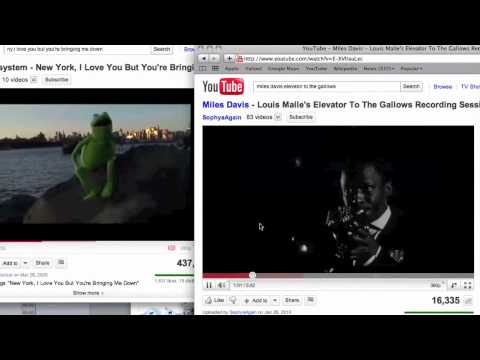
Youtube duet: Miles Davis improvising on LCD Soundsystem
Alessandro Grespan
4 HN recommender · 2021–2024
 5 mo on HN
The Caretaker - Everywhere At The End Of Time - Stages 1-6 (Complete)
vvmtest
5 HN recommender · 2020–2025
 5 mo on HN
Steve Reich, "Music for 18 Musicians" - FULL PERFORMANCE with eighth blackbird
Vic Firth
4 HN recommender · 2016–2025
 5 mo on HN
OK Go - This Too Shall Pass - Rube Goldberg Machine - Official Video
OK Go
5 HN recommender · 2010–2026
 5 mo on HN
MC Frontalot - It Is Pitch Dark
MC Frontalot
5 HN recommender · 2012–2026
 4 mo on HN
Danny Carey | "Pneuma" by Tool (LIVE IN CONCERT)
Vic Firth
3 HN recommender · 2021–2026
4 comments from Hacker News
An amazing morning to rediscover this amazing artist. I remember watching his videos when I was in school, enjoying his interpolation of popular video game ragtime. The last thing I remember hearing is that he was left comatose after a car crash, with poor outlook for his future. Turns out he's still alive and fairly well, which is a huge relief: link If you haven't; treat yourself, and just listen through a mix of his sight-read performances on the internet. He's a rare gem and a treat to the ears. link ▶ this video link link
This reminds me of this excellent video: ▶ this video Can we get this guy to play the Super Mario World ending theme with the notation from TFA?
Akshually... According to Wikipédia FR, the French equivalent of Sight Reading is "Lecture à vue" [1]. Notes: - I'm French; - I learnt to play the piano as a teenager, and I'm trying to get back to it again as at 45+; - I too discovered the "sight reading" term online, but that was long ago (as I recall, through a video of an adult piano player doing "live sight-reading" versions of songs he didn't know beforehand, such as the Mario theme [2]; ... and YET neither have I ever heard of nor used "Lecture à vue" (that I remember of). I too would use "apprendre le solfège" (EN: learn solfège) when saying that I'm learning to read the notes on sheet music while playing at the same time. [1]: link (change language for confirmation) [2]: Possibly this one? ▶ this video
Piano roll style notation systems can be useful, but they're very hard to use for human playback for basically all the reasons jcranmer states. They're originally intended for automatic playback in mechanical systems, and they work well for that, but for humans they waste lots of space on things that aren't terribly useful. They're about 1 level of sophistication above the "Square Notation" on the chart. They've become very popular on digital systems were lots of the expressiveness of the notes doesn't really need to be encoded and the playback is automated. Another popular and very similar system are tracker interfaces [1] which are at a slightly higher level of sophistication than many of the other examples given, but has a similar purpose to piano rolls in terms of automated playback. However, due to robust "effects" columns, can be very expressive in terms of encoding [2]. In this example, all the various pitch bends, volume, vibrato and so on are specifically encoded next to the notes. But it's also almost entirely impossible to read for human playback. Piano roll systems usually offload this kind of encoding to secondary displays and input systems and this further disassociates lots of the information from the note information. [3] Compare to a full score [4] which has - a couple dozen different voices - phrase encoding (important for performance) - timing (4/4 4 beats per musical unit with quarter notes being the unit of tempo) - rests where the instrument isn't being