Quasistatic Cavity Resonance for Ubiquitous Wireless Power Transfer
DisneyResearchHubCited 3× on HN, 2017–2020
demo · intermediate · 2017–2020 on HN
Disney Research's demo of quasistatic cavity resonance, which uses a purpose-built room or cabinet to generate magnetic fields that deliver kilowatts of power wirelessly to mobile receivers inside.
HN cites it as an example of early research into room-scale wireless power transfer.
Up next
 15 mo on HN
AT&T Archives: Similiarities of Wave Behavior (Bonus Edition)
AT&T Tech Channel
12 HN recommender · 2014–2026
 12 mo on HN
8-bit computer update
Ben Eater
14 HN recommender · 2017–2023
 11 mo on HN
“Hello, world” from scratch on a 6502 — Part 1
Ben Eater
11 HN recommender · 2019–2026
 10 mo on HN
Finding the Missing Memristor - R. Stanley Williams
The Qualcomm Institute
12 HN recommender · 2010–2024
 10 mo on HN
[LIVE] How to Achieve Proper Grounding - Rick Hartley - Expert Live Training (US)
Altium
9 HN recommender · 2021–2025
 8 mo on HN
I bought 1000 meters of wire to settle a physics debate
AlphaPhoenix
8 HN recommender · 2021–2026
 6 mo on HN
What your Differential Pairs Wish You Knew with Rick Hartley - AltiumLive Keynote
Altium
5 HN recommender · 2021–2026
 7 mo on HN
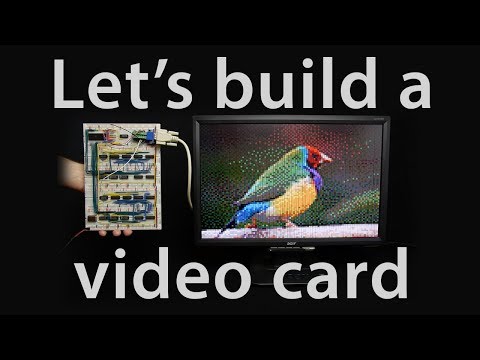
The world's worst video card?
Ben Eater
8 HN recommender · 2019–2024
 6 mo on HN
The Art of Making a Nixie Tube
Dalibor Farný
6 HN recommender · 2017–2026
 6 mo on HN
How does a USB keyboard work?
Ben Eater
7 HN recommender · 2021–2025
 5 mo on HN
Watch electricity hit a fork in the road at half a billion frames per second
AlphaPhoenix
5 HN recommender · 2024–2026
 6 mo on HN
BlueHat IL 2019 - Andrew "bunnie" Huang - Supply Chain Security: "If I were a Nation State...”
Microsoft Israel R&D Center
6 HN recommender · 2019–2024
3 comments from Hacker News
I mean, the issue with cameras on everyone is that they all require small batteries, meaning always recording with them isn't really practical. There is already early-stage research into long-range wireless charging ▶ this video so maybe 15+ years in the future it would be practical to have always-recording devices.
That is doable right now. I am only sort of being glib here. I just want to outline what's involved in what people think is a simple task in a spatial system. TLDR: As of right now, your wildest dreams are pretty possible. In the next 2 years, how we compute is going to get strange. Nothing is nearly as simple in an XR environment as a traditional computing one and currently most people don't really want what they'd ask for. Building a simple (useful) XR app makes launching a web product look like assembling a lego set vs. landing on the moon. --------- Imagenet[0] works just fine for the object identification. You would probably want to use RGBd sensors like the kinect[1] or Intel Realsense[2] instead of regular cameras, but tracking like what the Vive[3] uses could also work. The thing you just proposed would involve a network of server processes handling the spatial data and feeding extracted relevant contextual information to a wireless headset at a pretty crazy rate. Just to give you an idea a SLAM[4] point cloud from a stereo set of cameras or a cloud from a Kinect2 or Realsese produces a stream of data that is about 200mb a second. Google Draco[5] can compress that and help you stream that data at 1/8 the size without any tuning. Extracting skeletal information from that is really something that only Microsoft has reliably managed to deliver and it's at the core of the Kinect/Hololens products. NuiTrack[6] is the next best thing, but registering a human involves a T-Po
If you're having trouble loading the page, here is the direct link to the PDF: link Here are the YouTube videos: ▶ this video link