Why don't subtitles match dubbing?
Tom ScottCited 4× on HN, 2024–2025
explainer · general · evergreen · 2024–2025 on HN
Tom Scott explains why subtitles often differ from dubbed dialogue, covering how translation, timing and reading speed shape each. It features translators and voice talent working in several languages.
Cited in subtitle threads for its explanation of why subtitles are condensed and adapted rather than literal.
Up next
 12 mo on HN
George Lakoff: Moral Politics
University of California Television (UCTV)
3 HN recommender · 2016–2024
 6 mo on HN
Stephen Fry Kinetic Typography - Language
Built By Matt
4 HN recommender · 2012–2025
 6 mo on HN
What Languages Sound Like To Foreigners
Sara Forsberg
6 HN recommender · 2014–2021
 6 mo on HN
Adriano Celentano - Prisencolinensinainciusol
Le Pietre Rotolanti
6 HN recommender · 2016–2024
 5 mo on HN
Irving Finkel | The Ark Before Noah: A Great Adventure
The Institute for the Study of Ancient Cultures
4 HN recommender · 2021–2025
 5 mo on HN
Cracking Ancient Codes: Cuneiform Writing - with Irving Finkel
The Royal Institution
3 HN recommender · 2020–2024
 5 mo on HN
How to learn any language in six months | Chris Lonsdale | TEDxLingnanUniversity
TEDx Talks
5 HN recommender · 2014–2019
 5 mo on HN
The Unanswered Question 1973 1 Musical Phonology Bernstein Norton
cagin
4 HN recommender · 2018–2023
 4 mo on HN
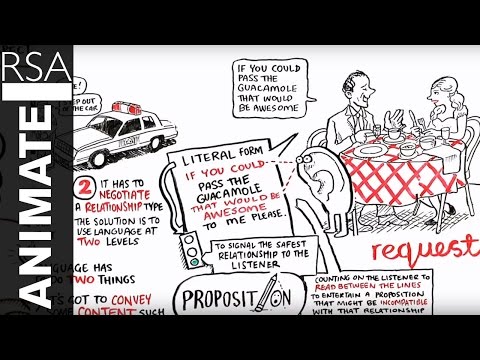
RSA ANIMATE: Language as a Window into Human Nature
Royal Society of Arts
2 HN recommender · 2011–2022
 3 mo on HN
Jorge Luis Borges: This Craft of Verse Lectures - thepostarchive
thepostarchive
3 HN recommender · 2019–2022
 4 mo on HN
The US Has More Tribes Than the World Has Countries
CGP Grey
4 HN recommender · 2020–2026
 4 mo on HN
George Carlin - Euphemisms
poyani
4 HN recommender · 2014–2025
4 comments from Hacker News
I agree there appears to be very little interest in subtitles in Japan from most Japanese people, but it is absolutely not true that Japanese subtitles are as haphazard as you say. The overwhelming majority of official Japanese subtitles I have seen (having studied Japanese for more than 5 years now) are not only word-accurate transcriptions, but also include transcriptions of noises (like あああああ for screams) as well as SDH-like notations for sound effects. Most include furigana for new/uncommon words as well. This has been the case for all anime, dramas, and movies I have watched with subtitles for the past 5 years (too many hours to count). Funnily enough, the complaints you have here actually apply more to English subtitles in my experience. Modern English subtitles tend to accurately transcribe what was said, but if you look at official subtitles from the mid-2000s and earlier you'll see that most subtitles are made much shorter than the original text. Tom Scott's video on subtitling talks about this historical practice and how it is different today[1]. Are you sure that the subtitle services you used are actually using official subtitles, and that they aren't actually translations or from some other source? How old are the shows you're watching (I believe some movies from the 70s I watched were character-accurate but that might not have been as common in the past)? [1]: ▶ this video
well, auto correcting grammar happens in normal subtitles too... "Why don't subtitles match dubbing?" by Tom Scott: ▶ this video
> Turn on the subtitles on any of his videos (particularly when there are multiple speakers) and you'll see the effort that goes in to it. He actually did a video on subtitles recently, "Why don't subtitles match dubbing?": * ▶ this video
> Unless the difference actually contains significantly different meaning and can lead to misunderstanding, I don't see why that'd an issue The following are some of the reasons why it's very desirable that audio and subtitles should match: (1) It's great when you're trying to learn a language or to watch in a language in which you're not fluent. It's extremely frustrating when the audio and subtitles don't match. This point is made by many people in the comments to the video[1]. (2) Even if you're fluent in the language, if you're watching with both audio and subtitles enabled, it's jarring when they don't match. (3) If you didn't understand something in the audio (because of poor pronunciation, poor sound quality, or whatever), and you turn on subtitles to see what was said, you expect to see exactly what was said, not something "similar in meaning". (4) A reason quoted directly from the YouTube comments[1] (which I think is a more common a problem that people realize): As someone with sensory processing issues but technically normal hearing - sometimes understanding what i'm hearing comes with a short delay, and accurate subtitles help bridge that gap so I can still keep pace with what i'm watching! If the subtitles don't match, however, it can COMPLETELY throw me off because of the conflict in information and I end up more confused than if i'd only read the subtitles or only listened to the audio. Accurate subtitles are an accessibility feature! > phrases that are commonl