Epicycles, complex Fourier series and Homer Simpson's orbit
Mathologer1 HN recommender · recommended in 1 month, 2022–2023
explainer · intermediate · evergreen · 2022–2023 on HN
Mathologer explains epicycles and complex Fourier series, inspired by an animation of Homer Simpson drawn with epicycles. It covers the shape of the Moon's orbit around the Sun and how to make your own epicycle drawings.
HN points to it as a visual teaching resource for Fourier series, and as a reference when epicycles come up as analogies.
Up next
 8 mo on HN
Powers of Ten™ (1977)
Eames Office
9 HN recommender · 2012–2025
 5 mo on HN
Cracking Ancient Codes: Cuneiform Writing - with Irving Finkel
The Royal Institution
3 HN recommender · 2020–2024
 4 mo on HN
Times Tables, Mandelbrot and the Heart of Mathematics
Mathologer
4 HN recommender · 2017–2023
 3 mo on HN
Why The World Relies On ASML For Machines That Print Chips
CNBC
4 HN recommender · 2022–2024
 5 mo on HN
Margin Call (2011) - Senior Partners Emergency Meeting [HD 1080p] (Re-Upload / Audio Fixed)
Extractor
5 HN recommender · 2018–2024
 18 mo on HN
Vectors | Chapter 1, Essence of linear algebra
3Blue1Brown
17 HN recommender · 2018–2026
 15 mo on HN
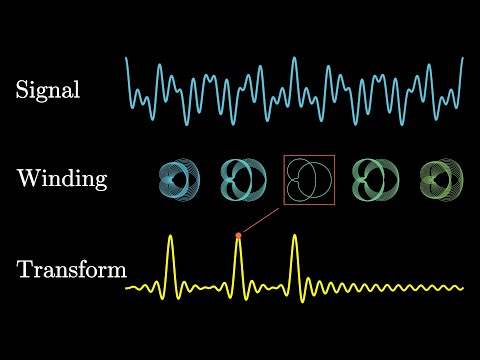
But what is the Fourier Transform? A visual introduction.
3Blue1Brown
16 HN recommender · 2018–2025
 14 mo on HN
But what is a neural network? | Deep learning chapter 1
3Blue1Brown
16 HN recommender · 2017–2025
 13 mo on HN
The Beauty of Bézier Curves
Freya Holmér
16 HN recommender · 2021–2026
 11 mo on HN
The Continuity of Splines
Freya Holmér
10 HN recommender · 2022–2026
 13 mo on HN
Jim Simons (full length interview) - Numberphile
Numberphile2
11 HN recommender · 2015–2024
 11 mo on HN
But how does bitcoin actually work?
3Blue1Brown
15 HN recommender · 2017–2024
3 comments from Hacker News
For an additional video exposition, I also like Eugene Khutoryansky's "Fourier Transform, Fourier Series, and frequency spectrum" link In particular, the visualization of the addition of sine waves of different frequencies in three dimensions is pretty spectacular. It's similar to Mathologer's "Epicycles, complex Fourier series and Homer Simpson's orbit": ▶ this video
> replicate the elaborate machines that engrave currency I think you may refer to a rose engine, which in operation is very close to a dimensional spirograph. A modern variant might be a core-xy open etch-a-sketch using those LCD writing tablets and a set of physical gears and pins that would control the stylus' motion, maybe powered by a folding handcrank like the Panic Playdate. It might even be a tool for teaching the Fourier series. rose engine: link core-xy: link LCD writing tablet: link Panic Playdate: link Teaching Fourier series: ▶ this video Also, projects on Hackaday: link
Falsifying supersymmetry is like falsifying Ptolemaic epicycles. You can never falsify it with data because epicycles can always be constructed to fit any data set [1]. Likewise, a sypersymmetric theory can be constructed to fit any set of parameters. But fitting the data is not enough. You have to fit the data with substantially fewer parameters than data points. That's the challenge. [1] ▶ this video