Atlas, The Next Generation
Boston DynamicsCited 14× on HN, 2016–2026
demo · general · 2016–2026 on HN
Boston Dynamics unveils a new, smaller Atlas humanoid robot that is electrically powered and hydraulically actuated. It balances with body sensors and uses lidar and stereo vision to navigate and manipulate objects.
Used as a benchmark of robotics progress and a go-to example of impressive bipedal walking in AI and automation debates.
Up next
 11 mo on HN
What Happened to Horses Is Happening to Us
CGP Grey
11 HN recommender · 2014–2026
 6 mo on HN
Zipline - How Rwanda Built A Drone Delivery Service
Real Engineering
9 HN recommender · 2019–2023
 5 mo on HN
Amazing Invention- This Drone Will Change Everything
Mark Rober
5 HN recommender · 2023–2024
 4 mo on HN
7 Minutes of Terror: The Challenges of Getting to Mars
NASA Jet Propulsion Laboratory
5 HN recommender · 2016–2021
 4 mo on HN
Slaughterbots
Stop Autonomous Weapons
4 HN recommender · 2018–2026
 4 mo on HN
Drone Delivery Was Supposed to be the Future. What Went Wrong?
Wendover Productions
4 HN recommender · 2022–2023
 3 mo on HN
Giant Robot Project, Part 1
Jaimie Stuff
3 HN recommender · 2011–2020
 4 mo on HN
Sci-Fi Short Film “Slaughterbots” | DUST
DUST
5 HN recommender · 2021–2026
 4 mo on HN
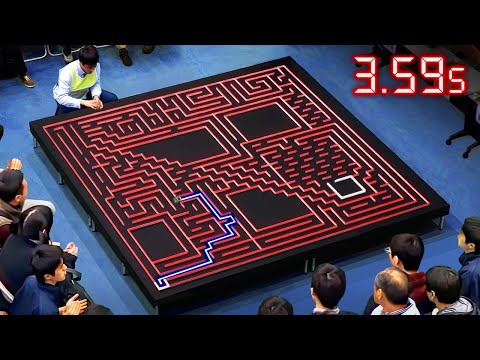
The Fastest Maze-Solving Competition On Earth
Veritasium
5 HN recommender · 2023–2024
 3 mo on HN
7 Minutes of Terror: Curiosity Rover's Risky Mars Landing | Video
VideoFromSpace
3 HN recommender · 2017–2021
 4 mo on HN
Festo - SmartBird
Festo
4 HN recommender · 2011–2021
 3 mo on HN
Boston Dynamics Big Dog (new video March 2008)
olinerd
3 HN recommender · 2008–2019
12 comments from Hacker News
While I agree we'll see millions of bipedal robots, it won't be because they're doing our chores. People will buy them for the same reason I'd want one today: They're fun toys. It's been 10 years since Boston Dynamics released this impressive video of Atlas. ▶ this video Even though today's robots are vastly more sophisticated, the progress of the last decade shows we shouldn't expect a sudden revolution in their abilities over the next ten years. As is often the case, solving those final few challenges that really make a difference always takes the longest.
>It would help a lot more to compare footage with real-world people interacting with the bipedal robot. Maybe I misunderstood your comment but there are definitely videos of people interacting with Atlas (the bipedal robot) to the point that it's a running joke that they'll remember said interactions. See ▶ this video
>>> We know this phenomenon from everyday life. Most of us are experts on walking. However, if we try to articulate how we walk, we certainly give a description that does not capture the skills involved in walking. All the article is based on statements like the previous one. Scientifically is possible to nullify it with a counterargument. [1] Boston dynamics Atlas. ▶ this video [2] Boston dynamics parkour. link QED.
Bipedal walking and running on uneven terrain has been demonstrated years ago - Boston Dynamics has a lot of nice videos; e.g. here's a four year old video on walking ▶ this video , here's two year old videos on running link and link - perhaps it's debatable if it's "full human level" but it seems sufficient to me for most purposes. IMHO any improvements to that would be mostly for sensors (seeing what terrain is there even in poor conditions e.g. fog/rain/snow) and modelling environment (understanding which objects might break or slide if you step on them), not walking/running as such. The main problem for bipedal robots that makes them still impractical is the hardware expense (wheels are simpler and cheaper) and the power supply required, so for most use cases it's more efficient to use something other than a bipedal robot and there's limited business application and future revenue in scaling up research demos of bipedal walking to practicality, so most people who are working on walking algorithms are doing so in simulated virtual environments (where we have algorithms that can learn walking and running "from scratch" through experimentation) and not building very expensive hardware.
> And where are the people proposing rocket designs, in modern AI research? We like people like Geoffrey Hinton as their work produces results - he is the first to admit you can't get there from here. I think it's the people who are concerned with fundamentals, like the people at the Sante Fe Institute - complex adaptive systems. In the beginning we believed in programming AI from the axioms of mathematics - not many people believe that now. A bit like configuring an animal from atoms. Difficult, pointless. The first story is that 'fundamentals' might mean some evolutionary framework being required to plug in results from other areas like computer vision and machine learning, my guess would be something from genetic algorithms. The other story is there exists a 'God Algorithm' that all sapient beings possess - but I find that difficult to believe. Another story is that we simply have to start from the start - literally everything we know is nearly worthless because consciousness is too unlikely with computer hardware - that the entire history of computing is a dead end. Great for human technology but just not the route to a synthetic version of biological beings. I suspect we're more biased against this possibility than we should be. I hope that it is the first story - my rationale is that biological intelligence and consciousness is not as far away as we think it is. If we look to evolution we see these vast periods of time in which nature works on different paths and it's o
Someone sent me this article on IM. My (unedited) response: nothing worse than someone who both doesn't understand wtf he's talking about and is very critical either are ok on their own >> He‘s wrong then? well if either author can provide an article from 10-20 years ago, saying "in 10-20 years, we'll invent a single machine that can reach almost human-level translation proficiency, drive a car in complex environments, beat the best human player at logical games including chess and Go, beat the best human player at language/knowledge based games like Jeopardy, hold a lengthy conversation and answer questions, be able to accurately describe and caption images and video, and outperform humans at trading the stock market and detecting fraud but I won't be impressed because all of those things are simple" then it might have some weight "The dream of artificial intelligence was supposed to be grander than this — to help revolutionize medicine, say, or to produce trustworthy robot helpers for the home." robots: we already have the vacuum cleaners. Actual flexible domestic work is coming soon, the moment the military gets bored and releases some knowledge and/or people have finished making money from helping amazon pack boxes and starts making money from normal people instead: ▶ this video medicine: same machines already being used to detect cancer and heart conditions more accurately than humans, as well as folding proteins to create new medicines. Not sure what more he wants.. "If mach
Your examples have a point in them - To really understand how insects fly, it is helpful to build and analyze various machines that can flap its wings - since aerodynamics is complex and the equations we use to model airplanes don't really work on that scale. To understand how exactly humans walk, it really helps to build a machine that can lift its two feet in alternating motion and analyze how all the minor forces interact to make it work. It's immensely useful when we're building e.g. powered ankle prosthetics, and bipedal movement has some advantages in terrain, so we also want machines to be able to do that (e.g. ▶ this video ) For understanding human eyes - experimenting with lense systems that change focus was how we got to "augmented vision" e.g. humans with spectacles. The same goes for analyzing and understanding how human brains work. It's also valuable to think about minds in general, but for many purposes we care about a particular mind, and all the individuals I currently care about are homo sapiens, not machines; so we need to understand their brains.
The Beam is a wimpy teleoperator. Send the new Atlas, from Boston Dynamics [1], to a conference, and you won't have that problem. People running away in terror might be more of an issue. (It's not clear what will become of Boston Dynamics. Google wants to sell them. DARPA and the Marines gave up on their BigDog as not militarily useful. The technology is impressive, but it cost well over $100 million (mostly DoD funding) and 25 years to get to this point, with no market in sight.) [1] ▶ this video
Man, if we think this self-driving car thing is jarring, I wonder how we'll adjust to the incoming teachable general purpose biped robots... ▶ this video Basically, however fast we think self-driving cars are happening and requiring adjustment, that shift is like we're still on training wheels, compared to the real game-changer. We'd better figure out how to take care of those truckers and taxi-drivers, or it doesn't bode well for our adaptability as a society.
Depending on how you mean 'reasoning, walking robots' then not yet really.. but every few weeks or months another amazing deep learning/NN whatever thing comes out in different domains. So these types of techniques seem to have very broad application. Of course, if you mean 'walking' in a literal sense, there are a number of impressive walking robots such as Atlas ▶ this video , HRP-2 link or HRP 4C link , etc.. Also there are many types of useful reasoning systems. I am guessing you are thinking of language understanding and generation.. but I believe these types of techniques are being applied quite impressively in that area also, from DeepMind or Watson link etc.
Other things called Atlas: HashiCorp's Enterprise Suite - link Stripe's startup tools - link Netflix's Telemetry Platform - link O’Reilly's learning environment - link Boston Dynamics's Robot - link ▶ this video Did I miss any?
So, what's stopping them from making 2.5m high units? Making it small and cute is just a trick to reduce the fear inspired by Boston Dynamics' war bots. I like this bot but I liked the BD bots too, sad to see such a promising company be cut off. Just take a look here, ain't it cute? So human-like (after a few bottles of wine) ▶ this video