The Unix Chainsaw - Gary Bernhardt
timmonta2 HN recommenders · recommended in 2 months, 2016–2022
talk · intermediate · evergreen · 2016–2022 on HN
Gary Bernhardt's Cascadia Ruby Conference 2011 talk on using the Unix shell for practical problem solving. He builds pipelines interactively by iterative refinement, using small tools as levers.
Recommended as a brilliant demonstration of how to think in Unix pipelines.
Up next
 2 mo on HN
Perl 6 for Mere Mortals
Curtis “Ovid” Poe
2 HN recommender · 2015–2015
 1 mo on HN
CANDO: A Compiled Programming Language for Computer-Aided Nanomaterial Design and Optimization
European Lisp Symposium
2 HN recommender · 2016–2019
 2 mo on HN
SymbOS MP3MSX Demostration
karloch
2 HN recommender · 2014–2018
 6 mo on HN
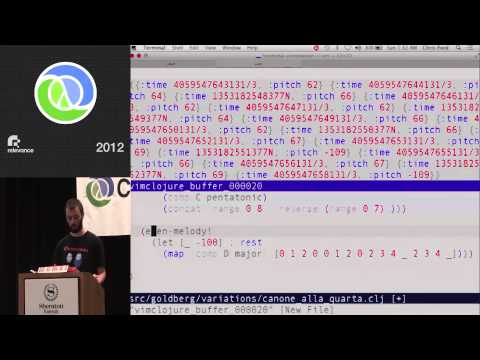
Functional Composition - Chris Ford
ClojureTV
6 HN recommender · 2013–2023
 2 mo on HN
01 The History of Standard ML: Ideas, Principles, Culture
ICFP Video
2 HN recommender · 2016–2022
 5 mo on HN
The mathematics of weight loss | Ruben Meerman | TEDxQUT (edited version)
TEDx Talks
6 HN recommender · 2017–2024
 8 mo on HN
Alan Kay: Doing with Images Makes Symbols (Full Version)
Kenneth Friedman
8 HN recommender · 2016–2023
 2 mo on HN
"Pixie - A Lightweight Lisp with 'Magical' Powers" by Timothy Baldridge
Strange Loop Conference
2 HN recommender · 2016–2017
 15 mo on HN
RailsConf 2014 - All the Little Things by Sandi Metz
Confreaks
15 HN recommender · 2015–2025
 11 mo on HN
"Testing Distributed Systems w/ Deterministic Simulation" by Will Wilson
Strange Loop Conference
12 HN recommender · 2014–2024
 11 mo on HN
🚀 TDD, Where Did It All Go Wrong (Ian Cooper)
DevTernity Conference
11 HN recommender · 2018–2024
 11 mo on HN
Bret Victor - Inventing on Principle
Rui Oliveira
12 HN recommender · 2013–2025
5 comments from Hacker News
Gary Bernhardt[1] gave a great talk about practical problem solving with the unix shell: "The Unix Chainsaw"[2]. "Half-assed is OK when you only need half of an ass." In the talk, he gives several demonstrations a key aspect of why unix pipelines are so practically useful: you build them interactively . A complicated 4 line pipeline started as a single command that was gradually refined into something that actually solves a complicated problem. This talk demonstrates the part that isn't included in the the usual tutorials or "cool 1-line command" lists: the cycle of "Try something. Hit up to get the command back. Make one iterative change and try again." [1] You might know him from his other hilarious talks like "The Birth & Death of JavaScript" or "Wat". [2] ▶ this video
From the same person: - The unix chainsaw, how to use tiny tools[1] as lever upon themselves. No absurd wit as in wat. Simply brilliant. ▶ this video - Also listed above the wat page, link : boundaries, a whole new world. More abstract wishful thinking. Still brilliant.
1.) Be curious. Stay curious. Experiment, play with things. Your time during university is likely the best time for this and it will likely get harder later on when you're on the job and there's much more emphasis on finished work than on learning experiences. Also, I'm quite sure that it will be beneficial for you if you familiarize yourself with different ways of thinking (obviously programming languages, environments and paradigms, but that will likely apply to anything non-technical, as well). I gained this perspective from dealing with people who didn't really do that, but also from knowing that I personally also did this way too late (and from the benefits it brought me nonetheless). If you're only familiar with Windows, try Linux. Try BSD. Try OS X, if you want to. Try working in the terminal. Familiarize yourself with different editors (especially Vim and Emacs, maybe also newer ones like Kakoune). Learn bash, have a look at AWK and sed. Maybe learn Perl. Try out functional programming, logic programming (like Prolog) and so on and so forth. If you're feeling adventurous, play with niche systems like Haiku[1] or TempleOS[2], just to gain new insights on how things could work. Maybe try the ACME editor[3]. [1]: link [2]: link [3]: link Of course, there might be courses that will nudge towards some of those tools. If you visit some of those: Cool! But if there are no such courses (I didn't encounter many of them myself), try to explore these things nonetheless. Ev
As others have already menti9oned, running 'bc' isn't actually that expensive. Comparing it to Bitcoin is ridiculous. Let's investigate the actual cost of that sum: $ cat foo.sh #!/bin/bash a="1.5" b="0.5" sum="$(echo "${a} + ${b}" | bc)" echo "The sum of ${a} and ${b} is ${sum}" $ /usr/bin/strace -q -D -w -c ./foo.sh The sum of 1.5 and 0.5 is 2.0 % time seconds usecs/call calls errors syscall ------ ----------- ----------- --------- --------- ---------------- 55.53 0.001225 123 10 read 9.75 0.000215 215 1 execve 5.53 0.000122 7 18 mmap 4.03 0.000089 8 11 3 open 3.04 0.000067 7 10 mprotect 2.99 0.000066 5 13 rt_sigprocmask 2.54 0.000056 56 1 clone 2.45 0.000054 5 10 close 2.40 0.000053 5 11 rt_sigaction 1.81 0.000040 5 8 fstat 1.41 0.000031 8 4 lseek 1.22 0.000027 5 5 3 stat 0.91 0.000020 20 1 write That was 56us to clone(2) the process and 215us to execve(2) 'bc'. All together just 12.74% of the time spent running syscalls , and an even smaller portion of the total time to launch and execute this simple example. Most of the time is sent launching bash itself at the beginning. Using a language such as python or launching a custom binary will have similar costs to to launch the program. If we're talking about a single persistent process (e.g. an interactive shell), then we're still talking about paying just 0.25ms of CPU time to perform a useful calculation . Compared to intentionally wasting time by design maximizing hash prefix guesses to "mine" Bitcoin "ain't the same fucki
I know I've had a few situations where the "play around with the numbers" part happened first. Usually once the actual goal was known the algebra (or similar details) would be obvious... but sometimes the inefficient/toy implementation was good enough. Sometimes half-assed is ok, if it's the the right half of the ass.[1] The wrong half becomes yet another type of technical debt to be refactored "someday". (this is not an excuse to ignore algebra or blindly assume the easiest/most-fun method is correct/useful/sane) [1] link via ▶ this video