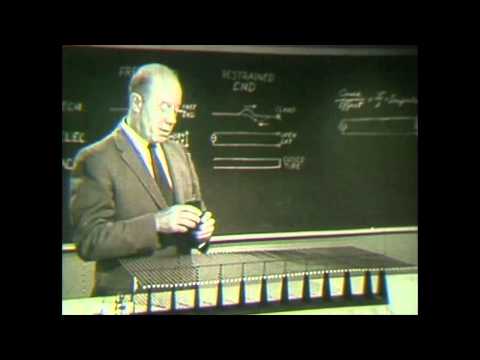
Speedy Cutover Service, SXS switching cutover to ESS filmed live at Glendale CA central office, 1984
AT&T Tech ChannelRecommended by 2 HN commenters across 2 months, 2018–2025
documentary · general · evergreen · 2018–2025 on HN
A 1984 AT&T film showing the live cutover of a Glendale, California central office from step-by-step switching to an electronic switching system. Installers prepare the site and then cut cables in a coordinated operation.
HN links it as a vivid example of high-stakes telco cutovers, done with careful coordination, big cable cutters and under a minute of downtime.
Up next
 4 mo on HN
The Gym of Life
Not Just Bikes
Recommended 4× on HN · 2022–2026
 2 mo on HN
Machine with Concrete - Arthur Ganson
Arthur Ganson
Recommended 2× on HN · 2015–2025
 15 mo on HN
AT&T Archives: Similiarities of Wave Behavior (Bonus Edition)
AT&T Tech Channel
Recommended 12× on HN · 2014–2026
 14 mo on HN
Micro Men - 720p (2009)
gimpymoo
Recommended 15× on HN · 2015–2026
 11 mo on HN
Light Years Ahead | The 1969 Apollo Guidance Computer
TNMoC
Recommended 11× on HN · 2021–2026
 12 mo on HN
Mechanical Computer (All Parts) - Basic Mechanisms In Fire Control Computers
Excelsior10000
Recommended 13× on HN · 2014–2025
 12 mo on HN
Project Code Rush - The Beginnings of Netscape / Mozilla Documentary
The Documentary Network
Recommended 13× on HN · 2015–2026
 11 mo on HN
Bret Victor The Future of Programming
Joey Reid
Recommended 12× on HN · 2017–2026
 11 mo on HN
Alan Kay - Normal Considered Harmful
powerfuloutlet
Recommended 10× on HN · 2012–2026
 10 mo on HN
VCF East: Ken Thompson interviewed by Brian Kernighan
Vintage Computer Federation
Recommended 11× on HN · 2019–2025
 11 mo on HN
U.S. NAVY BASIC MECHANISMS OF FIRE CONTROL COMPUTERS MECHANICAL COMPUTER INSTRUCTIONAL FILM 27794
PeriscopeFilm
Recommended 11× on HN · 2018–2026
 10 mo on HN
Alan Kay's tribute to Ted Nelson at "Intertwingled" Festival
TheTedNelson
Recommended 7× on HN · 2016–2025
6 comments from Hacker News
This[1] is a great video on the topic of cutovers. Not quite downtime-less, but seriously impressive little amount of downtime in any case. [1] ▶ this video
There's an old AT&T video showing the careful coordination and huge amount of manpower needed to upgrade a single telco switch. They had rows of workers with cable cutters, in order to literally cut the entire service over to the new equipment. Total downtime was just 47 seconds. (And even during the cutover, they're careful not to interrupt any emergency calls.) ▶ this video
Unrelated, but the title made me think of this video where AT&T failed over old switch frames to new ones by manually cutting all the cable bundles, very dramatic. ▶ this video (Speedy Cutover Service, SXS switching cutover to ESS filmed live at Glendale CA central office, 1984)
There's some videos on the AT&T Tech Channel on YouTube that show inside the CO, like this one for the "Speedy cutover service": ▶ this video
The central office switch that a landline is connected to is almost certainly doing analog/digital conversion. Digital switches were introduced in the 1970s and Analog exchanges were all but extinct by 2000 (according to [4], the last step by step exchange in Canada was replaced in 2002). If the call remains old school POTS, it will be essentially a T1/PRI call from that point on. Circuit switched digital calling was phased in over time, as CO switches were replaced. Chances are, a landline is actually handled by a remote terminal out in the field, and a/d converted there. Long distance (to most destinations) calling probably switched to digital trunks faster than local calling, because long distance calling was already separate equipment from local calling, and replacing central office switches is a big process (including a pretty intense cutover [1]). Long distance calling would have more equipment in the path than a local call, of course, and may not have had very optimal routing paths compared to today. I found a route map from the 1960 AT&T Long Lines network [2], and a fiber map with no provenance of 'today' [3] ... it's widely similar, but there's some routes that pop out at me as not being well connected in the 1960: Salt Lake City to Seattle; Amarillo, TX to Dallas, TX. On the other hand, Long Lines was radio, and radio is faster than fiber, so that makes up a little. There may have also been more cases where routing was simplified to be more manageable at the expens
Ma Bell had some ill ill communication. Those were the days, when the real paperclip payphone trick still worked. I'm not even sure pay-phones still exist in the Western world unless they're Tardises. Btw, here's a video from her vault about an actual cutover done in 45 seconds with a few dozen folks with big garden cutters: ▶ this video PS: I'm so old, I remember the days of operators, telephone books and fingers doing the walking. :) Speaking of old meets new, I recently used an antique rotary phone that's built into a brass end-table to diagnose an Xfinity VOIP call issue. It still works.