October CincyRb - Jim Weirich on Decoupling from Rails
Launch Scout1 HN recommender · recommended in 1 month, 2014–2017
talk · intermediate · evergreen · 2014–2017 on HN
A Cincinnati Ruby meetup talk by Jim Weirich on decoupling application logic from Rails. He argues for separating business logic from framework and database models.
Cited in HN debates on testing and clean architecture as a concrete example of keeping domain code separate from Rails so tests run fast.
Up next
 15 mo on HN
RailsConf 2014 - All the Little Things by Sandi Metz
Confreaks
15 HN recommender · 2015–2025
 14 mo on HN
"Simple Made Easy" - Rich Hickey (2011)
Strange Loop Conference
14 HN recommender · 2022–2026
 13 mo on HN
"Making Impossible States Impossible" by Richard Feldman
elm-conf
9 HN recommender · 2017–2026
 12 mo on HN
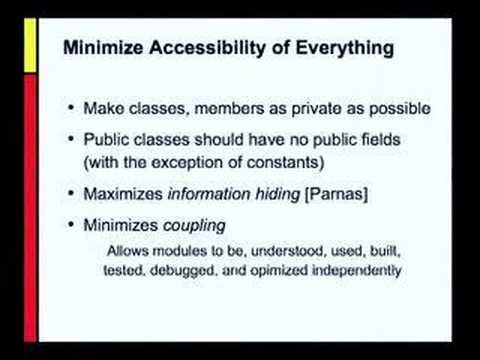
How To Design A Good API and Why it Matters
Google TechTalks
12 HN recommender · 2011–2025
 11 mo on HN
The Value of Values with Rich Hickey
InfoQ
10 HN recommender · 2014–2023
 10 mo on HN
Overwatch Gameplay Architecture and Netcode
GDC Festival of Gaming
16 HN recommender · 2019–2025
 11 mo on HN
Solving Problems the Clojure Way - Rafal Dittwald
Clojure/north
10 HN recommender · 2019–2025
 10 mo on HN
Lecture 1A: Overview and Introduction to Lisp
MIT OpenCourseWare
10 HN recommender · 2019–2026
 11 mo on HN
Alan Kay - Normal Considered Harmful
powerfuloutlet
10 HN recommender · 2012–2026
 10 mo on HN
A Philosophy of Software Design | John Ousterhout | Talks at Google
Talks at Google
11 HN recommender · 2018–2026
 10 mo on HN
"Uncle" Bob Martin - "The Future of Programming"
Paul Stringer's Mobile Tech
10 HN recommender · 2016–2022
 10 mo on HN
Effective Programs - 10 Years of Clojure - Rich Hickey
ClojureTV
10 HN recommender · 2017–2026
5 comments from Hacker News
I'm interested to hear the patterns that users of MVC frameworks like Rails and Django have adopted when "fat models" start to become unwieldy. The video "Decoupling from Rails"[1] that's linked in this article was quite interesting, and argued a complete separation of business logic from the model code, to allow the business logic to be tested (and reused) more easily. I've definitely found fat-model code to be tricky to mock and test at times in Python/Django, as mocking out the ORM is gnarly. But if the business logic operates on proxy objects, then it would be much easier to do so. On the other hand, DHH's retort to this approach also makes some good points regarding the introduction of excess complexity[2]. It's a fair point that architectural decisions should not be motivated by the speed of the UTs. But perhaps there are other benefits to the Hexagonal architecture, as well. [1]: ▶ this video [2]: link
This is a powerful technique, though I'd say it's more useful for the build pipeline than for developers running UTs while coding (since the schema can change more frequently while doing so). To provide a counterpoint though, an advantage touted by advocates of complete decoupling from the DB is that your UT suite can run in O(one minute), rather than O(ten minutes). E.g. see ▶ this video . I'm not 100% sold on this approach yet (separating your domain objects entirely from the ORM wrapper is an uphill struggle), but it's interesting.
Here's a retort to that argument from the source (Uncle Bob): link DHH wrote an article with the title "test induced design damage", not sure if he coined the term. I think there's a grain of truth there; it is possible, but not necessary, to mangle your architecture to enable testability. The case that DHH was complaining about is quite interesting in itself; it was an architecture that Weirich suggested ( ▶ this video ) where the framework DB models (in his case Rails) are separated from the Domain Models, to allow you to 1) run your tests of the business logic faster (without spinning up a DB) and 2) decouple your business logic from your choice of framework. I've felt the need for this factoring in my own code, but actually making it happen is tricky, since you lose a lot of the magic that makes your life easier (but that also couples every level of your architecture to the framework's concepts).
Decoupling business logic from web frameworks might be an interesting architectural problem that could use better tooling. Here's Jim Weirich going about it manually in Rails: ▶ this video
Am I only the only one that doesn't find 'All tests in 4 minutes, all model tests in 80 seconds' very impressive? It sounds like a really long time to me. You know what could increase the speed dramatically.... decoupling. I also think decoupling phrased in the context of the Rails 2 to Rails 3 upgrade, where pretty much everything changed, makes perfect sense. Imagine just having a few wrapper classes that spoke to Rails and only having to adapt them. Sounds good to me! Bernhardt: Boundaries link Weirich: Decoupling from Rails ▶ this video Wynne: Hexagonal Rails link