CppCon 2018: Stoyan Nikolov “OOP Is Dead, Long Live Data-oriented Design”
CppCon3 HN recommenders · recommended in 3 months, 2018–2021
talk · intermediate · evergreen · 2018–2021 on HN
A CppCon 2018 talk arguing that OOP has failed to deliver on reuse and performance, and presenting data-oriented design for C++ with practical worked examples from real systems.
HN cites it as a concrete, worked example of data-oriented design and as an alternative to OOP in performance-sensitive code.
Up next
 10 mo on HN
Overwatch Gameplay Architecture and Netcode
GDC Festival of Gaming
16 HN recommender · 2019–2025
 15 mo on HN
RailsConf 2014 - All the Little Things by Sandi Metz
Confreaks
15 HN recommender · 2015–2025
 14 mo on HN
"Simple Made Easy" - Rich Hickey (2011)
Strange Loop Conference
14 HN recommender · 2022–2026
 13 mo on HN
"Making Impossible States Impossible" by Richard Feldman
elm-conf
9 HN recommender · 2017–2026
 12 mo on HN
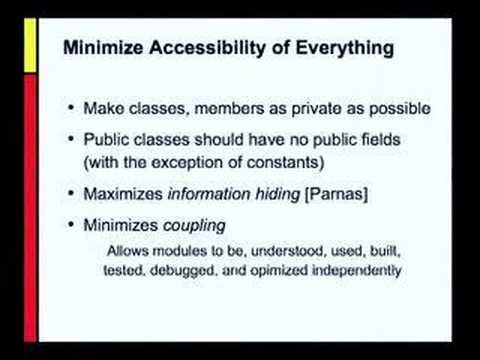
How To Design A Good API and Why it Matters
Google TechTalks
12 HN recommender · 2011–2025
 11 mo on HN
The Value of Values with Rich Hickey
InfoQ
10 HN recommender · 2014–2023
 11 mo on HN
Solving Problems the Clojure Way - Rafal Dittwald
Clojure/north
10 HN recommender · 2019–2025
 10 mo on HN
Lecture 1A: Overview and Introduction to Lisp
MIT OpenCourseWare
10 HN recommender · 2019–2026
 11 mo on HN
Alan Kay - Normal Considered Harmful
powerfuloutlet
10 HN recommender · 2012–2026
 10 mo on HN
A Philosophy of Software Design | John Ousterhout | Talks at Google
Talks at Google
11 HN recommender · 2018–2026
 10 mo on HN
"Uncle" Bob Martin - "The Future of Programming"
Paul Stringer's Mobile Tech
10 HN recommender · 2016–2022
 10 mo on HN
Effective Programs - 10 Years of Clojure - Rich Hickey
ClojureTV
10 HN recommender · 2017–2026
10 comments from Hacker News
Glad to see some agreement there. I'm interested in building an ECS-based approach for a UI system at some point. The Yoga layout engine (implements flexbox -- link ) seems to actually be pretty amenable to just incorporating as a `Layout` or `Flex` component, then you could have components for platform-specific renderings (eg. `iOSTextInput`, `AndroidTextInput`, `DOMTextInput` in wasm, ...) that could read from cross-platform common components (`TextInput`). A core aspect would also be a `Hierarchy` component that just has a parent entity id and a list of child entity ids (that it keeps in sync properly). Then bind things to JS and allow you to code it from React, while still being able to eg. run an animation thread for some specific animations that just queries and reads/writes the `Layout` and `AnimationSpec`s etc. Interesting talk re: data oriented design for a webby animation engine here actually: ▶ this video
Just adding a more recent video on it from CppCon 2018 where the presenter goes over a specific worked example. ▶ this video
That's a very good point. It might be question of high versus low level. From a video I watched today (the rest of the video is worth watching, too, but the following stand-alone quote is apropos): "Polymorphism and interfaces have to be kept under control. I don't believe that their role is in a very low level system like interpolating a couple of numbers in the animations, but they have their place in high level systems, in client facing APIs. They are amazing if you do a type of plug in and you really need some type of dynamic polymorphism." ▶ this video
There's been a few talks: CppCon 2014: Mike Acton "Data-Oriented Design and C++": link CppCon 2018: Stoyan Nikolov “OOP Is Dead, Long Live Data-oriented Design”: ▶ this video Building a Data-Oriented Future - Mike Acton [2019]: link And a blog/book has been created: link
Some UI rendering engines for games do something like this, eg. link -- talk by one of the devs of that at ▶ this video
Static typings + type inference Parse, don't validate link All libs/products should be pure functions, with input output documented, making libs/products predictable Use in-app event sourcing to reduce the need for global states states DoD ▶ this video In non bare-metal languages, this will be useful for readability For errors, return instead of throw
Having your PR rejected in a healthy environment means that your PR is radically far from the reviewer's expectation. Having your PR rejected in a toxic environment can mean a lot of things, and a company sought after doesn't mean that it MUST be not toxic. First, you have to make sure if both of YOU and YOU ENVIRONMENT is healthy. If both are healthy, proceed reading. > The challenge here is to deliver good quality code, while maintaining a decent speed of delivery. You made it sound like producing good quality code = slowness. FALSE. Seeming slow, good quality code boosts your team's velocity. BUT keep in mind: "quality" is "the standard of something as measured against other things of a similar kind; the degree of excellence of something". Your team has its standards, either is a derivative of other globally acknowledged standards such as link , link , link , etc, or self-made standards. You go follow them, make them happy! Coding and design skill has a different definition than code quality. It is what punches up to the sky: the overall velocity, the success of the team, the balance of growth and culture retainment of the company, the development experience, the users' thumbs ups, amazements, and "this app is life changing" comments, the number of milestone celebration in All You Can Eat restaurants each years, the number of people rising up from junior to senior each years, etcetera etcetera. Not only you make your team happy with the quality code based on their st
There's plenty of good talks and literature on the subject and why it is applicable to game development, but also more generally. This talk by Mike Acton (Formerly Insomniac now Unity): link I recommend this talk all the time, since it is the one that got me convinced to look into DoD seriously. Also: More Mike Acton (now at Unity): link Stoyan Nikolov “OOP Is Dead, Long Live Data-oriented Design”: ▶ this video Overwatch Gameplay Architecture and Netcode (More specifically about ECS): link The main argument is that you work with data so you should care about data. All a program does is take some input, do something with it, and give you an output. If you structure your program around this mindset, a lot of problems become much simpler. Concurrency is one thing that becomes much simpler to reason about now that you understand how your data is managed and moved around. Realisations that most of the time you have multiple of something and very rarely do you have a single thing. So having a lot of small objects of the same type each doing some work within their deep call-stack, rather than running through an array of them and doing the work you need to do. I disagree that encapsulation is a brilliant idea _in general_, because it promotes hiding data, and hiding data is not inherently good. There's obviously cases, where there is internally critical, but since all your state is simply tables of data, your program is just choosing to represent that data in some way, which can mak
People are starting to use data oriented design instead of OOP. Data oriented design doesn't hide state, is generally faster and easier to comprehend as it doesn't abstract too much. link ▶ this video link
In the article they mention that most programs are not dominated by arrays but objects. An other cure for that is to use arrays of primitives a lot more: ▶ this video