CYMATICS: Science Vs. Music - Nigel Stanford
Nigel John Stanford1 HN recommender · recommended in 1 month, 2019–2023
music · general · evergreen · 2019–2023 on HN
Nigel Stanford's music video Cymatics, in which real science experiments, such as Chladni plates, ferrofluid and water, visualize the audio.
Mentioned as a striking example of sound producing physical effects and a favorite among his videos.
Up next
 2 mo on HN
Firing the Lorentz Plasma Cannon
LightningOnDemand
2 HN recommender · 2025–2026
 3 mo on HN
How to achieve nanometer precision in space?
Breaking Taps
4 HN recommender · 2022–2026
 11 mo on HN
Video explains the world's most important 6-sec drum loop
Landon Proctor
15 HN recommender · 2011–2026
 10 mo on HN
Fear the Boom and Bust: Keynes vs. Hayek - The Original Economics Rap Battle!
Radical Discourse
10 HN recommender · 2010–2024
 6 mo on HN
Adriano Celentano - Prisencolinensinainciusol
Le Pietre Rotolanti
6 HN recommender · 2016–2024
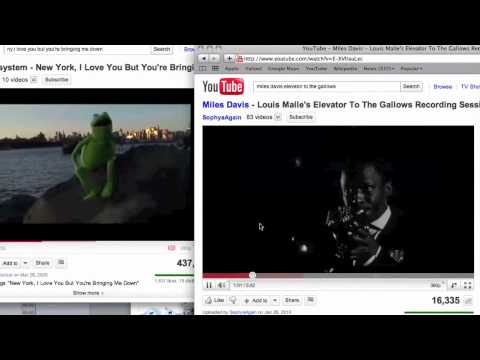 4 mo on HN
Youtube duet: Miles Davis improvising on LCD Soundsystem
Alessandro Grespan
4 HN recommender · 2021–2024
 5 mo on HN
The Caretaker - Everywhere At The End Of Time - Stages 1-6 (Complete)
vvmtest
5 HN recommender · 2020–2025
 5 mo on HN
Steve Reich, "Music for 18 Musicians" - FULL PERFORMANCE with eighth blackbird
Vic Firth
4 HN recommender · 2016–2025
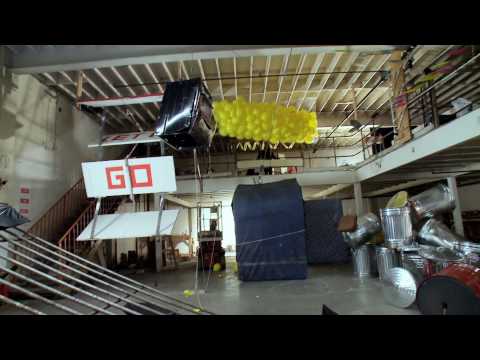 5 mo on HN
OK Go - This Too Shall Pass - Rube Goldberg Machine - Official Video
OK Go
5 HN recommender · 2010–2026
 5 mo on HN
MC Frontalot - It Is Pitch Dark
MC Frontalot
5 HN recommender · 2012–2026
 4 mo on HN
Danny Carey | "Pneuma" by Tool (LIVE IN CONCERT)
Vic Firth
3 HN recommender · 2021–2026
 5 mo on HN
William Shatner - Common People
dsjkhd
6 HN recommender · 2013–2023
3 comments from Hacker News
I quite like this one: link AUTOMATICA - Robots Vs. Music - Nigel Stanford More industrial robot arm choreography and creative film making, but with some fun mindless destruction too. (And if you like that, another one of his I like is tghis: ▶ this video )
Thanks! With the caveat that I profoundly lack depth on both, and am a bit artsy craftsy in my intuitions, I did buy the Maths module precisely because it was an analog computer. The intent was to create some generative music, and seeing if I could use it to create 1/f noise, and exploring self-similarity using a musical ear instead of in code. Still working on it. When you look at what you can do with magnets hooked to a synth with a ferrofluid, e.g. ▶ this video , the sound and your ear helps to develop an sense for what kinds of waves can be used to yield physical effects. If you can functionally suspend and maipulate a ferrofluid with waves, there are likely analogies to laser pulses and electrons for quantum computing. Waves gonna wave, etc. The other piece that grabbed me recently was "analog fractals," ( link + that rabbit hole) where if you can get those artifacts instantaneously as the effect of physical feedback instead of rendering them computationally, there are likely faster functional approaches to a lot of other problems, only a subset of which we use ASICs and FPGAs to implement today. It's speculative based on laughably incomplete understandings on my part, but that's hacking.
Related: What is Oscilloscope Music and how do you display it on your oscilloscope? link Jerobeam Fenderson's Oscilloscope Music YouTube Channel link Intuitively, there seems to be a relationship between Oscilloscope Music and Cymatics: CYMATICS: Science Vs. Music - Nigel Stanford ▶ this video (Also, there's an implied 2D to 3D mapping from the Oscilloscope experiments...)