A New Way to look at Networking
GoogleTalksArchive4 HN recommenders · recommended in 4 months, 2012–2025
talk · advanced · evergreen · 2012–2025 on HN
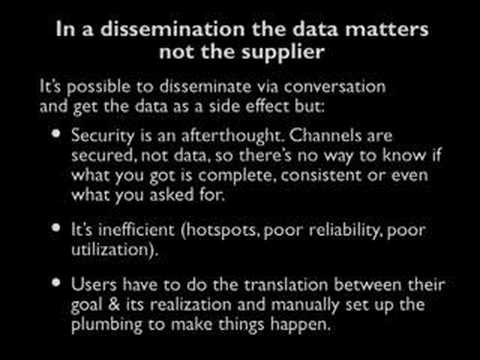
Van Jacobson's 2006 Google Tech Talk on rethinking networking around named content instead of host-to-host conversations. He recounts packet-networking history and lays out the content-centric networking idea that later became NDN.
HN commenters point to it as an inspiring talk behind content-addressed designs like IPFS, Urbit and immutable URLs.
Up next
 3 mo on HN
A New Way to look at Networking
Google TechTalks
3 HN recommender · 2012–2024
 6 mo on HN
TigerStyle! (Or How To Design Safer Systems in Less Time) by Joran Dirk Greef
TigerBeetle
2 HN recommender · 2023–2025
 9 mo on HN
Harder Drive: Hard drives we didn't want or need
suckerpinch
12 HN recommender · 2022–2025
 9 mo on HN
This Video Is Sponsored By ███ VPN
Tom Scott
9 HN recommender · 2019–2026
 6 mo on HN
A New Way to look at Networking
Google
6 HN recommender · 2011–2018
 6 mo on HN
Net Neutrality: Last Week Tonight with John Oliver (HBO)
LastWeekTonight
7 HN recommender · 2014–2017
 4 mo on HN
Characters, Symbols and the Unicode Miracle - Computerphile
Computerphile
4 HN recommender · 2014–2025
 5 mo on HN
8 Frames in 16ms: Rollback Networking in Mortal Kombat and Injustice 2
GDC Festival of Gaming
4 HN recommender · 2020–2025
 4 mo on HN
Why SpaceX is Making Starlink
Real Engineering
4 HN recommender · 2019–2020
 3 mo on HN
AWS re:Invent 2015 | (NET403) Another Day, Another Billion Packets
Amazon Web Services
3 HN recommender · 2017–2020
 3 mo on HN
Email Hates the Living
m
3 HN recommender · 2015–2022
 3 mo on HN
Ricardo Signes - 闇のEメール伝説
yapcasia
3 HN recommender · 2011–2021
11 comments from Hacker News
Yes! Ted Nelson talks about this in this amazing and inspiring Google Talk video from 2006. He talks about the rise of packet-based networking, and how the future will be content-centric. ▶ this video
I was surprised to command-F for Van Jacobson and not find this lecture, "A New Way to Look at Networking". ▶ this video Van Jacobson was the major architect of TCP/IP; here is how the Internet would work if he were in charge. If this is ever implemented it will change everything.
The thing that got me interested in Urbit when it was first announced back in 2010 was reading Van Jacobson's "Networking Named Content" paper [1] and related work from PARC, referenced in this blog post [2]. As someone who has spent 15 years now working on web development, browser development, and web standards, I feel the Internet really needs some form of "named data" networking as its next big step. I don't know if Urbit is the way it's going to happen, but it'll happen somehow. Maybe we'll evolve browsers and HTTP into a named data network instead. (On the one hand, it would be orders of magnitude easier than building an entire new model of computing from scratch... on the other hand, you don't get to throw out the whole ball of mud if you just keep building on top of it.) Anyway, I encourage everyone to read the Van Jacobson paper or watch the tech talk. It points out some assumptions that are so baked into our network architectures that I had never really thought about them. And it gives some context for these slides' claim that "the internet has failed," by pointing to a working alternate system that's a better fit for some common cases. The link from the Urbit blog to the Van Jacobson talk is broken since Google Video was shut down, but you can now find it on YouTube [3]. [1] link [2] link [3] ▶ this video
You may be interested in this Google Tech Talk from 2006 - ▶ this video . I found it interesting at the time it came out.
It's both, link > NDN has its roots in an earlier project, Content-Centric Networking (CCN), which Van Jacobson first publicly presented in 2006.. NDN applications name data and data names will directly be used in network packet forwarding.. Its premise is that the Internet is primarily used as an information distribution network, which is not a good match for IP, and that the future Internet's "thin waist" should be based on named data rather than numerically addressed hosts. NDN talk by Van Jacobson at Google (2006): ▶ this video
Fun fact: An open source[1] version of BTSync called Snakebite was introduced back in 2006, predating BTSync by 6-7 years.[2][3] These days, it's not well known at all, and the Internet seems to have mostly forgotten about it, but there it is. Van Jacobson made a couple of offhand references to Snakebite at a Google TechTalk he gave in 2006.[4] The student who created it went off to do international NGO work or something, but his co-conspirator ended up working at BitTorrent, Inc for a bit. I don't know what BTSync is like today, but a few years ago when the call for beta testers first went out, its UX as described at the time was more or less the same as the way Snakebite's web interface worked.[5] 1. link 2. link 3. link 4. ▶ this video 5. link
These migrations would be much easier if we specified dependencies by content, not location. Obviously not Google's fault, just something to think about as we build future systems. ▶ this video
It's interesting that you mention TCP/IP, because that's the most famous example of a technology that "works in practice, but not in theory". Take a look at Van Jacobsen's presentation on the history of ARPANET: ▶ this video Packet switching was "utter heresy" (20m in) when it was invented. It "wasn't a network, it was an inefficient way to use an existing network". And it almost collapsed 25 years after it was invented; the presenter is famous for inventing the modern TCP/IP congestion control that saved the Internet [1]. The TCP/IP flow congestion algorithm has been redesigned several times since [2]. It works not because it was designed well, but because it wasn't designed and instead evolved over many years with many contributions from people devoted to keeping it working. Alan Kay is usually who I think of for great ideas that "work in theory, but not in practice". He's done some crucially important work in OOP, programming languages, and GUIs. But note that we don't actually use SmallTalk; instead we got C++ and Java. Nor do we use Dynabooks and Altos; instead, we got Microsoft Windows. [1] link [2] link
Isn't this identical in spirit to Content-Centric Networking (CCN) as espoused by Van Jacobsen? I distinctly remember watching his Google Tech Talk on the idea ( ▶ this video ) when I first joined AeroFS.
This reminds me of Van Jacobson's Google Talk several years ago: ▶ this video Basically a sketch of if the entire HTTP-based web worked like bittorrent.
The mainstream internet is headed for content-centric networking. link ▶ this video That is what all of these ideas (like Tent) are moving towards (gradually). All it takes is for everyone to run a client that can do UDP and speaks a content-centric protocol. That could be an app, or built into Firefox & WebKit (the ideal route), or a browser extension. Doesn't require any servers. Actually after reading the content-centric Wikipedia article again, one related approach which isn't emphasized in that article are application-level distribution systems built on top of things like UDP and Kademlia (and its successors). The fundamental way that data layer is organized intersects with the way social information is distributed.