2017 ACM PPoPP Keynote: It's Time for a New Old Language
Guy Steele3 HN recommenders · recommended in 4 months, 2018–2023
talk · intermediate · evergreen · 2018–2023 on HN
Guy Steele's PPoPP 2017 keynote surveying the history of computer science metanotation, including BNF, inference rules, and overline notation. He argues the field's notations are inconsistent and fragmented.
HN recommends it as an excellent talk on notation problems, useful when reading papers or designing a new metalanguage.
Up next
 11 mo on HN
Principles for Dealing with the Changing World Order by Ray Dalio
Principles by Ray Dalio
10 HN recommender · 2022–2025
 3 mo on HN
John Carmack Tech Talk with UMKC-SCE
UMKC School of Science and Engineering
3 HN recommender · 2017–2023
 4 mo on HN
"Data Driven UIs, Incrementally" by Yaron Minsky
Strange Loop Conference
4 HN recommender · 2018–2022
 11 mo on HN
Maybe Not - Rich Hickey
ClojureTV
14 HN recommender · 2018–2025
 6 mo on HN
The Clean Architecture in Python
Next Day Video
5 HN recommender · 2017–2021
 3 mo on HN
GopherCon 2016: The Design of the Go Assembler - Rob Pike
Gopher Academy
3 HN recommender · 2017–2025
 2 mo on HN
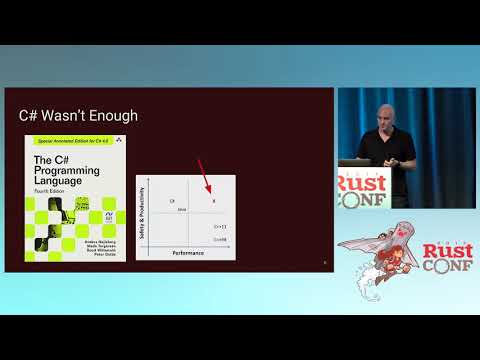
RustConf 2017 - Closing Keynote: Safe Systems Software and the Future of Computing by Joe Duffy
Confreaks
2 HN recommender · 2017–2025
 4 mo on HN
Dtrace Review
GoogleTalksArchive
4 HN recommender · 2013–2026
 16 mo on HN
How Python was Shaped by leaky Internals, Armin Ronacher, Flask framework
Видео с мероприятий {speach!
15 HN recommender · 2017–2025
 12 mo on HN
Why Isn't Functional Programming the Norm? – Richard Feldman
Metosin
12 HN recommender · 2019–2025
 10 mo on HN
Conway's Game Of Life in APL
Dyalog
11 HN recommender · 2010–2024
 9 mo on HN
Lecture 1A | MIT 6.001 Structure and Interpretation, 1986
MIT OpenCourseWare
11 HN recommender · 2012–2024
4 comments from Hacker News
You might be interested in Guy Steele’s talk “It’s time for a new old language”. He talks about similar notations and the problem of inventing new ones (although most of his talk is about things other than BNF-like notations : he just talks about them for a bit in the beginning). It’s an interesting talk and is useful in thinking about proposing new notations. YouTube: ▶ this video If you search for the talk title you can find the PDF of the slides.
Or ideas in general, should we ever gate keep the dissemination of ideas and knowledge? Innovation is more likely to occur when people cross disciplines and they can only do that if it is approachable, it is gradual and discoverable. Simple is hard, simplistic is easy. Someone is going to come back with essential vs accidental complexity [1] but we can always strive for simpler, more cohesive ways to exchange knowledge. How much of our current notation systems are essential? And when do they diverge for non-essential reasons? Computer systems form primarily around notation (language and syntax), so notation is definitely important [z] In the post the author mentions an excellent talk by Guy Steele that goes over issue of notation and balkanization titled, "It's Time for a New Old Language" where he outlines "the history and current status of computer science metanotation". [2] Notation, like syntax is important, but like a plethora of ill defined and specified Domain Specific Languages (DSL), notation also needs to be defined, regular and learnable. For notation takes words and turns them into pictures that compose into thought structures that cannot be expressed in human written language to the same specificity. Think Feynman [3] and Railroad [4] Diagrams, or musical notation [5] The abstract explains it beautifully, > The most popular programming language in computer science has no compiler or interpreter. Its definition is not written down in any one place. It has changed
(Nice to see your work shared here :) ) I went through the corresponding videos last year: link link It was a great refresher as someone who once liked math but hasn't done much of it in ~20 years :) I had seen the blog posts, but there was some "color" in the videos that helped. For example I didn't realize that the fonts sometimes matter! Honestly, I still don't really read the notation, as I haven't had a strong reason to, but I feel it would be useful at some point. ---- For others, I also recommend this 2017 talk by Guy Steele It's Time for a New Old Language ▶ this video Because even people in the field seem to have problems with the notation. He also was asked about this work a few days ago here and said he was still working on it in the background (being a "completionist"): link ----- FWIW as you know, Oil is more static than shell, and that was largely motivated by tools and static analysis (and negatively motivated by false positives in ShellCheck link ) I would like to go further in that direction, but getting the basic functionality and performance up to par has taken up essentially 100% of the time so far :-( My use of Zephyr ASDL was also partly motivated by some vague desire to get the AST into OCaml. However I haven't used OCaml in quite awhile and I get hung up on small things like writing a serializer and deserializer. I don't want to do it for every type/schema, so it requires some kind of reflection. And my understanding is that there are a bunch of pac
This is great! I wish I had seen something like this years ago. Related: "It's Time for a New Old Language" by Guy Steele. ▶ this video He gives a history of metalanguage notations (for both language semantics and syntax, including regexes and CFGs). And then he criticizes the inconsistency that has cropped up in these notations over the years. The irony is that people who are formalizing precise semantics of programming languages do not agree on the syntax/semantics of the metalanguage. I guess this is what you notice when you read hundreds of programming language papers, as I'm sure Guy Steele has. ----- Also, does anyone know if what he refers to as "progress and preservation" are the same / related to "liveness and safety" in distributed algorithms? It sounds like the same kind of idea.