How our voting system (and IRV) betrays your favourite candidate
The Center for Election Science5 HN recommenders · recommended in 4 months, 2014–2023
explainer · intro · evergreen · 2014–2023 on HN
The Center for Election Science explains favorite betrayal in instant-runoff voting: in some elections, ranking your favorite first can cause your least favorite to win. It contrasts this with plurality voting's spoiler problem.
The standard link in ranked-choice voting threads to show IRV does not eliminate the spoiler effect.
Up next
 4 mo on HN
Animated Voting Methods
Unify The Vote
3 HN recommender · 2018–2022
 2 mo on HN
This high-speed rail project is a warning for the US
Vox
2 HN recommender · 2022–2023
 3 mo on HN
What P vs NP is actually about
Polylog
4 HN recommender · 2024–2026
 9 mo on HN
Harder Drive: Hard drives we didn't want or need
suckerpinch
12 HN recommender · 2022–2025
 2 mo on HN
Professional SMT Soldering: Hand Soldering Techniques - Surface Mount
John Gammell
2 HN recommender · 2016–2023
 2 mo on HN
Bayes theorem, the geometry of changing beliefs
3Blue1Brown
2 HN recommender · 2022–2024
 5 mo on HN
Why do prime numbers make these spirals? | Dirichlet’s theorem and pi approximations
3Blue1Brown
7 HN recommender · 2019–2024
 4 mo on HN
John Cleese vs Extremism
eroosters
4 HN recommender · 2018–2024
 12 mo on HN
George Lakoff: Moral Politics
University of California Television (UCTV)
3 HN recommender · 2016–2024
 11 mo on HN
Why Electronic Voting Is Still A Bad Idea
Tom Scott
11 HN recommender · 2020–2026
 11 mo on HN
Republic, Lost | Lawrence Lessig | Talks at Google
Talks at Google
10 HN recommender · 2011–2017
 11 mo on HN
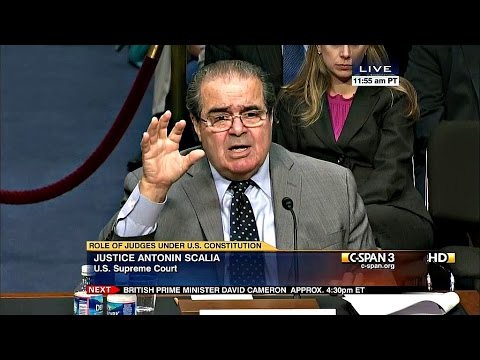
Antonin Scalia - On American Exceptionalism
AmericanRhetoric.com
12 HN recommender · 2019–2025
12 comments from Hacker News
RCV doesn't solve what is claimed in the article. It is interesting since countries that they give as examples are clear evidence of this. (Yes, I'm going to advocate cardinal systems like Approval, Range/Score, and STAR) > More moderate candidates. RCV doesn't encourage this at all. Australia is a clear example of this. In the house Liberal and Labor (the two major parties) control 85% of seats. The next major party (National) is part of a coalition with the Liberals and this sums to 95%. Things are only slightly better in the senate. Look at any country that uses IRC/RCV and you'll see a similar pattern. The system didn't encourage more parties and more moderates, Australia still has divided politics like America. As to the more parties, I have an alternative explanation. They use a parliament, which uses proportionate representation. Don't buy it? Go look at countries with parliaments and don't have IRV and you'll find similar distributions. We also need to recognize that in America our parties are closer to coalitions in other countries out of the necessity. I'm not sure how anyone can look at someone like AOC or Sanders and think they are the same "party" (by other country norms) as Biden or Pelosi (similarly on the Republican side, though Trump caused a consolidation). > ranked-choice voting can drastically reduce the possibility of spoilers. Yes, but no. It reduces spoilers when a candidate is not going to win anyways (e.g. Jo Jorgensen spoiling Trump). But this does n
I agree with what /u/zestyping says in the other comment, so I won't repeat it. But here's a video explaining the strategic voting issue: ▶ this video Also, wikipedia has an example of a non-monotonic result here: link
I always recommend this pair of videos when discussing STAR voting vs other alternative systems. The first video is an easy-to-follow explanation of how spoiler effects can happen in both plurality voting and IRV [1]. In the second [2], the guy who created Star voting applies Ka-Ping Yee's methods to Star voting and animates it side-by-side with alternative systems to show its performance. [1] ▶ this video [2] link
This is a shorter video from the same source as the other reply that deals specifically with IRV: ▶ this video >Unless I misunderstand IRV, there is no "vote stealing" due to your vote automatically dropping off to your next-preferred candidate. The problem is that they drop to your next preferred candidate who has not been eliminated . If you're thinking about the problems that occur with plurality voting, it's easy to imagine your second choice will always be a popular "safe" choice, but if third parties get stronger (which is surely the point?) those safe choices can end up being eliminated before your second choice can help them.
This issue has been solved by math PhD's and political scientists who've studied the matter for decades. www.electology.org/approval-voting-vs-irv IRV can elect X even if Y was preferred to X by an arbitrarily huge majority and got more first-place votes than X. www.electology.org/core-support Regarding favorite betrayal, you might enjoy this video. ▶ this video
strategy affects all deterministic voting methods, and an optimal ranked ballot can be quite complex. see an example from andy jennings, who did his math phd thesis on voting methods and co-founded the center for election science (with myself and some others). ▶ this video optimal approval voting strategy is simply to approve everyone you prefer to your expected satisfaction. to an approximation it's, "vote for who you normally would, plus everyone you like better." so it's rarely any more taxing than now, and often easier. hundreds of thousands of voters have now used approval voting in fargo and st louis, and we've heard no reports of difficulty. approval voting is also simpler in essentially every way we can objectively measure. most of the points here apply to approval voting even more so. link
this is obviously false. simply consider that green party supporters usually vote democrat. with score or approval voting, they'd ALSO want to vote for the green. whereas with ranked voting methods, they'd still strategically rank the democrat in 1st place, crushing any hope for the greens. ▶ this video
no. scoring is more resistant to strategy. consider a green party supporter who normally votes democrat. with score voting or approval voting, he also votes green (of course). with ranked voting, he still ranks the democrat strategically in 1st place to avoid getting the republican, and that makes it impossible for third parties to grow. ranking is too vulnerable to strategy. ▶ this video
For a more interesting experiment Fargo had an election with Approval Voting[0]. Unfortunately RCV (IRV) doesn't solve many of the problems that it claims to do. One of the claims is that IRV prevents spoilers, which is objectively false[1][2]. We're pretty interested in the Favorite Betrayal Criterion to prevent this[3]. We also see that IRV has a fairly poor voter satisfaction efficiency (VSE)[4][5]. It really feels like people just watched the CGP Grey videos on election science and dug no further. Even Arrow himself said that cardinal voting (Approval, score, STAR) is probably the likely answer. They also tend to be much simpler as they only are single rounds and resistant to people accidentally "ranking" two candidates equally (which you might actually favor two candidates equally and these methods let you express that). [0] link [1] ▶ this video [2] link [3] link [4] link [5] link
Perhaps I am suffering a failure of imagination, but in what circumstance does "ranking someone too high .. cause them to lose"? Edit: Found this[0] talking about it; what remains unclear to me is whether this should be seen as "this hurts my candidate" over "this result better reflects the electorate". [0]: ▶ this video
> it exacerbates the issue of voting being highly tactical. No. Approval voting has been extensively studied by game theory experts like NYU political science professor Steven Brams, and found to be one of the most resistant to tactical voting. Computer simulations show it performing exceptionally well even with highly strategic voters. link link There's even a mathematical theorem (proof) that, given plausible strategic behavior by voters, approval voting always elects a beats-all "Condorcet winner" when one exists. This is mild (some would say GOOD) reaction to strategy. link > Checking approve on someone I believe to be more popular than my favorite candidate lowers the chance my favorite candidate wins. Yes, this is beneficial not harmful. The alternative is that the voting method must ignore all preference data about the relative support of X vs. Y as long as the voter prefers X to Y. That causes big problems. link It is precisely why ranked voting methods like Instant Runoff Voting are so vulnerable to tactics. If I prefer the Green, my general best strategy is to tactically rank the Democrat in 1st place, thus "burying" the Green and making the mere appearance of un-electability a self-fulfilling prophecy. ▶ this video link The major moral of voting theory is to AVOID RANKED VOTING METHODS, favoring RATED voting methods like score voting, STAR voting, and approval voting. Here's a presentation I gave in 2015 to the Colorado League of Women Voters explaining more.
If Nader takes enough votes from Gore, then Gore will have the fewest first place votes and get eliminated first. Then Nader has to go up against Bush and it all comes down to who the Gore voters put as their second choice. It may only take a small percentage of them putting Bush second for Bush to win. ▶ this video Was this election spoiled? By Nader or by Gore? You can argue the semantics of what "spoiler" means, but to me it's clear that IRV doesn't handle this situation well. It is safe to vote for a third-party only if they can't win. When three-way elections get close, you have to be more careful.