Why We Run FreeBSD current at Netflix – Drew Gallatin
OpenFest BulgariaRecommended by 1 HN commenter across 1 month, 2024–2026
talk · advanced · 2024–2026 on HN
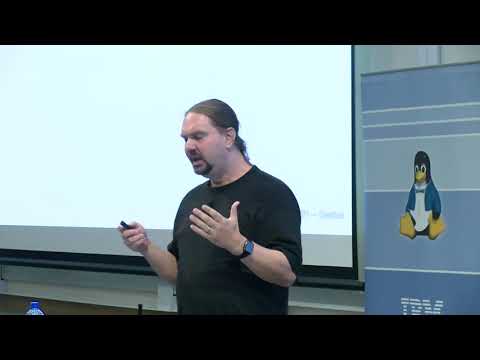
Netflix engineer Drew Gallatin explains why the company runs FreeBSD-current on its CDN. He describes the team, how they track upstream, their contributions and performance milestones, and a bug causing a 20% performance regression.
HN cites it as the Netflix case for staying close to -CURRENT and upstreaming changes.
Up next
 1 mo on HN
So You Think You Know Git - FOSDEM 2024
GitButler
Recommended 1× on HN · 2024–2025
 14 mo on HN
The Tragedy of systemd
linux.conf.au
Recommended 16× on HN · 2019–2025
 10 mo on HN
The Real Story Behind Wayland and X - Daniel Stone (linux.conf.au 2013)
Mladen Mijatov
Recommended 13× on HN · 2013–2026
 9 mo on HN
LISA11 - Fork Yeah! The Rise and Development of illumos
USENIX
Recommended 9× on HN · 2012–2026
 8 mo on HN
Tech Talk: Linus Torvalds on git
Google
Recommended 9× on HN · 2007–2023
 7 mo on HN
DebConf 14: QA with Linus Torvalds
Adnan Hodzic
Recommended 7× on HN · 2014–2021
 6 mo on HN
Gtk to Qt - a strange journey [linux.conf.au 2014]
Konstantin Bläsi
Recommended 5× on HN · 2014–2024
 6 mo on HN
User-level threads....... with threads. - Paul Turner - Google
Linux Plumbers Conference
Recommended 6× on HN · 2013–2024
 5 mo on HN
Using a 1930 Teletype as a Linux Terminal
CuriousMarc
Recommended 4× on HN · 2020–2025
 5 mo on HN
How I Designed a Free Music Font for 5 Million Musicians (MuseScore 3.6)
Tantacrul
Recommended 5× on HN · 2021–2024
 5 mo on HN
NSA operation ORCHESTRA: Annual Status Report
HUP
Recommended 9× on HN · 2014–2019
 4 mo on HN
The real story behind Wayland and X
Linux.conf.au 2013 -- Canberra, Australia
Recommended 4× on HN · 2018–2024
4 comments from Hacker News
In addition to the vendor summit, Netflix gave a tech talk recently where they recommended both upstreaming and keeping as close to -CURRENT as possible "Why we run FreeBSD CURRENT at Netflix": ▶ this video
> Or just run -current in production, like we do.[0] If you develop, it's probably best to do that against current [1], but if I'm running a web, mail, file, database, etc , server there is IMHO very little advantage to doing so. Most folks aren't trying to push >400Gbps. [0] ▶ this video [1] link
Your comment suggests that FreeBSD is a thing of a past and no longer capable of "quality networking", due to poor WiFi support. I can only agree with the poor WiFi support part. But WiFi is by no means something you can judge networking stack dedicated for servers. FreeBSD was never designed for consumer hardware networking. There were a few "desktop distros" but all have more or less died, and the few FreeBSD-based "storage distros" moved to Linux after FreeBSD changed its upstream for ZFS. And I'm saying this as someone who made a lot of effort to use FreeBSD on laptop over the years, and a current user of 15.0-CURRENT on ThinkPad. But FreeBSD was and is THE choice for high-bandwidth wired networking. Netflix is both an early adopter and an active contributor to FreeBSD's networking codebase. They hack FreeBSD[0] to achieve cool numbers over and over[1][2]. Intel's device mentioned by you - AX200 - works "fine" on my ThinkPad, for a few months now. The device was on supported hardware list for more than a year prior, but the actual driver wasn't covering all vendor/device id pairs (different flavors of hardware or behavior all known as "the same" chip; this is a major problem with consumer devies since chip outages started). That said, by "fine" I mean that I can use the card and finally can connect to 5GHz networks and avoid disruptions related to 2.4GHz congestion. But FreeBSD is still incapable of utilizing speeds offered by modern WiFi specifications. Even with 5GHz co
Its here, in this talk in from this year. ▶ this video They did 800gbps in 2022 and now seems to be focusing on low power usage with arm.