Why Your Vote Doesn't Count
CGP Grey10 HN recommenders · recommended in 10 months, 2015–2025
explainer · general · evergreen · 2015–2025 on HN
CGP Grey explains first-past-the-post voting and why it pushes elections toward two dominant parties. It is the first in his series on electoral systems.
HN's go-to explainer for why FPTP leads to a two-party system, linked in countless voting-reform and US politics threads.
Up next
 6 mo on HN
Gtk to Qt - a strange journey [linux.conf.au 2014]
Konstantin Bläsi
5 HN recommender · 2014–2024
 9 mo on HN
LISA11 - Fork Yeah! The Rise and Development of illumos
USENIX
9 HN recommender · 2012–2026
 2 mo on HN
Rust NYC: Jon Gjengset - Demystifying unsafe code
Rust Programming Language
2 HN recommender · 2020–2024
 8 mo on HN
Once you understand game theory, you understand the world.
Veritasium
10 HN recommender · 2023–2026
 11 mo on HN
What Happened to Horses Is Happening to Us
CGP Grey
11 HN recommender · 2014–2026
 12 mo on HN
George Lakoff: Moral Politics
University of California Television (UCTV)
3 HN recommender · 2016–2024
 11 mo on HN
Why Electronic Voting Is Still A Bad Idea
Tom Scott
11 HN recommender · 2020–2026
 11 mo on HN
Republic, Lost | Lawrence Lessig | Talks at Google
Talks at Google
10 HN recommender · 2011–2017
 11 mo on HN
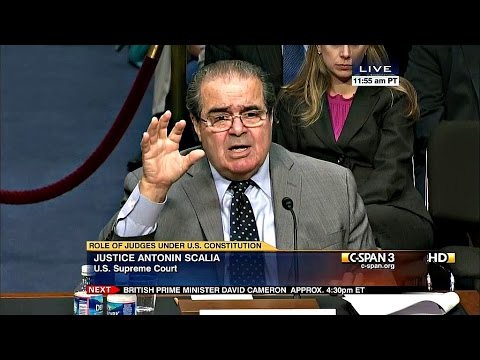
Antonin Scalia - On American Exceptionalism
AmericanRhetoric.com
12 HN recommender · 2019–2025
 10 mo on HN
The Cardboard Box Reform - Nixon's Ghost Bill & A Crucial Flaw in Democracy
CRI
9 HN recommender · 2014–2025
 10 mo on HN
The Coming Collapse of the Middle Class with Elizabeth Warren
University of California Television (UCTV)
10 HN recommender · 2008–2022
 9 mo on HN
We the People, and the Republic we must reclaim | Lawrence Lessig
TED
8 HN recommender · 2013–2026
12 comments from Hacker News
I highly recommend the following CGP Grey video for further detail about the problems of First Past the Post voting ( ▶ this video ). > But instead we have FPTP, and why? Its the simplest and most naive electoral system so Joe Bloggs understands it. Its just "the person who gets the most votes wins". The problems this system causes are ephemeral statistical problems that require more than a 10 second soundbite to explain or even to detect happening. So from Joe Bloggs point of view, you want to change his fundamental right to vote based on the fact that your intellectual busywork has concluded that the wrong person can win the election. That's how the UK failed to get Alternative Vote passed in 2011.
It's because of the First Past The Post voting system that is used in the US, which means winner takes all. If you want to understand why the US seems so uniquely politically divided, then you will understand once you understand how FPTP voting works and how it inevitably leads to binary politics. Most countries have a voting system that leads to broader representation. US politics will always be black and white and divided so long as FPTP voting is used. There's a great video by cpg grey explaining FPTP: ▶ this video
And it will fail due to the current voting system. CPG Grey has a great explainer on why there will only ever be 2 political parties under the current system ▶ this video
Okay, one more from Justin because it is a video: link Of course, everyone already knows CGP Grey's videos, right? .. wait.. nobody's posted it yet? OK, here's his whole video set: ▶ this video
I like CGP Grey on this issue. ▶ this video I completely agree as far as voting methods are concerned and do think it would be a better system, but I still don't like giving a group of people rights to commit acts considered immoral when done by an individual.
Check out this video, it helps explain why diversity of thought has little to do with the number of political parties that form in a system. ▶ this video Dem/Rep are just two big coalitions in the US, and with first past the post voting, it's nearly impossible to have more than two parties in the long term.
At that point you're basically discussion voting systems. Using first-past-the-post with three options, two of them being breixt, would heavily rig the vote towards remain. Improving voting systems would be great (especially looking at the US, if you ever want more than two real parties), but doing it on the back of such an important decision would be problematic at best. Here is a cutesy video for those new to FPTP voting issues: ▶ this video
Also, this CGP Grey video explains how a first-past-the-post voting system all-but-guarantees a two party system to emerge over time: ▶ this video
Ideologically, from a single voter's perspective, you're right. But practically, and looking at the entire population, it's not. The first past the post voting system we use will always result in two prominent parties, and the spoiler effect certainly exists. I've always found this video a good explanation of the problems of our voting system ▶ this video
C.G.P. Grey has an entire series on why our voting system forces a two-party system. The issue isn't getting your neighbour to change their voting habits, the issue is changing the system: ▶ this video
To anyone sad about this: The alternative offered was Kamala Harris. Thanks DNC. First-past-the-post voting practically guarantees a two party system emerges over time: ▶ this video The US gov has been worn way at for decades by unscrupulous people seeking power and made so unpleasant to work in that few young people want to go into political leadership - and those that do don’t get far enough to have impact (eg. Buttigieg).. hence, old ass presidents. Truly impactful movers and shakers have easy access to capital in the US, can keep their companies and lives private, and achieve a very comfortable life. Why would anyone choose politics over that? Finally, the US gov system of checks and balances was designed assuming it could be perfected incrementally, but long-lived systems also need cycles of renewal - think of a forest. That design flaw is showing up now as key systems are getting cracked open by opportunists.
I'll start off with my prototype: link Anyone into electoral methods or game theory? If you've ever watched CGP Grey's videos on electoral methods or seen Nicky Case's *To Build a Better Ballot*,[1] it's very much in the spirit of that. It's mostly a toy that will run a single election in a large number of different electoral methods. Currently I've implemented ~26 different electoral methods which is pretty neat. However, I've shied away from the methods that voting theory nerds love the most: Condorcet methods. I've implemented Copeland (although there's a mistake I haven't fixed yet) as well as Kemeny Young. However, Kemeny Young is implemented in the most brute force way possible and is O(n!) right now. Mostly I think I'm just looking for people with a math/game-theory background that would be interested in helping out, but I'm open to anyone interested. I know there's a lot of optimizations I could make to the Kemeny Young algorithm, but I've been hesitant to do so because I can't find the right theorems to make sure certain assumptions are true. For example, I'm quite sure that a subset of weak Condorcet winners would be at the front of the winning path, but I haven't found a textbook that's stated this explicitly and it's been a long time since college so I'm kinda iffy on proving it to myself. I also don't think having to learn the proof everytime just to make sure my assumptions are mathematically sound is the best way to develop such a tool. Thanks It's all open-s