RSA ANIMATE: Crises of Capitalism
Royal Society of Arts4 HN recommenders · recommended in 4 months, 2011–2016
explainer · intro · evergreen · 2011–2016 on HN
An RSA Animate video that illustrates a talk by geographer David Harvey on the crises of capitalism. It covers creative destruction, wage stagnation masked by credit, and the search for a more just economic order.
HN commenters recommend it as a quick animated introduction to Harvey's and Marx's critique of capitalism.
Up next
 4 mo on HN
World's Roundest Object!
Veritasium
6 HN recommender · 2013–2018
 17 mo on HN
How The Economic Machine Works by Ray Dalio
Principles by Ray Dalio
18 HN recommender · 2014–2026
 1 mo on HN
Milton Friedman - Who Benefits From Licensing?
LibertyPen
1 HN recommend · 2015–2019
 4 mo on HN
The A.I. Dilemma - March 9, 2023
Center for Humane Technology
11 HN recommender · 2023–2024
 3 mo on HN
Sinclair's Soldiers in Trump's War on Media
Deadspin
3 HN recommender · 2020–2025
 1 mo on HN
Richard Feynman: Can Machines Think?
Lex Clips
1 HN recommend · 2022–2025
 3 mo on HN
Who Killed Captain Alex: Uganda's First Action Movie (English Subtitles & Video Joker) - Wakaliwood
Official Wakaliwood
2 HN recommender · 2018–2023
 12 mo on HN
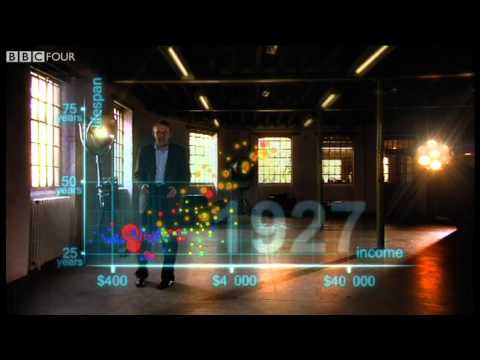
Hans Rosling's 200 Countries, 200 Years, 4 Minutes - The Joy of Stats - BBC
BBC
10 HN recommender · 2010–2023
 11 mo on HN
Principles for Dealing with the Changing World Order by Ray Dalio
Principles by Ray Dalio
10 HN recommender · 2022–2025
 10 mo on HN
Fear the Boom and Bust: Keynes vs. Hayek - The Original Economics Rap Battle!
Radical Discourse
10 HN recommender · 2010–2024
 10 mo on HN
Why American Cities Are Broke - The Growth Ponzi Scheme [ST03]
Not Just Bikes
14 HN recommender · 2021–2024
 8 mo on HN
The Spider's Web: Britain's Second Empire | The Secret World of Finance
Independent POV
6 HN recommender · 2019–2024
8 comments from Hacker News
Disasters like this are, in theory, actually beneficial to economies--especially stagnant ones like Japan's. The capacity for immediate bonafide economic growth has been diminished but that doesn't mean that economic production will decline. There is now ample room to deploy all that surplus capital (humans, machinery, money) that was previously unproductive. The upper echelones of the financial sector will make a killing shorting and re-buying. Advanced reading on a parallel concept: link The quoted and cited David Harvey piece (2007, albeit the condensed article veresion and not the full-length book) would have been a better reference however is apparently no longer online. This, though, is amazing: ▶ this video I believe Naomi Klein made a good buck on dumbing down and re-orienting the above hypothesis.
The main explanation is not considered here: Automation and Outsourcing. Both reduce the demand for local human labor, and thus depress wages. They cause wealth redistribution upwards by providing a power imbalance between the capitalist and the worker. David Harvey did a nice talk about this: ▶ this video
In this particular case it may also have something to do with the LTOV's association with Marxist economics. The only thing Americans are expected to know about anything even vaguely associated with Marxism is that it's bad (mmmkay?), so U.S. educational institutions tend to avoid teaching things in that category to students who aren't specializing in economics. Which leads to Americans coming up with their own labels and descriptions for things that Marx observed and labeled long ago. All of which is too bad, because Marx had a lot of interesting and valuable things to say about the problems of industrial economies (see ▶ this video for a good introduction), even if the solutions that were tried in his name didn't work out. It just wastes people's time and energy having them spin their wheels re-discovering things he discovered 150 years ago.
Oh Graeber's book is out! Lovely! I have been passing around his essay by the same name for some time now. Should be a good intro to the book link I would also recommend anything by David Harvey. Start out with this animated version of one of his talks: ▶ this video Then move on to his Capital vol. 1 lecture series. link There is also a book format of his reading guide
Reminds me of this: ▶ this video I personally believe it is all the automation and outsourcing that is changing the fundamentals and causing a drop in the demand for human labor - thus undermining our trusty wage-based mechanisms to get money to the masses, who then spend it back on necessities. The drop in demand means less investment and lending. So the money supply shrinks. The "Great Depression" was coined as a term by Hoover because it sounded calmer than the term commonly used at the time: FINANCIAL PANIC. A lot of it was caused by automation leading to overproduction by farmers while simultaneously laying off their workers. It took years to build up a manufacturing economy, and it helped that after WW2 the USA had no competitors. So we became #1.
Okay here is some background: ▶ this video Show me the data you've seen. The 1970s were the height of wages and unionization, and then globalization (thanks to technology) led to outsourcing. Early physical automation was ok because people all started to sit in front of computers. But now, the mental tasks are being automated away, and that leads to jobs coming back... to robots. Also read this: link Automation is also what led to the Great Depression as we lost primary sector jobs and it took a decade to migrate to the cities and build up the secondary sector, factories, workforce.
Love it! This article is the best I've seen so far on a topic I've been writing about for years, ever since Obama said this: link All those politicians promising the middle class jobs to come back ... they are selling you a bill of goods. Automation and outsourcing has caused wages to fall. David Harvey argues this started in the 70s but was masked by the consumer credit boom and the internet boom: ▶ this video WE WILL NEED expanded safety nets, preferably in the form of a universal basic income, so laid off people can re educate themselves. This money can come from taxing the gains that corporations make from automation, not enougu to disincentivize R&D but enough to redistribute some of that value to offset the DEMAND SHOCKS to local human labor. Without this we are heading for trouble. We do not have an elastic system right now that responds to increasing automation! "He who does not work does not eat" - we need to decouple these in our economic system. And contrary to what anarcho capitalists believe, it will enable more efficient allocation of resources: link
On Mayday of all days such a characterization of Marxism as the extreme on a 1D number line of political responses to urbanization feels simplistic. Of the infinitude of academic distinctions of Marx's writing to be raised here, the distinction between "political Marxism" and "analytical Marxism" seems fruitful. For the purposes of this distinction, political Marxism would be the set of writings embedded in the political climate of Marx's age, The Manifesto, etc. The politics that resulted from these writings bloomed initially, but as the mantle was passed through Stalin, Lenin, Trotsky the politics became increasingly fraught with problems (being gentle here.) Analytical Marxism for me is limited to _Capital_. Marx proceeds analytically, taking the rich tradition of political economy to heart. Ricardo and Adam Smith are addressed directly. Marx attempts no emotional arguments here, no appeals for solidarity or revolution. Instead, the ideals of capitalism (e.g. exchanges between individuals are mutually beneficial) are taken as true, and Marx attempts to create a framework for analyzing the structural forces that result from this economic mode. _Capital_ provides a set of analytical tools that are timeless and non-dogmatic. A great example is the exploration of how the relative prices of various commodities are set (Marx suggests it is emergent behavior). _Capital_ also takes on such problems such as the contradiction between exchange value and use value, and how the investo